- Search Cartoons
- Comic Archive
-
Payne
Store



 Henry Payne RSS

Articles Blog
Payne: Honda Type R, Focus RS, Subie STI head-to-head
Posted by hpayne on July 28, 2017


In 2014 I terrorized California’s Monterey Peninsula in a new Subaru WRX STI, the baddest kid on the block for under $40,000.
With muscular fenders, hood scoop and an outrageous rear wing so big you could do chin-ups on it, Subaru’s wild child had the specs to back up its pecs: 305 turbocharged ponies, all-wheel drive and enough cornering grip to pull the lips off your teeth.
Only Volkswagen’s Golf R could hold a candle to its performance, but the German’s conservative wardrobe was for a different customer. The rowdy ’Ru was Dennis Rodman coming at you with a taunt and pierced lip.
That was then, this is now. Subaru got wannabes.
Like Tom Brady followed Joe Montana. Like Justin Verlander after Nolan Ryan. Like LeBron in Michael’s footsteps. Every athlete inspires a new generation. So, too, the STI. In the last two years the 2016 Ford Focus RS and 2018 Honda Civic Type R have traced Subaru’s trail as nice compacts turned into in-your-face, tire-smoking, 300-plus horsepower wild things.
How do they compare to the King of Wing Bling? All three are terrific — the margins small between them. I saddled them up on track, city and rural roads to suss out the differences.
For 2018 my $39,455 Subaru tester has updated its fierce face with a thinner grille, meaner headlights and bigger chin openings to feed more air to the hungry turbo-4 within. If you ogled the blood red, tire-smoking 2007 STI “Baby Driver” co-star, then the more-refined ’18 model will make your heart race.
But Subie looks modest compared to the punked-out, $34,775 2018 Type R. With a rear wing stolen off an F1 racer, more mascara than Gene Simmons of Kiss, and more body vents than a pair of distressed jeans, Type R is a paparazzi magnet. It’s all show and even more go.
In Montreal, Honda took us to the track to test the Type R (in showrooms now) before we ever set tire on road. The R is the offspring of two parents, Honda’s 10th-gen Civic and Formula 1 race program. Take 2016 North America Car of the Year Civic’s wider, lower chassis and inject it with F1 DNA: front spoiler, front-wheel air curtains, stiffer shocks, beefier anti-roll bars … and that outrageous rear aerofoil. It looks like the Civic was rear-ended by the Red Baron.

The Type R is then stuffed with the heart of a lion. Coaxing 306-horsepower and 295 pound-feet of torque out of a mere 2.0-liter turbo, the four-pot is the production manifestation of everything Honda has learned in 60 years of motorsport.
Around Montreal’s iCAR race track, the R immediately recalled the Si sibling I tested in Mojave earlier this year — intuitive, planted, balanced. But with 50 percent more power. The Si made headlines last decade with a 2.0-liter, normally-aspirated engine that put out 100 horsepower per liter — a feat only Ferrari and BMW engines could match. In the turbo era, the Type R’s 150-ponies-per-liter eclipses even the mighty Porsche Turbo (143 per liter).
At the legendary Nurburgring, the Type R threw down the gauntlet with a front-wheel-drive car record 7.43-minute lap. Nail the turbo to 7,000 rpms and somehow the front Pirelli Sports stay on despite 295 torques coursing through them.
This muscle-bound physique is only an issue in low speed second-gear corners as torque overwhelms the steering, and the tires fling asphalt like a mutt digging for a bone. Throttle management is required. I pine for the STI’s all-wheel traction.
Next to these two wing nuts, the squat $39,560 Focus RS looks positively working-class. No exotic triple or quad pipes here — just twins. No wing, just a big, hatch-hitched spoiler. The face is inelegant — its bumper stuffed into its enlarged grille like Rocky Balboa’s mouthpiece. But like Rocky, this thing is a champ.

Underneath its hood are 350 horses and the most sophisticated powertrain of the lot: a torque-vectoring all-wheel drive system with twin rear clutch packs that speed up the outside rear wheels for better rotation (the STI’s AWD system uses inside-wheel braking). Fifty horses shy of the Focus RS, the Subaru STI still matches the Focus on zero-60 and quarter-mile times. But despite its cosmetic upgrades, the STI did not get sister Impreza’s all-new architecture — an oversight that also puts it a generation behind the Honda. The old bones of the Focus are no match for Honda, either — but its powertrain compensates.
On track at Waterford Raceway, the Ford rotated nimbly through the long, challenging Carousel — then put down the AWD power on exit.
The hard-backed seats and stiff suspension of the RS will beat you up around town, though, the nose porpoise-ing along Detroit’s choppy roads. Type R’s comfortable thrones are better daily wear. The Subaru’s Recaros? Somewhere between the two.
On the road, the Type R may be a Rottweiler off its chain — bounding around country roads looking for something to chew on — but its Comfort setting is the most livable, dialing back the ride from rock hard to merely stiff.
The four-banger of the RS brings welcome character. It roars furiously with the pedal down, then farts and pops when you let off. It’s wonderfully obnoxious compared to the STI’s flat-4 VW Beetle-like putter, and the Type R’s generic bark.
If you don’t know how to drive a stick, you’re in the wrong aisle. These bad boys come manual only.
The Honda’s silver ball-topped shifter is the standout here, its short throws making for easy box navigation. It’s an entree to the car’s well-thought out ergonomics from seats to center console to easy-pull rear shade. Even with the third pipe exhaust resonator the car is quiet inside.
Infotainment systems? Huh? Are the cars not entertainment enough? Suffice to say all offer Apple CarPlay/Android Auto apps to get you to the local track.
I am also biased to the hot hatches — the RS and Type R’s five-door utility matching their performance. Load ’em with luggage for South Haven, blitz Gingerman Raceway for track day, then hang at the beach afterward. The STI sedan is less space efficient — but at least you can dry your wet towel over the rear wing.
The verdict? Focus RS is the performance champ, but the content-rich Type R lays down a new marker of wing-bling affordability for a cool $5K less than its rivals. The STI, meanwhile, plots in the shadows. When it gets the Impreza’s new chassis, watch out.
Henry Payne is auto critic for The Detroit News. Find him at hpayne@detroitnews.com or Twitter @HenryEPayne.
2018 Honda Civic Type R
|
VEHICLE TYPE |
FRONT-ENGINE, FRONT-WHEEL DRIVE, FIVE-PASSENGER HATCHBACK |
|
Powerplant |
2.0-liter, turbocharged inline 4-cylinder |
|
Transmission |
6-speed manual |
|
Weight |
3,117 pounds |
|
Price |
$34,775 |
|
Power |
306 horsepower, 295 pound-feet torque |
|
Performance |
0-60 mph, 5.0 seconds (Car and Driver); 170 mph |
|
Fuel economy |
EPA est. mpg: 22 city/28 highway/25 combined |
Report card
|
HIGHS |
NEW WING-BLING CHAMP; THE BUDGET CHOICE |
|
Lows |
Wing-bling may not be your thing; tough putting power down with FWD |
Overall:★★★★
2017 Ford Focus RS
|
VEHICLE TYPE |
FRONT-ENGINE, ALL-WHEEL DRIVE, FIVE-PASSENGER HATCHBACK |
|
Powerplant |
2.3-liter, turbocharged, inline 4-cylinder |
|
Transmission |
6-speed manual |
|
Weight |
3,459 lbs. |
|
Price |
$36,995 base ($39,560 as tested) |
|
Power |
350 horsepower, 350 pound-feet torque |
|
Performance |
0-60 mph, 4.7 seconds (manufacturer); top speed: 165 mph |
|
Fuel economy |
EPA 19 mpg city/29 mpg highway/25 mpg combined |
Report card
|
HIGHS |
TRACK CHAMP; AWD OMG |
|
Lows |
Stiff seats; stiff daily driver |
Overall:★★★★
2018 Subaru WRX STI
|
VEHICLE TYPE |
FRONT-ENGINE, ALL-WHEEL DRIVE, FIVE-PASSENGER SEDAN |
|
Powerplant |
2.5-liter, turbocharged, boxer 4-cylinder |
|
Transmission |
6-speed manual |
|
Weight |
3,463 pounds |
|
Price |
$36,995 base ($39,455 as tested) |
|
Power |
305 horsepower, 290 pound-feet torque |
|
Performance |
0-60 mph, 4.7 seconds (Car and Driver); top speed: 159 mph |
|
Fuel economy |
EPA est. mpg: 17 city/23 highway/19 combined |
Report card
|
HIGHS |
POWERFUL FLAT-4; TRACTION READY FOR ACTION |
|
Lows |
Aging chassis; hatchback, please? |
Overall:★★★
The mighty Dodge Demon by the numbers
Posted by hpayne on July 28, 2017

We came. We saw. It conquered.
For 12 tantalizing weeks before the New York Auto Show last April, Dodge teased its Challenger SRT Demon. On the show’s opening night, the 840-horsepower brute was unveiled as the fastest production car ever produced, claiming an unheard of 9.65-second quarter-mile time at 140 mph.
This week the wraps came off media first-drive impressions of the Demon at Indianapolis’s Lucas Oil Raceway, where it proved as breathtaking behind the wheel as its gaudy stats had suggested. Face-flattening, 1.8-G launch forces. Demonic shrieking from inner headlight air intakes. Three-foot-long wheelies.
And still we want more. The Demon lives large and has the numbers to prove it.
To help us wrap our heads around the Demon’s world, Dodge’s mad genius engineer Chris Cowland and his merry crew shared a few more numbers.
■Demon has a 200 mph speedometer, but is governed at a top speed of 168-mph lest the street-legal, radial racing tires explode from the heat generated by sub-10-second quarter-mile times.
■Just 800 feet off the line (7.35 seconds down the drag strip), the hungry, supercharged, 6.2-liter V-8 will have sucked the equivalent of all of the air out of the Demon’s cabin. That’s 2,973 liters of air (at a record rate of 32,564 liters per minute). When Dodge’s unholy warrior crosses the quarter-mile it will have consumer 4,900 liters.
■To up the ante over the insane, 707-horse Dodge Challenger SRT Hellcat, the bonkers Demon underwent 25 major component upgrades including a larger supercharger (2.7 liters vs. 2.4 liters) and a higher redline (6,500 rpm vs. 6,200 rpm).
■In order to produce 840 horsepower, Demon was outfitted with high-flow fuel injectors (that’s 101 pounds per square-inch — or 27 percent more than the 707-horse Hellcat’s 80 PSI). At full power, Demon is drinking 1.36 gallons-per-minute of high-octane unleaded gasoline — or nearly the same amount of liquid (two gallons per minute) that comes out of your shower head.
■ So powerful was the Demon’s supercharged V-8 that only a NASCAR-rated dynamometer could hold it for testing.
■Each piston downstroke — which occurs 50 times a second — is delivered with the compressive force of 11.1 tons from the cylinder chamber.
■How do you get 11.1 tons of compressive force? Ram supercharged air and fuel into a combustion chamber and detonate it with a spark plug, of course – an explosion that creates a peak combustion temperature of 4,500 degrees. That’s almost half the temperature of the sun’s surface.
■Isn’t that enough heat to melt the aluminum cylinder head? In theory, yes, since aluminum (depending on alloy) melts at 1,200-1,300 degrees. Fortunately, that heat is quickly dissipated — to crankshaft power, the exhaust, engine structure and heat transfer into surrounding coolant. As a result, the head stays at around 480 degrees.
■Naturally, Cowland’s team painted the V-8 cylinder block “Demon Red.”

■Demon is the first-ever production car to lift its front wheels — the result of a 2,576-pound weight transfer at launch to the rear which carries the fronts for a Guinness World Record wheelie of 35 inches long.
■On 91-octane pump gas, the Demon produces 808 horsepower and 717 pound-feet of torque. Add the available engine controller (found in the $1 Demon crate full of drag goodies) — calibrated for 100-plus, unleaded, high-octane fuel — and you get the full 840 horse/770 torque numbers.
■The Demon wears 12.6-inch-wide Nitto drag racing tires on all four corners (for optimum quarter-mile performance, Dodge recommends replacing the fronts with skinny “rollers” — also in the crate — for lower roll-resistance). An IndyCar’s race tires measure 10 inches wide in front and 14 inches in the rear.
■Atop the Demon’s hood is the largest functional hood scoop — with an opening 45.2 square inches — in production today.
■To save 113 pounds of weight, the front and rear passenger seats were removed (they can be optioned back for $1 each).
■To save 4 pounds, Demon uses a manual tilt/telescope steering column.
■For all its steroid-pumped power, the $86,090 Demon still comes with Fiat-Chrysler’s standard five-year/60,000-mile limited powertrain coverage.
■Dodge will make 3,000 Demons for the U.S. and 300 for Canada. Deliveries begin around Halloween.
Payne: The epic Dodge Demon
Posted by hpayne on July 20, 2017

Imagine it’s dawn on Dream Cruise Saturday. We are sitting in lawn chairs at 16 Mile. A Dodge Demon, Tesla Model S P100D and McLaren 570GT roll up to the stoplight with nothing but clear pavement ahead of them. The light turns green and they explode down the quarter-mile.
The curvaceous, $198,950 McLaren screams past in 10.7 seconds like something out of video game, its 7-speed, dual-clutch transmission clicking off instant shifts. The electric $140,000 Tesla sails by at the same time but without a sound, initially surging ahead of its gas rivals with instant torque, its launch so concussive the driver experiences momentary, inner-ear dizziness.
But at a fraction of the cost of its competitors, the $86,090 Demon puts on the best show.
Its 4,280-pound body recoils off its rear haunches as the pilot releases the launch control, briefly chucking the front wheels into the air. A wheelie! It surges past the quarter over a second ahead of the others, its supercharger sucking in air through small, inner headlight holes that make the most unholy shriek this side of the River Styx.
You’ll have goosebumps the size of cantaloupes. Just as I did the first time I launched the Demon down Lucas Oil Raceway in Indianapolis.
The Demon’s full name, of course, is Dodge Challenger SRT Demon — the latest monster from Dr. Tim Kuniskis Frankenstein’s SRT lab. The Demon emerged from Manhattan’s Pier 94 in April like some sort of sci-fi monster left over from Stephen Spielberg’s “War of the Worlds.” The deafening beast obliterated every other entry at the New York Auto Show with its alien capabilities: An unheard of zero-60 time of 2.3 seconds and a production car record 9.65-second quarter-mile time.
The quarter was so stunning that the National Hot Rod Association banned the Demon from racing because it’s illegal to drag-race without a roll cage if you break the 10-second barrier.
On paper, the Demon is a member of Dodge’s swaggering Challenger gang that includes the R/T and wicked-looking, 485-horse Scat Pack that I have reviewed on these pages. It’s tempting to say that the Demon is the 707-horsepower Hellcat’s big brother, but it’s much, much more.
With Dodge putting the Viper sports car out to pasture this year, the Demon takes over its mantle as family scion. The Dodge halo car comes with a sticker about $10,000 north of a Hellcat — and $30,000 south of the Viper. It’s the most powerful muscle car ever made.
“We wanted to design a big middle finger to our competition,” says Demon designer Mark Trostle. But the defiant digit is also a message to pointy-headed pundits who predict a dystopian future of homogenous, self-driving pods governed by interstates bristling with sensors to monitor speeds and keep vehicles in line.
The Demon is a challenge to the system. A big honking hunk of individuality.
Rampaging through suburban Indianapolis, my Demon turned heads at every corner. With its huuuuge, 12.4-inch, grooved-slick race tires, the Demon is an inch wider than the Hellcat on paper but feels six feet wider on road. Its bigger shoes turn into corners more sharply, inducing more confidence that the Demon’s outrageous 840 ponies can be unleashed on public roads without taking out every neighborhood mailbox.
Since the 1960s, the Mustang and Camaro have defined themselves on road-racing courses. So it is today with the Mustang GT350 and Camaro ZL1, which are the most capable track pony-cars I have ever driven. The Demon’s territory is on a different track — the drag strip. Woodward with staging lights.
With its muscle-bound physique and sense of humor — Dodge will sell you a front seat, rear seat, and a crate of drag racer trick parts for $1 each — it has the personality of a celebrity wrestler. If it were a movie character it would be played by Dwayne Johnson. But look more closely and Demon is an engineering marvel underneath. “We’ve created a machine that can perform with the world’s most exotic cars out of the Challenger toolkit,” says Demon engineer Erich Heuschele.
This is refined dragster that brings all the tricks of the quarter-mile trade to a production, street-legal package.
Let me take you inside that launch down the quarter-mile.
Easing into the “water box” at Lucas Oil Raceway for a pre-stage burnout warming up the tires, I set “Line Lock” in the console. This electronic feature — controlled by my left thumb on the steering wheel — locks the front brakes while I spin the rear tires. I lift by thumb and the beast eases forward into the staging area.
For decades, drag racers have constructed trans-brakes in order to keep their earth-pawing creations poised before explosive launches down the strip. My comfortable, leather-stitched Demon pairs this tricky concept with Dodge’s excellent, eight-speed production transmission and double, electronically adaptive shocks at every corner.
I bury the brake with my left foot.
Pull back on twin paddles behind the steering wheel, arming the launch procedure.
With my right foot, I modulate throttle at 1,700 rpms.
Remove (really) my left foot from the brake.
The engine continues to gurgle ominously at 1,700 rpms under my right.
Release the left paddle, leaving only the right paddle transbrake holding this land missile stationary.
I let go the right paddle and unleash the hounds of hell.
The Demon erupts off the line like mighty St. Helens herself. In an instant my right foot goes from feathering 1,700 rpms to full WOT (wide-open throttle in drag parlance), creating a neck-snapping, 1.8 g-loads of acceleration. The red-hot combustion chamber loads the piston and connecting rod with 11 tons of force, 50 times a second. As if on rails, Demon surges down the strip with so much velocity that I don’t even register the 140-millisecond, automatic gear shifts. I cross the quarter-mile at 138 miles per hour, big Brembo brakes putting an end to the violent speed spasm.
I exhale. My eyes slowly reform in their sockets. The Demon gurgles happily as if it’s finished a good meal.
And then I do it again. And again. And again …
Henry Payne is auto critic for The Detroit News. Find him at hpayne@detroitnews.com or Twitter @HenryEPayne.
2018 Dodge Challenger SRT Demon
|
VEHICLE TYPE |
FRONT-ENGINE, REAR-WHEEL DRIVE, FOUR-PASSENGER COUPE |
|
Powerplant |
6.2-liter, supercharged, hemi V-8 |
|
Transmission |
8-speed automatic |
|
Weight |
4,280 pounds |
|
Price |
$86,090 base |
|
Power |
840 horsepower, 770 pound-feet torque |
|
Performance |
0-60 mph, 2.3 seconds (manufacturer); top speed: 168 mph |
|
Fuel economy |
NA |
Report card
|
HIGHS |
SUPERCAR ACCELERATION FOR $86,000; I MEAN, JUST LOOK AT IT |
|
Lows |
Nitto slicks not made for rain; every cop can hear you coming 5 miles away |
Overall:★★★★
Jaguar E-PACE leaps into compact SUV fray
Posted by hpayne on July 13, 2017

Another day, another corner-carving SUV.
Jaguar on Thursday took the wraps off its compact E-PACE, the performance brand’s third SUV in two years. The 2018 E-PACE, which will be available next year, joins the hot-selling midsize Jaguar F-PACE and electric I-PACE in Jaguar’s portfolio. Like Porsche, Alfa Romeo and Maserati, Jaguar is a sports-car brand that is finding success translating its performance DNA to a broader luxury demographic hungry for utility vehicles.
The five-door, two-row E-PACE was to be introduced Thursday in spectacular fashion in London, completing a 270-degree corkscrew barrel-roll at the end of a 50-foot jump. The feat was meant to communicate the cat’s agility in the fast-growing compact SUV niche that includes the BMW X1, Audi Q3, Mercedes GLA and Infiniti QX30.
As ute sales have surpassed sedans, SUVs have become critical to luxury automakers’ bottom lines. Jaguar has made enormous strides on SUVs in a short period – its F-PACE is already the brand’s best-seller. It flies off dealer lots in an average of just 19 days, a faster pace than any model in the U.S. F-PACE sales outsold all Jaguars combined in June, dwarfing its traditional F-Type sports car and XF sedan.
The E-PACE will put added pressure on premium Detroit brands like Cadillac that have lagged in the SUV revolution. It is also a shot across the bow of Porsche and Fiat-Chrysler’s luxury division Alfa Romeo – direct Jaguar competitors who do not yet have compact SUVs in their lineup. Alfa’s first SUV, the midsize Stelvio, hit dealer lots this month. Jaguar expects that the E-PACE – which offers standard all-wheel drive and starts at $38,600 – will bring new buyers to Jaguar at an affordable entry-price point.
Jaguar has been transformed since its sale by Ford in 2008. Under the ownership of India’s Tata Motors, its sales have exploded. “We anticipate (the E-PACE) will see its global sales peak at around 61,500 units during 2019, at which point we see Jaguar’s overall volumes standing at 270,800 units,” said IHS auto analyst Ian Fletcher. “This is a far cry from the lows of under 50,000 units that it sold globally in 2011.”
Like other Jaguars, the E-PACE makes extensive use of aluminum for trimming weight. There’s an aluminum hood, roof and tailgate – and the aluminum block of its new family of 4-cylinder Ingenium engines.
But E-PACE is a departure from traditional Jags as well.
It will be the first Jaguar manufactured outside of England – produced alongside its corporate cousin, Range Rover, in China, Austria and a new plant in Slovakia. The Jaguar is expected to share the transverse-engine mounted architecture of the Rover Evoque – a notable change from the longitudinal-engine, rear-drive based platforms of its sports sedans and F-PACE ute.
The move seems to be a nod to making interior room a priority. Interior touches include extensive connectivity featuring 4G Wi-Fi for up to eight devices and four available USB ports.
No Jaguar comes without lots of power for its four paws, and the E-PACE will be no different. It will purr along on two turbocharged, 2-liter engines ranging from 236 horsepower for the base model, to a 296-horse unit. The latter will be available in the car’s sporty, R-Dynamic trim. Both engines will be mated to a 9-speed transmission. R-Dynamic trimmed vehicles will top out at $53,100.
Payne: McLaren 570GT is a carbon-fiber rocket ship
Posted by hpayne on July 13, 2017

There are entry-level cars, and there are entry-level supercars.
The most affordable entry-level car on the market today is the $12,855 Nissan Versa which introduces 16-year-olds to the world of four-wheel mobility. The most accessible supercar, on the other hand, will run you $200,000 and introduce earthlings to cyborgs made from unobtanium that can transport you into hyperspace in 10 seconds.
I’ve been to that future in the 2017 McLaren 570GT. It. Is. Dazzling.
The Versa appetizer is intended to tingle your taste buds for pricier fare like, say, the $32,000 Nissan Maxima sedan or $30,000 Nissan 370Z sports car. So, too, the 570GT. This six-figure supercar, developed by one of Formula One’s premier teams, gives you a taste of what the company’s top-of-the-line $1.5-million P1 hypercar is like.
It also gives you a hint at what it’s like to date a supermodel. On my 500-mile round trip to Mid-Ohio race course (where I would be racing my own Lola sports car), the McLaren was mobbed everywhere I went. On the Ohio Turnpike, other drivers attached themselves like sucker fish to a shark, trailing me for miles. At gas stops, entire service station populations came over to have their picture taken with her — er, it.
No wonder. The mid-engine beauty is a stunner in Pacific Blue — its long curves poured over silver, 20-inch wheels like Alexandra Daddario on a divan. It’s also a dead-ringer for the legendary 903-horsepower, zero-to-60-in-a-blink P1 — of which only 375 have been made. The 570 doesn’t have big brother’s hybrid powertrain, hydraulic suspension and active aerodynamics, but the fundamentals are there. Same Formula One-derived racing tech, carbon-fiber chassis, same twin-turbo, 3.8-liter V-8 engine — same scissor doors and low, velociraptor front end sniffing the ground.
These grand additions made for a thoroughly pleasant driving experience as I trundled along the Ohio Turnpike at 80 mph with paparazzi in tow. But underneath its calm Pacific Blue surface lurks the same weaponized drivetrain as the S: twin turbos revving eight pistons to 9,000 rpms with 443 pound-feet of torque and 570 horsepower (at last a logical alphanumeric badge — 570 means 570 ponies).
Actually, forget 0-60.
Push the Launch button. Floor the brake and accelerator pedals with both feet. Revs modulate at 3,000 rpms. Release brake pedal. The McLaren explodes past 60 mph in about three seconds, the dual-clutch, race-derived, 7-speed tranny (no manual could keep up) flicking off 300-millisecond shifts. Only a Tesla P90D launch compares with its dizzying, 100 percent torque launch off the line. But past 60 mph the Tesla starts to wane, whereas the McLaren is just getting interested.
The 570’s speedo goes by 100 mph without hesitation. Relentlessly, linearly, it continues. Only pilots who launch F-18s off aircraft carriers for a living won’t find this astonishing.
One of my racing pals at Mid-Ohio likened the McLaren’s acceleration to turning on a faucet with more water flooding out with each turn. I blow past 130 mph (on a closed test track) in 10 seconds with no sign of exhaustion. The bloody thing wants to go to the moon. And what is just as remarkable is how tranquil the experience is.
Buffered by a sound-proofed cabin and twin-turbos, the V-8’s muffled wail sounds like an angry vacuum cleaner. The car’s carbon tub is as rock solid as when I left the line, the ECU channeling 500 pound-feet of torque through the rear Pirellis without a slip. I might as well be driving a video game in my home.
It’s breathtaking.
And reassuring. McLaren’s carbon tub is not only stiffer and lighter than the aluminum tubs used by its $200,000 competitive set — Porsche 911 Turbo, Acura NSX, Audi R8 V10 — but safer. Just YouTube one of those horrific F1 crashes in which drivers walk away unscathed.
I applaud Alfa Romeo for bringing carbon tubs to the masses for under $60,000 in its mid-engine 4C in order to demonstrate its extraordinary stable handling ability. McLaren simply takes the next (dollar) step in mating its carbon tub to a V-8 and dual-clutch tranny to bring the whole race-car package to the street.
At M1 Concourse’s test track, the 570’s rear-wheel drive makes it more tossable compared to the all-wheel drive cyborgs in its class — its telepathic chassis following my every steering input. Like the Porsche Turbo I flogged at Thunderhill Raceway last year, the McLaren’s dual-clutch tranny is so smart I don’t even bother with manual mode. Eventually the car’s capabilities overwhelm the mere, street-legal Pirelli P-Zeros (first accessory purchase: four track slicks).
Confident the 570S already had its competitors beat in visual drama — note the “floating tendon” door handles on the scissor doors — McLaren baselined its ergonomics to the Porsche with a very usable “frunk” (my Mid-Ohio luggage fit nicely, thank you) and rear shelf.
Other ergonomics fall short — most notably the car’s handling and powertrain mode buttons which are low on the console, requiring me to divert my eyes from the road. McLaren might dip into its F1 tech bin for steering-wheel mounted controls next time?
And the 570’s electronics and infotainment system proved buggy — the sort of questions you ponder on long drives to Lexington, Ohio (also, how come Detroit doesn’t have a McLaren dealer?). But only momentarily. Then you’re muting the radio, activating Track mode and listening to that V-8 soundtrack rocket you into the future.
Henry Payne is auto critic for The Detroit News. Find him at hpayne@detroitnews.com or Twitter @HenryEPayne.
2017 McLaren 570GT
| VEHICLE TYPE | MID-ENGINE, REAR-WHEEL DRIVE, TWO-PASSENGER SPORTS CAR |
| Powerplant | 3.8-liter, twin-turbocharged V-8 with dry-sump lubrication |
| Transmission | 7-speed, dual-clutch automatic
with paddle shifters |
| Weight | 3,296 pounds |
| Price | $198,950 base ($210,400 as tested) |
| Power | 570 horsepower, 443 pound-feet torque (manual) |
| Performance | 0-60 mph, 3.4 seconds (manufacturer); top speed: 204 mph |
| Fuel economy | EPA est. mpg (manual): 16 city/23 highway/19 combined |
Report card
| HIGHS | RELENTLESS ACCELERATION; TELEPATHIC HANDLING |
| Lows | Light steering;
supercar, super-slow infotainment system |
Overall:★★★★
Love Bug lives! Just don’t call it ‘Herbie’
Posted by hpayne on July 11, 2017

Indianapolis – Blockbuster sequels are in this year: “Spider-Man,” “Guardians of the Galaxy Vol. 2,” “The Fate of the Furious.” And now, coming to a race track near you, the 560-horsepower Love Bug.
But this 2017 Volkswagen is no fictional movie character.
This is a real-life, tire-smoking, all-wheel drive monster designed to win on Sunday and sell on Monday. Andretti Autosport’s VW Beetles dominated last weekend’s Red Bull Global Rallycross at Lucas Oil Raceway, adding to their lead in the U.S. championship. Piloted by American stars Tanner Foust and Scott Speed, and prepared by two-time IndyCar champion Michael Andretti’s race shop, the Bug team is the highest-profile VW competitor since Disney’s Herbie graced the silver screen in six films from 1968 to 2005.
“To take our most iconic car and modernize it has been fantastic,” VW marketing specialist Sean Maynard said at Team Andretti’s Indy headquarters. “Our core millennial audience is transitioning from traditional media to crowd contenting. We get comments on Facebook from fans who would never have considered a Beetle but now say — hey, that’s a bad-ass looking thing.”
In the 21st century, racing is a critical marketing tool for auto brands from Cadillac IMSA prototypes to LeMans-wining Ford GTs to Mazda Miata Cup cars. Add Global Rallycross, which demands more of a car than perhaps any other series.
Based on a production platform, a Global Rallycross chariot must conquer dirt, asphalt and a suspension-crushing jump over the course of a lap — while pushing a four-cylinder engine to unheard-of limits. The Bug’s success couldn’t come at a better time for VW, which has been struggling under a cloud of Dieselgate and disappointing U.S. sales. The Global Rallycross program is not only successful, but helps the brand build relationships with first-time buyers — a relationship it hopes will progress to volume, family Tiguan and Atlas SUV sales.
“We brought Scott and Tanner into the (new) dealership here and over 100 people came out to interact with them,” said Maynard. “Word-of-mouth is the number-one generator of sales. Fans see this amazing Beetle going around the track, then they go to the dealer … and see an Atlas someone in the family might need.”
When Volkswagen decided to enter a car in Global Rallycross in 2014, the Beetle got the nod.
The Bug’s legacy is heavily rooted in ’60s nostalgia. When Disney’s quirky Herbie took down-on-his-luck-racing driver Jim Douglas (played by Jones) to victory over villain Peter Thorndyke and his stable of race cars (including a Ferrari), it made for a feel-good underdog hit. Herbie grossed $51 million as the third-most popular movie of 1968 (that’s $352 million in today’s dollars, or what “Wonder Woman” has earned).
But this is no underdog effort. Winner of five Indy 500s and four IndyCar championships, the Andretti Autosport helped take Global Rallycross to another level when they partnered with VW four years ago. Competing alongside factory-supported teams from Ford, Subaru, and Honda, Andretti’s Bug has won the last two championships and is on course for three in a row with three races remaining.
“This is the gnarliest beast I’ve ever driven,” says Foust, who is leading this year’s driver’s points race. “Since I got into Rallycross in 2009, the cars have gone from a backyard mechanic status to full-manufacture, wind-tunnel-tested, ultra-professional grade.”
The Grand Rallycross Beetle has come a long way from Herbie. Built in Mexico on the same, front-engine platform as the Golf, the Bugs were shipped to Germany where they underwent surgery that would make Dr. Frankenstein proud. The race car must share the same turbo-4 cylinder technology, chassis, doors and roof as the production Bug. And little else.
The winged rear deck and front fenders are made of carbon fiber with NASCAR-like stickers for headlights. The 8,000-rpm engine is blown out of its mind, and a six-speed sequential gearbox is mated to an all-wheel drive powertrain. The 3,000-pound varmint is then shipped to Andretti’s shop where it’s fortified with race suspension, roll cage and wrapped in sponsor livery.
Off the starting line, the V-dub hits 60 mph in two seconds flat.
In this guise the Bug is probably better described as a red fire ant or African killer bee. Just don’t call it Herbie.
“We can’t talk about Herbie,” says VW’s Maynard. “Disney owns the rights to the name. So if we did that, we’d have to pay them a significant amount of (licensing) money.”
Foust says the team is determined to build its own legend beyond Herbie. “We took the first GRC race car and did a video (making) skid marks that spelled out: ‘Don’t call me Herbie,’ ” he says and laughs.
At Lucas Oil Raceway, Scott Speed’s red, Circle K-sponsored V-dub and Foust’s black, Rockstar Energy Drink-sponsored twin flew away from the Ford Focus RS, Subaru WRX STI, and Honda Civic Si competition. Between race heats, fans climbed into a production Golf, Beetle and Atlas on display outside the stands.
In a champagne-drenched victory circle afterward, the winning duo accepted trophies while a sea of young race fans waved “Volkswagen” signs in the crowd. “It’s unbelievable how many kids are there,” says Foust. “We are raising a new generation of car fans.”
France, Volvo, and Trump’s timely withdrawal from the Paris Climate Accords Read more at: http://www.nationalreview.com/article/449322/france-volvo-paris-climate-accords-electric-vehicles-hurt-automakers-bottom-lines
Posted by hpayne on July 8, 2017
One of the Trump Administration’s most crucial economic decisions was its withdrawal in June from the Paris Climate Accords. Politically, the decision upheld a campaign promise. Practically, it avoided saddling the country with the deal’s arbitrary, restrictive CO2-emissions caps.
Just how suffocating those strictures could have been was illustrated this week when the French government upended its automotive sector by mandating the elimination of gas and diesel engines by 2040 in order to meet the climate accord’s targets. The decision will give French consumers — and manufacturers — no choice but to transition to expensive, unproven battery-powered vehicles. It comes on the 25th anniversary of the publication of Al Gore’s Earth in the Balance, in which the then-senator called for eliminating the internal combustion engine by 2017. Needless to say, none of the environmental calamities Gore predicted a quarter century ago have come to pass.
But that hasn’t slowed the march of wrongheaded policies meant to combat climate change. Just 24 hours before the French government’s decision, Volvo announced that it would electrify every vehicle in its lineup beginning in 2019. The move may be intended to place Volvo at the forefront of the electric-vehicle revolution — but in fact it shows how deeply government global-warming diktats threaten the future of global automakers.
Volvo’s announcement was met with universal praise from left-wing U.S. media; it was also universally mis-reported. “Volvo Vaults to Volts, Planning to Pull Plug on Gasoline Engines” Bloomberg’s headline blared. “Volvo going electric, phasing out gas and diesel engines,” read the Seattle Times’. “Volvo Moves to Phase Out Conventional Engines,” declared the New York Times.
Not quite. In truth Volvo’s decision will help perpetuate the internal combustion engine, which still makes up the overwhelming majority of vehicle sales. While the automaker will add a plugin-hybrid option to every model line and build five all-electric cars beginning in 2019, its core, best-selling gas- and diesel-engine variants will simply add a small, 48-volt battery to compliment existing twelve-volt batteries.
Where traditional twelve-volt batteries turn on a car’s lights and infotainment systems, the 48-volt unit will help power the influx of electric features — steering racks, brake pumps, etc. — into modern cars, while increasing fuel economy by 10–20 percent in order to satisfy looming Chinese and European CO2 mandates. (Europe will force automakers to reduce the CO2 emissions of their vehicles to 95 grams per kilometer by 2021.) In short, contrary to news reports that Volvo is ending gas engines, the company is merely making such engines compliant with the coming rules.
“Sensationalist headlines today suggest Volvo is going 100 percent electric and ending gasoline and diesel engines,” wrote auto-industry analyst Anton Wahlman. “The Volvo announcement was not (about) going to 100 percent EVs. It wasn’t even about setting an end-date for gasoline or diesel cars. It was about making 48 volt systems standard in all cars.”
If more countries follow France’s lead in banning the gasoline engine, other automakers will similarly struggle to turn a profit. Volvo’s compliance strategy is understandable, because few customers are buying electrified vehicles. In France, just 1.1 percent of new cars sold are fully electric. In the U.S., despite over 50 new battery-powered vehicles introduced since 2009, fully electric models have just a 2.4 percent share of the automotive market.
Volvo itself currently sells only one battery-powered vehicle, a plugin version of its best-selling Volvo XC90 SUV that costs $18,000 more than its $50,000 gasoline model. This year, Volvo has sold just 807 XC90 plugins, accounting for a mere 7 percent of the XC90’s overall sales. Yet, in adding more electric and plugin hybrids to its lineup this week, Volvo CEO Håkan Samuelsson claimed that “people are increasingly asking for electrified cars and we want to meet our customers’ current and future needs.”
To be sure, many auto executives count themselves members of the global elite that shares Gore’s belief in the “mortal threat” posed to society by the gasoline engine. The green religion is strongest among upper-middle-class buyers who purchase premium cars from the likes of BMW and Audi, which are also pursuing 48-volt strategies. But despite $7,500 tax breaks offered to American consumers who purchase fully electric models, even the wealthy have been shy to take the plunge. Tesla’s miniscule pool of customers is the exception, but Elon Musk’s company has yet to turn a profit, despite average prices in excess of $100,000 for its Model S and Model X vehicles.
If more countries follow France’s lead in banning the gasoline engine, other automakers will similarly struggle to turn a profit. In condemning the Trump Administration’s withdrawal from the Paris Accords, media darling and former Obama EPA official Marge Oge told the New York Times that “the rest of the world is moving forward with electric cars. If the Trump administration goes backward, the U.S. won’t be able to compete globally.”
In reality, the opposite is true. Thanks to less-stringent emissions rules and low gas prices, the U.S. is essential to most automakers’ profits, driving as it does the high-margin sales of popular pickup trucks and SUVs that can’t be sold elsewhere in the world. GM, for example, withdrew from the European market this year because its small cars are unprofitable there.
Ford joined the corporate chorus in condemning Trump’s Paris withdrawal saying that “we believe climate change is real, and remain deeply committed to reducing greenhouse gas emissions in our vehicles and our facilities.” Yet the politically correct statement would seem a financial death wish. Some 80 percent of Ford’s profit reportedly comes from U.S. pickup sales. A France-like gas-engine ban to satisfy CO2 targets would destroy the company’s bottom line.
Chinese-owned Volvo’s 48-volt strategy will, say experts, increase its cars’ prices by $1,000-$1,500. Though that’s not insignificant, it likely won’t prove prohibitive for those who would otherwise purchase the premium XC90. But mainstream automakers such as Ford and Chevrolet have not committed to installing 48-volt systems as a baseline in their cars, precisely because their profit margins are slimmer than Volvo’s already.
“A 48-volt system is an expensive add-on for a $16,000 basic car,” Wahlman writes. “For a $38,000 Volvo, not as much.”
Force compact cars — currently popular in France — to go all-electric at an additional cost of $5,000–$10,000 each and they will simply become unaffordable.
Payne: Toyota C-HR a stormtrooper helmet on wheels
Posted by hpayne on July 7, 2017

Concerned that everything is starting to look the same? Same suburban tract housing? Same workplace cubicles? Same ol’ five-door SUVs?
Good news, friends. The Toyota C-HR offers a little escapism.
It would appear that Toyota has moved its design studio to Hollywood, because this once-dowdy appliance-maker is turning out vehicles that belong in science-fiction films. First came Lexus with a spindle grille so fearsome it might have have been approved by Lord Darth Vader himself. Then Toyota stunned last fall’s LA Auto Show with its new C-HR compact crossover which appeared to have been shipped over from a Lucasfilm stage.
A white and black C-HR arrived in my driveway this summer looking like someone had grafted a “Star Wars” stormtrooper helmet on a “Tron” Light Cycle.
With its slit front headlights, huge wheels and “distinctive diamond” design philosophy, it shames big brother RAV-4’s conservative wardrobe. It deserves a place alongside the BMW i3 and Kia Soul for most funk-a-riffic vehicle. As the auto world splits between SUVs and sedans, these hatchbacks seek a third way: segment busters with a bold mix of ingredients. The i3 breaks out as an electric hatch. The Kia Soul is a peppy toaster. And the rad C-HR (for “Coupe-High Rider”) brings flashy, chase-scene handlin
Climb aboard and the sci-fi scene continues. The exterior’s “RoboCop” mask theme continues across the dash which holds a pop-up navigation screen for easy forward visibility. The instrument display features twin, oval clusters with a leather-wrapped shifter at my hand — a much-improved effort over past, notchy Toyota efforts. Then there’s a back-up camera with the display located — not in the console — but in the rear-view mirror. Viva la difference.
Turn on the C-HR and it’s clear this Happy Meal toy wants to play.
The C-HR was trained on Nurburgring’s epic, 14-mile racetrack and it shares its platform with the new Camry — another appliance that has made the transition to the sporting goods department.
It’s still begging.
When the “Tron”-mobile left the studio for the track, apparently the only thing lying around the locker room was a pair of hiking boots. Driven by Toyota’s uninspiring 144-horsepower, 2.0-liter four-banger mated to a continuously-variable tranny, the C-HR is Luke Skywalker wielding a rolling pin. Captain America with a trash can lid. Optimus Prime with a pop-gun.
Car and Driver’s gearheads clocked the C-HR from zero-60 in Prius-like 10.2 secondsand that seems like modest reading.
The C-HR is full of such contradictions. My base, gym-toned XSE is a mixed bag of features compared to its competitive set where tradeoffs are necessary to come in on budget.
As a crossover it lacks the all-wheel drive of the similarly priced Mazda CX-3. But compared to the front-wheel drive funky hatch competitor Kia Soul Turbo, it’s down 57 horses – 144 versus 201. The CX-3, Soul Turbo, and Golf Wolfsburg all come standard with push-button start, but the futuristic Toyota still requires a 20th-century key and (strangely for a car aimed at Millennials) lacks smartphone app connectivity. But the C-HR steps up with first-in-class collision brake-assist, adaptive cruise-control, fold-flat rear seats – and gee-whiz options like two-tone paint schemes and automatic high beams.
Sci-fi styling requires compromise, too. Suspended above those Tron Light Cycle rocker panels is a floating roof and slit windows that taper to shoulder-height door handles. Cool. But that creates a blind spot the size of Manhattan (time to upgrade to the $25,000 Premium model). Put a passenger in the back seat and they’ll have less sunlight than a Turkish prison.
“It’s dark back here!” my friend Laurie exclaimed as she peered around the C-pillar.
So the C-HR is still a work in progress.
Credit the Toyota with simplicity of price, a leftover from its Scion, one-size-fits-all roots. My base XSE comes in at $23,460. The Premium package is $2,000 north. Simple. No haggle.
And no same ol’, same ol’. In a summer of sequels, the C-HR is a sci-fi original.
Chevy, Honda lead NACTOY picks with 3 vehicles each
Posted by hpayne on July 6, 2017
Nominees for 2018 North American Car, Truck and Utility of the Year were announced Thursday morning, with Chevrolet and Honda leading the talented pack with three vehicles each.
Chevy’s mid-size Equinox and full-size Traverse will both vie for the SUV crown, while the brand’s Colorado ZR2 off-road pickup will be a favorite for Truck of the Year. Honda has defied the decline in sedan sales — its 2016 Car of the Year compact Civic continues to rack up record sales — and will field both the mid-size Accord and hydrogen-powered Clarity for car honors.
Among luxury makes, Alfa Romeo, BMW and Audi have two nominees each. Alfa’s nimble Giulia sedan and Stelvio SUV are the automaker’s first mass-market entries for the award as the brand seeks to post a win in a premium segment long defined by German excellence. Another startup of note is Silicon Valley-based Tesla, which will put up its Model 3, a sub-$40,000, 200-mile-plus range electric that’s aimed at the heart of the premium market. The Model 3 hopes to follow in the footsteps of Chevy’s 238-mile-range Bolt EV which won 2017 Car of the Year
The GT is the production version of the race car that won the 24 Hours of LeMans’ GTE Pro class last year on the 50th anniversary of Ford’s historic defeat of Ferrari. The iconic sports car was not deemed eligible for the award given its low sales volume, its $450,000 sticker price and lack of availability to the general public. Ford has selected all 750 buyers of the GT through an application process.
Dodge’s 840-horsepower Demon stole the New York Auto Show this year with its eye-popping 9.65-second quarter-mile time, a production car record. Like Ford’s GT, Dodge is building it as the brand’s halo vehicle. However, with the same drivetrain and structure as Dodge’s 707-horse Challenger SRT Hellcat — introduced for the 2015 model year — the Demon is not sufficiently altered to meet NACTOY’s criteria as a separate model.
In the truck category two titanic SUVs – the three-row Ford Expedition and Lincoln Navigator — are entered with Chevy’s midsize ZR2 pickup. Both utes qualify for the truck category as they sit on pickup-shared, body-on-frame architectures with resulting towing capacity that counts as a significant reason for purchase.
The award is one of the industry’s most prestigious with the jury consisting of independent journalists from a range of media outlets. With sport utilities now accounting for a significant majority of vehicle sales — 47 percent of all vehicles sold in June versus just 37 percent cars — the award for the first time honored utes as a separate category last year. And while auto sales this year are off their record 2016 pace, the thirst for SUVs has not abated, with 20 of the NACTOY entries coming in the utility category versus 12 cars and three trucks.
Come September, the nominees will be winnowed to a list of semifinalists by some 60 automotive journalists from the U.S. and Canada, including the author of this article. The semifinalists will be further evaluated in October over a week of extended testing, thrashing and jawboning in the Metro Detroit area.
Three finalists from each category will then be selected and the winners announced at the opening of the 2018 Detroit auto show in January. The award honors excellence in innovation, design, safety, performance, technology, driver satisfaction and value.
NACTOY nominees
Car of the year
Alfa Romeo Giulia
Audi A5 Sportback
BMW 5-series
Honda Clarity
Honda Accord
Hyundai Ioniq
Kia Stinger
Lexus LC500
Porsche Panamera
Subaru Impreza
Tesla Model 3
Toyota Camry
Utility of the year
Audi Q5/S5
Alfa Romeo Stelvio
BMW X3
Buick Enclave
Chevrolet Equinox
Chevrolet Traverse
GMC Terrain
Honda Odyssey
Jeep Compass
Kia Niro
Land Rover Discovery
Range Rover Velar
Mazda CX-5
Mini Countryman
Nissan Rogue Sport
Subaru Crosstrek
Toyota CH-R
Volkswagen Atlas
Volkswagen Tiguan
Volvo XC60
Truck
Chevrolet Colorado ZR2
Ford Expedition
Lincoln Navigator
Payne: Alfa Romeo Stelvio, sports sedan in disguise
Posted by hpayne on July 6, 2017

How do you make an Alfa Romeo SUV? Take a road-carving Alfa Giulia sedan, jack it up 21/2 inches, bolt in all-wheel drive, and the next thing you know you’re hounding sports cars through Hell, Michigan’s twisted back roads.
Say hello to Stelvio, the latest performance car in crossover clothing.
With the SUV trend here to stay, performance brands like Alfa need to adapt to market demand. But that doesn’t mean they need sacrifice who they are. Indeed, sports car manufacturers like Alfa, Jaguar, Porsche and Mazda are leading an SUV revolution that is blurring the line between sedan and ute.
Porsche saw the opening first with its Cayenne and Macan crossovers channeling the brand’s racing DNA to make the best-handling small trucks ever built. Alfa and Jaguar have taken the formula a step further by building their midsize Stelvio and F-Pace SUVs on the same bones as their performance sedans (Giulia and XE, respectively). For their next act may I suggest building Alfa’s compact crossover on the 4C sports car’s carbon-fiber tub? Or Jaguar’s compact E-PACE on the F-Type’s aluminum spine?
With the Stelvio, Alfa has not only crafted a performance vehicle with five-door utility (in the old days we would have called it a sporty station wagon), but it has made it affordable. In the sweet spot of the mid-size luxury sport utility market, the Stelvio brings $50,000 Macan handling for just $43,000 — with more horsepower, more features and more utility. Who says you can’t have your cake and eat it, too?
Your fearless critic tested Stelvio through gnarled mountain roads southeast of Nashville — a southern extension of my native Appalachia. A few decades ago, these trails wouldn’t have seemed welcoming to an Italian performance brand, much less an SUV. But the Stelvio was right at home.
How times have changed.
A vintage, orange-and-Confederate-flagged “General Lee” Dodge Challenger sat by the road in rural Leiper’s Fork. It was a relic of a different age. Today, Leiper’s Fork is a hip suburb on the southeast edge of country-music capital Nashville, home to sprawling ranches owned by singer celebrities like Justin Timberlake and Chris Stapleton.
Manicured horse fences border estates with long, gated driveways leading to imposing mansions with oak front doors answered by beautiful people. As I galloped along in the sexy Stelvio — Boy, this filly is fun to ride! — it turned a lot of heads. As it will in other multicultural metropolises like Detroit, Los Angeles, New York, Atlanta and Washington. Their driveways are chock-full of BMW after Audi after Mercedes. All of them silver. All of them familiar. All of them with sterile, alphanumeric badges like X3 and Q5 and GLC. All of them soooo … German.
Detroiters might even feel a pang of kinship since Alfa is Fiat-Chrysler’s luxury brand. Surely, the Italian shares some Yankee ingenuity underneath? Well, no.
“Alfa is separate. Separate engineering group in Modena (Italy). Separate distribution,” says Alfa boss Reid Bigland. “Our belief is if you want credibility, you cannot co-mingle with mass market operations.”
Alfa carries this principle to a fault. It doesn’t even share Chrysler’s acclaimed UConnect infotainment system, which would be an improvement over the Stelvio’s middling, rotary-controlled entry. This signorina oozes the Italian authenticity of a vehicle that was raised along Italy’s formidable Stelvio pass. There’s the Giulia’s signature Alfa snout. And the three-piece Trilobo grille.
But above all there’s the same Giorgio platform that underlies the Giulia sedan.
The first thing you notice is the sports car-like steering. It’s not hydraulic like the halo 4C sports car, but the point of 4C was to set a tone. Stelvio and Giulia share a crisp, 2.3-turns lock-to-lock steering that required minimal input as I dashed through Tennessee countryside. Paired with the same sophisticated suspension, 280-horsepower (class best), fuel-efficient (24 mpg — just 2 mpg less than Giulia), turbocharged 2.0-liter engine and eight-speed transmission, Stelvio deserves comparison to its sedan sister — even though Giulia’s lower roofline (by almost 9 inches) and center of gravity are reminders that SUVs aren’t quite cars.
But while the Stelvio is a bargain athlete compared to the reigning Teutons, it must also be compared to the new crop of ambitious, mainstream SUVs nipping at luxury’s heels. Consider the Mazda CX-5, which is my reigning Utility Bargain of the Century at $34,000.
At a whopping $22,000 below my loaded, red Stelvio Ti Sport edition, the Soul Red Mazda is also an easy-on-the-eyes, all-wheel drive athlete. The Mazda’s list of features (including two-way cruise control and driver-safety assists) are the equal of the Italian. Most eye-opening is the similarity in their Euro-styled interiors.
The interior is a sore spot with Stelvio (though its roomy back seat is a welcome improvement over the Giulia’s Delta coach-class quarters). For all the Alpha’s drama outside, its interior is undistinguished in the premium class. It’s pleasant. But where is the personality? Think of Volvo’s Scandinavian wood or the Audi A5’s virtual cockpit as transformative interiors.
Alfa might have done this too with a dash that echoed the Stelvio’s nose. Or a digital, motorbike dash that echoed the 4C. Even where Alfa tries to be unique — think the Ti Sport’s awkward, steering-column-mounted shift paddles — the result is lacking. My advice would be to accept the interior and play to Stelvio’s strengths: standard features, raw athleticism and sex appeal.
Take a well-endowed base, leather Stelvio. Option the safety-assist, Sirius XM, heated seats/steering wheel and Alfa’s signature, smoky black, five-hole wheels, and you have a spicy Italian dish for just $45,685. That’s $10,000 north of the Mazda, but well south of the Germans.
For those with money to burn (looking at you, Timberlake), save it for the coming special dessert: the Stelvio Quadrifoglio. As you might have guessed, it’s a crossover version of Giulia’s earth-pawing, BMW M3-blitzing, Nurburgring-lap record-holding, 505-horsepower sedan.
It promises to destroy the Nurburgring lap record for SUVs. Heck, has any SUV even dared tackle the legendary German course’s 73-turn roller-coaster? Consider the line between SUV and sedan permanently blurred.
Henry Payne is auto critic for The Detroit News. Find him at hpayne@detroitnews.com or Twitter @HenryEPayne.
2018 Alfa Romeo Stelvio
| VEHICLE TYPE | FRONT-ENGINE, ALL-WHEEL DRIVE, FIVE-PASSENGER SUV |
| Powerplant | 2.0-liter, longitudinal, turbocharged inline 4-cylinder |
| Transmission | Eight-speed automatic |
| Weight | 4,044 pounds |
| Price | $42,990 ($55,240 Ti Sport as tested) |
| Power | 280 horsepower, 306 pound-feet torque |
| Performance | 0-60 mph, 5.5 seconds (Car and Driver); top speed:
144 mph |
| Fuel
economy |
EPA est. mpg: 22 city/24 highway/28 combined |
Report card
| HIGHS | BEST-IN-CLASS, 4-POT ENGINE;
SEXY ITALIAN ACCENT |
| Lows | Generic interior design; haunted by Italian reliability
questions |
Overall:★★★
Payne: Honda Civic’s hot rod trifecta
Posted by hpayne on June 29, 2017

Turn One at Honda’s Mojave Desert proving grounds is a fast, left-hand 150-degree sweeper taken in fourth gear. With no obvious reference points in the featureless desert, I reel the Civic Si tester into the apex somewhere beyond my A-pillar, my right foot squeezing the gas as I dance on the edge of adhesion so I can slingshot off exit and into Turn 2 — a fast right-hander. Downshift to third. Search for another distant apex, then hard on the throttle over a blind crest. Fourth gear. Stand on the binders into a downhill, third-gear left-hander.
This high-speed roller coaster goes on for two miles, and as I learn it I never question the car. It’s an extension of my hands, a predictable tool carving unknown terrain.
The Honda Civic Si is back on my shopping list. But do I want it more than the Civic Hatchback Sport or Type R?
Truth be known, I covet them all. It’s a fine quandary Tokyo’s automaker has put us motorheads in. To which of the hot Civic triplets do we propose?
We knew this was coming. Two years ago, Honda debuted an all-new 2016 Civic compact — a wider, lower, Nurburgring-tested, Audi A3-baselined statement that screamed at the top of its lungs: CIVIC IS BACK! The passionate cry was heard by Honda-philes like yours truly who had drifted from the brand over the last decade as it pursued sales volumes and the growing SUV market.
My 2006 Civic Si is one of the best vehicles I’ve ever owned. My sons learned to race in it at Waterford Hills. An all-around all-star, my front-wheel-drive coupe was a snowmobile through Michigan winters, and an apex-carving pocket rocket when the temperatures warmed.
It’s the last Civic that interested me. Until now.
The base car’s athletic new bones were a clear statement that there was much more sinew to come. The standard Civic was statement enough, taking back the compact segment’s crown with best interior volume, biggest back seat, best base horsepower, best fuel economy, first-to-market smartphone apps, and a partridge in a pear tree. It won 2016 North American Car of the Year by a landslide.
Honda was just getting warmed up. Its performance lineup of Sport, Si and Type R is unprecedented in the segment. Ford’s terrific trio — meet sexy Fiesta ST, Focus ST and Focus RS — play across two model lines. As does VW’s Teutonic triad of the Jetta GLI sedan, Golf GTI and Golf R sisters. But only Honda brings three cars of the same model. They’re a triple threat aimed to satisfy gearheads on a budget.
The threesome’s heart and soul is the Si, Honda’s longtime fun badge.
My 2006 car was the howl heard round the world. One of only four cars at the time to milk 100 horsepower-per-liter, the 201-horsepower, 2.0-liter, V-Tec four-banger was a bullet-shaped, cab-forward Rottweiler. At 6,000 rpms, the meat of the peaky torque band, the dual exhaust would release an unholy howl. It was addictive.
Huge Lambo-like front corner air scoops dominate a face smeared with a menacing, black grille. But the air scoops are fake — an ornament since the mere 1.5-liter turbocharged engine under the hood doesn’t need to inhale like a Huracan.
But it sure tries. This miniature gem acts like a motor with twice its displacement boasting remarkable low-end torque that pulls all through the rev band to a 6,500-rpm redline. There’s none of the drama of my old four — but then you probably wouldn’t hear it anyway — so hushed is the Civic interior (even above 100 mph).
The Si comes loaded with Android Auto/Apple CarPlay, sunroof, limited-slip differential, 18-inch wheels — everything but leather and safety-assist systems — at a very tempting $24,600. That’s $1,500 cheaper than a stripped, base GTI. And ALG.com reports the last-generation Si residual value is 15 percent better residual value than the Golf. That’s real money to compact cars’ youthful demographic.
For 2017, Honda even gives the traditional coupe Si a sedan option. Same price. A mere 17 pounds heavier. What Si doesn’t offer, however, is a hatchback. But don’t fret, my hot-hatch brothers, Civic has two new models for you.
At just $23,100, the five-door, 2017 Sport offers a surprisingly roomy hatch (don’t be fooled by the coupe roofline) including a clever luggage-hider that pulls across the rear like a blanket (you’ll never want to go back to the old rail style). The cheaper Coupe lacks only the Si’s infotainment system, limited-slip differential and 25 horsepower — but so good is the blown 1.5-liter that you may not notice.
What you will notice is the 2018 Type R’s 306 horse, 2.0-liter furnace.
The triplet’s official bad seed, the R is a no-holds-barred, tattooed, winged bat out of hell. Limited to Europe for the last three generations, Honda is finally introducing it to polite company in the USA. It, um, makes an impression.
I took it to road and track and held onto its leash for dear life. The baddest-looking beast this side of a Subaru WRX STI, the Type R is remarkably well-trained under stress. Strapped down with more tire, more suspension, more torque-vectoring and 40 percent more chassis-stiffening than the Si, engineers have put 306 horses through two front wheels with minimal torque steer.
Competitors like Ford’s RS and Golf’s R use all-wheel drive to manage that kind of juice. Not R. Without the extra equipment, Honda’s Hellboy comes in at 3,117 pounds — more than 350 pounds lighter than the RS. And a whopping $6,000 less to boot.
That’s a lot to process, I know. A day with the Civic triplets will exhaust you. But the great thing is that each is such a cheap date.
Just try and choose one.
Henry Payne is auto critic for The Detroit News. Find him at hpayne@detroitnews.com or Twitter @HenryEPayne.
2017 Honda Civic Hatchback Sport
| VEHICLE TYPE | FRONT-ENGINE, FRONT-WHEEL DRIVE, FIVE-PASSENGER HATCHBACK |
| Powerplant | 1.5-liter, turbocharged inline 4-cylinder |
| Transmission | 6-speed manual; continuously variable
transmission (CVT) |
| Weight | 2,871 pounds (manual) |
| Price | $22,175 |
| Power | 180 horsepower, 177 pound-feet torque (manual) |
| Performance | 0-60 mph, 7.0 seconds (Car and Driver) |
| Fuel economy | EPA est. mpg (manual): 30 city/39 highway/33 combined |
Report card
| HIGHS | ENGINE ONE OF HONDA’S JEWELS; BUDGET BARGAIN |
| Lows | Limited options with manual;
lots of non-functional styling |
Overall:★★★★
Payne: At speed in (wee) Mazda Miata Cup racer
Posted by hpayne on June 27, 2017

Fielding an IndyCar for the season costs about $6 million. If that sounds too rich, Mazda has a deal for you.
For $58,900 you can go racing in a race-prepared Mazda MX-5 Miata Cup car.
The Cup car is based on Mazda’s adorable little $25,790 MX-5 Miata production sports car, now in its fourth generation. Since its inception in 1989, the Miata has anchored Mazda’s sporty brand, sold more than a million cars and introduced thousands of motorheads young and old to motorsports.
With the more expensive Cup toy, Mazda is most interested in that latter stat as it sucks new recruits into the racing wars. Master the entry-level MX-5 Cup series and Mazda will give you a seat in a Formula F2000 car. Continued success will take you further up the racing ladder to Indy Lights Mazda racer where graduates go on to pro racing jobs like driving Mazdas’a RT24-P Daytona Prototype that carved up Belle Isle this June.
Or you can keep your day job and be a weekend Miata jockey in some of the most entertaining racing on the planet.
Your entree is a stripped MX-5 modified for racing by Long Road Racing. The North Carolina race shop takes a fresh Miata, filets it, strips it of all interior comforts and sound-deadening materials — then bolts in a roll cage and racing seats. Add racing slicks and shocks, bake in 15 more horsepower from engine tuning and — voila! — Cup racer.
The production Miata is already the tightest squeeze of any production car on the market. The Cup model was doubly tight for your 6-foot-5 scribe. Screw me in and before I even turn the key I’m stuffing the easy-stow ragtop in the boot. Otherwise, my head is in the roof.
The Cup car may have jettisoned the soft top, but in its place is a full roll cage that could keep great white sharks at bay. I enter through a small side cage opening that is then immediately sewn up with a window net.
Knees in my teeth, helmet wedged under the cage, elbows in net, I then put on the steering wheel — removable so that I could get my size 15 flippers down the wheel well in the first place. And I thought my wee Porsche 906 was a tight fit.
Mazda could market the MX-5 Cup as a cure for claustrophobia. There’s no better place to be.
At M1 Concourse in Pontiac, the Cup is immediately familiar as a Miata on steroids. Fling the rear-wheel driver through corners, then mash the throttle on exit. Too much throttle? No problem. The short wheelbase car is predictable, easy to correct at full slide. The sport exhaust howls, but the 15 extra ponies are barely noticeable in the small-displacement, 2.0-liter mill.
More noticeable are the BF Goodrich slicks which gives the minnow a much bigger handling envelope that the street car. Rotate the Miata into fast Turn 7 at the end of the back straight and the slicks bite, creating more confidence with each lap as I danced on the limit.
It’s what makes the Miata such a perfect entry-level race car and the most raced sports car on the planet. That confidence also allows Mazda Cup cars to race just inches from one another in Cup racing, where drivers are separated by tenths of a second and drafting is essential.
Cup grad Tristan Nunez, who piloted the Mazda prototype to third place at Belle Isle the following weekend, gave me a taste of this kind of racing (stuffed in the passenger seat, I had even less room than the driver’s side) with three of his peers around M1. Playfully, they tucked behind one another, drafting down the straight, popping out for a pass under braking. Fun, fun, fun.
In real Cup racing, however, the gaps would be narrower, passes made under more duress. The lead pack is often an eight-car train. That means a lot of fender rubbing. So add a couple thousand dollars a weekend for repairs and new rubber to that $60,000 investment. Serious drivers will want to turn their car over to a racing shop — Long Road will do — to make sure you ring every tenth out of your car on race day.
If that sounds like too much coin, then Mazda still has a deal for you: Just go to www.MazdaMotorsports.com and buy parts — roll cage, limited-slip, brakes — to transform your own production MX-5. So you can commute to work then terrorize M1 (or Gingerman or Grattan or an autocross parking lot) on weekends.
Racing is a drug. And the Miata is your gateway.
Henry Payne is auto critic for The Detroit News. Find him at hpayne@detroitnews.com or Twitter @HenryEPayne.
2017 Mazda MX-5 Miata Cup race car
Vehicle type: Front-engine, rear-wheel-drive, two-passenger sports car
Price: $58,900
Power plant: 2-liter, dual overhead-cam 4-cylinder
Power: 170 horsepower
Transmission: Six-speed manual
Performance: 0-60 mph, NA
Weight: 2,230 pounds (about 100 lbs. lighter than production MX-5)
Fuel economy: NA
Report card
Highs: Sticky BF Goodrich slicks; 15 more horses
Lows: Tight fit for six-footers; seriously addictive
Overall:★★★★
Alfa aims Stelvio SUV at luxury market’s sweet spot
Posted by hpayne on June 23, 2017

Nashville — In the ferociously competitive luxury auto market, new entry Alfa Romeo has made all the right moves. Its stunning carbon-fiber 4C sports car whet America’s appetite for Alfa performance when introduced in 2015. Last year, the Alfa Giulia Quadrifoglio set the table as the fastest sports sedan to ever lap the famous Nurburgring race track. And this month comes the main course, the competitively priced $42,990 Stelvio for the red-hot, midsize crossover segment.
The Italian automaker is open for business with a menu tailored for Americans.
“The Stelvio is absolutely the right vehicle at the right time,” Alfa boss Reid Bigland said here this week at the ute’s media test program. “Midsize SUV is the largest premium segment in the U.S., representing 25 percent of sales. The premium midsize car is second at 22 percent. So with Stelvio and Giulia, almost overnight the Alfa Romeo brand is competing in 47 percent of the premium market.”
Anticipation has been red hot. In the first quarter of 2017, Alfa’s YouTube channel recorded 35 million views and its website 3.5 million visitors. Alfa’s trifecta of Super Bowl ads also turbocharged interest.
“They are hitting the sweet spot. Luxury buyers are looking at Stelvio and Giulia because they want something different than the same ol’ BMW, Mercedes or Audi that their neighbors have,” says Rebecca Lindland, senior auto analyst with Kelley Blue Book. Alfa has been at the top of KBB’s website for visitors considering a new vehicle.
That means fresh eyes for a refreshed Alfa. And it’s not just in the U.S. With China the biggest emerging market for auto sales, luxury manufacturers see historic opportunities.
These market dynamics have helped inspire three all-new luxury automakers in the last five years: Tesla, Genesis and Alfa. The rookies have very different business models.
Tesla is an electric-car maker out of Silicon Valley. Hyundai is following in the footsteps of Toyota (Lexus), Honda (Acura) and Nissan (Infiniti) in creating its Genesis luxury brand. Alfa, on the other hand, is a heritage badge trying to resurrect itself with a 21st-century performance lineup.
“What maybe makes it easier for Alfa is that is has a great heritage,” says Bigland, referencing the Italian’s five Formula One championships over the last century. ‘For those who take the time to understand Alfa history going back to 1910, there is a number of great Alfas with three things in common: state-of-the art-technology, incredible performance and gorgeous Italian design.”
Bearing Alfa’s trademark “Trilobo’ grille, the Giulia and Stelvio show off their sport DNA by featuring the most horsepower in their classes, quickest zero-60 sprint and fastest Nurburgring time (the Stelvio Quadrifoglio is expected to shatter the track’s SUV record this fall).
Separated at birth, the two vehicles are built on the same, rear-wheel drive Giorgio architecture (Stelvio adds all-wheel-drive). They bristle with performance technology including carbon-fiber prop shafts, aluminum suspension components and 50-50 weight balance.
“The thing they have in common is phenomenal driving dynamics,” says Bigland. “The entire world is wired to SUVs, but in building and designing it for a brand like Alfa it needs to be an Alfa first and SUV second.”
“Every customer is a conquest,” said Bigland. “With FCA we have significant mass-market operations. Alfa is separate. Separate engineering group in (Italy). Separate distribution. Our belief is if you want credibility you cannot co-mingle with mass-market operations.”
Many of the 215 dealerships Alfa will have in place by year’s end will be shared with Fiat, but the brand is focused on pairing more dealerships with its luxury kin, Maserati. Maserati has a similar — if more highly priced — product mix to Alfa while demonstrating the potential of SUV sales to a heritage badge. In less than a year on the market, Maserati’s full-size Levante SUV is already 50 percent of that brand’s sales.
Even before the Stelvio hits lots this month, brand sales have been encouraging despite low volumes. The Giulia has the highest transaction price in its mid-size segment — $47,000 — while its 50 percent residual value tops both Mercedes (41 percent) and BMW (38 percent). Its 505-horsepower Quadrifoglio variant has made up a whopping 12 percent of sales.
KBB’s Lindland says Alfa’s “sweet spot” portfolio is paying early dividends among brand loyalists and buyers seduced by its sexy lines and low $42,990 entry price in a sea of pricey German competitors.
“The challenge is going to be keeping momentum,” she says, “because every sale is going to be a conquest.”
The brand will also have to overcome the stereotype of poor Italian quality — and then there’s that other heritage sport brand, Jaguar. The big cat is undergoing its own product renaissance and has beaten Alfa to market with a similarly priced midsize sedan and SUV — though its sporty 2.0-liter F-Pace crossover comes in a full second shy of the lighter Stelvio’s torrid 5.4-second time.
Alfa plans five more dishes for its menu — two of them utility vehicles — by 2020. All will be made with the Girogio platform’s secret sauce.
Payne: Acura MDX has the NSX-factor
Posted by hpayne on June 15, 2017

The Woodward stoplight turns green. I floor the brake pedal with my left foot. Then I floor the accelerator pedal with the right and the tachometer needle flicks quickly to 1,500 rpms. I drop the brake and the three-row Acura MDX Sport Hybrid rockets forward. My right hand flicks off quick, dual-clutch shifts on the steering-wheel paddle like an NSX supercar.
A sport ute with launch control? No (the above procedure is a standard, electronic “rev-cutoff” feature on most modern cars). But I understand if you start exploding out of stoplights. The battery-assisted MDX is a three-row dragster.
When Honda’s luxury brand birthed its second-generation NSX supercar at the Detroit auto show two years ago, some NSX purists moaned. Gone was the raw first-generation Ayton Senna-inspired budget supercar; it had been replaced by a complicated, 3,800-pound $160,000 hybrid robot. The peanut gallery complained the NSX was too exotic to inform a brand whose costliest RLX sedan tops out at $66,000.
Peanuts weren’t the only ones who freaked out. Acura North America boss Jon Ikeda concedes the product team was concerned when CEO Takahiro Hachigo demanded the next NSX get with the 21st century by adopting hybrid technology usually found on million-dollar Ferrari LeFerraris and Porsche 919s.
But as the concept sunk in, the engineers saw a method to Hachigo-san’s madness.
Honda was determined to make exotic hybrid technology applicable to its affordable luxury brand. The ferocious 573-horsepower, all-wheel drive mid-engine NSX supercar showed off hybrid performance for one-10th the price of a Porsche 918. Next step was to bottle the formula and feed it to every newborn sedan and SUV in the lineup.
The MDX Sport Hybrid is the first application. And, by gum, it works.
The idea of translating sports-car halos to SUVs is nothing new, of course. Porsche’s racing spirit breathes in every Cayenne and Macan it makes. And inside every Mazda CX-9 SUV is a playful MX-5 Miata busting to get out.
But the big, three-row MDX is probably the most ambitious application of halo-to-family vehicle that I’ve experienced. After all, a two-row Cayenne — for all its capabilities — isn’t stuffed with the 911’s flat-six turbo. And neither is a CX-9 a drop-top roadster. The MDX Sport, however, rips the whole torque-vectoring electric-motor concept out of the rear-wheel-drive NSX platform and adapts it to the MDX’s front-wheel-drive platform. Now that’s gutsy.
Intoxicated with NSX DNA, the MDX rhino thinks it’s a ballerina.
I threw the big ute around Metro Detroit country roads with abandon. The non-hybrid NSX is already a decent athlete with rooted steering and mechanical torque-vectoring AWD adapted from the TLX sedan. The Sport Hybrid takes this to another level by throwing in adaptive dampers and twin electric motors in the rear to spin up the outside wheel for better rotation of the rhino’s 4,484-pound mass.
With the motors doing the work in the rear there is no need for a driveshaft connecting engine to aft axle, so Acura has cleverly stored all the hybrid hardware in the basement. That makes for a center of gravity that’s an inch lower for the Sport Hybrid.
I toggle the Drive mode to Sport Plus (yes, a three-row SUV with Sport Plus mode) — just like in the NSX — so that the 3-liter engine and 1.6 kWh are at maximum effort. Sport Plus also opens a guttural roar from the exhaust pipes so that the kids in the third row (if I still had tykes small enough to fit in the third row) get the full entertainment experience as I bear down on a poor, unsuspecting Mercedes driver in front of me. Rhino Sport Hybrid comin’ through!
This, in my opinion, is how hybrids should be: fuel sippers running on battery one minute, deranged electron-torqued animals the next. Why must e-cars be limited to tree-huggers? Didn’t the NSX show us that hybrid drivers can have it all?
Did I mention that the MDX Sport Hybrid gains not only 31 more horsepower than the non-hybrid MDX but 45 percent better fuel economy? It’s like low-cal chocolate mousse. Or diet Haagen-Dazs.
All this goodness comes for just $1,500 more than the MDX non-hybrid. Acura predicts the Sport Hybrid will only make up 5 percent of sales but for that kind of bargain, why not 95 percent?
Acura’s bet on battery technology puts it in rare air with other stylish three-rows like the (imminent) Audi SQ7 and Volvo XC90 that also offer advanced drivetrains but for much more coin. The Audi, expected to start at over $70,000, sports a supercharged twin-turbo diesel V-8 pushing out 435 horsepower while the Volvo’s supercharged turbo 4-banger can reach an eye-watering $105,000.
But while my loaded, $57,475 MDX will go toe-to-toe with these athletes in the ring, style has never been Acura’s forte. So Acura cooked up another halo car, the Precision Concept — unveiled at the 2016 Detroit Show — to craft a wardrobe fitting for the brand’s new swagger.
The most notable feature of the concept was its so-called “diamond pentagon” grille and the MDX Sport Hybrid is the first Acura to wear it. It’s a welcome change from the family’s previous mug which was variously panned as a parrot’s beak, bucktooth, or bottle-opener. But the real problem with the chrome beak was it looked too much like the chrome nose on sister Honda; it compromised the Acura’s claim to be the family’s luxury looker.
Covered with diamonds and jewels (Acura’s signature 10-LED “jewel-eye” headlamps), the front end is a virtual prom queen. The pentagon grille’s detail resembles Mercedes’ “diamond-block” grille and draws you into the car.
The same can’t be said for the Acura’s infotainment system, alas. The confusing, twin-screen system carries over in the MDX with a touchscreen below and a button-controlled navigation screen above (or is it the reverse?). Otherwise the interior design is pleasant if unremarkable.
What is remarkable — as with the Honda Pilot SUV with which the MDX shares a platform — is the family-friendly storage and seats. The configurable central console can swallow a large purse while the one-touch button second row seats make for easy, third-row access for the kids.
Maybe most remarkable about this state-of-the-art hybrid is that Acura doesn’t trumpet its hybrid-ness. But for a blue badge on the front quarter panel and the wee battery gauge on the instrument panel, the MDX modestly absorbs its high-tech geegaws.
Its performance is anything but modest. There’s an NSX inside waiting to get out … as that sports sedan gasping in my dust at that Woodward stoplight can attest.
Henry Payne is auto critic for The Detroit News. Find him at hpayne@detroitnews.com or Twitter @HenryEPayne.
2017 Acura MDX Sport Hybrid
| VEHICLE TYPE | FRONT-ENGINE, ALL-WHEEL DRIVE, FIVE-PASSENGER SUV |
| Powerplant | 3.0-liter V-6 with electric-motor assist |
| Transmission | Seven-speed, dual-clutch automatic |
| Weight | 4,484 pounds |
| Price | $52,935 ($57,475 as tested) |
| Power | 321 horsepower, 289 pound-feet torque |
| Performance | 0-60 mph, 5.7 seconds (Car and Driver); no towing
recommended |
| Fuel economy | EPA est. mpg: 26 city/27 highway
/27 combined |
Report card
| HIGHS | MORE POWER, BETTER MPG THAN STANDARD MDX FOR JUST $1,500;
EASY THIRD-ROW ACCESS |
| Lows | Generation-old dual-info screens; towing not recommended |
Overall:★★★
Cars of tomorrow: Fiat Chrysler honors student designs
Posted by hpayne on June 15, 2017
For a peek at what Chryslers and Dodges might look like 30 years from now, Fiat Chrysler Automobiles designers went to the high school students who might one day be drawing them.
Paige Webb, a student from Rochester Hills’ Stoney Creek High School, is among the three winners of FCA’s 2017 Drive for Design Contest announced Thursday. Webb finished third behind Richard Chen of Delmar, Delaware, and first-place winner Davis Kunselman from Macon, Georgia.
All three entries share long, aerodynamic shapes with small greenhouses and huge wheels typical of design concept sketches. The designs feature huge air intakes for cooling which hint at a future in which gas engines will still be prominent. The first two prize-winners are sleek, mid-engine designs, while Webb’s gorgeous third-place entry explores a Dodge coupe concept with a long front hood suggesting FCA’s performance brand may be making Son-of-Hellcat three decades from now.
Webb, 18, graduated from Stoney Creek this summer and is eying a future in automotive design. “I’ve always loved cars,” she says.
Prizes for the winners include:
■Two-week summer automotive design course at Lawrence Technological University
■Passes to EyesOn Design Vision Honored Black Tie and Silent Auction
■Automotive Design Exhibition in Grosse Pointe Shores
■An Apple MacBook Pro
Demand fuels hot cars like the Civic Type-R
Posted by hpayne on June 15, 2017

Young Americans have no enthusiasm for cars and can’t wait for the next generation of self-driving automobiles. So goes the conventional wisdom.
Someone forget to tell consumers.
Honda debuts its ferocious 306-horsepower, $34,775 Honda Civic Type-R to dealerships this month, the latest in a flood of driver-centric enthusiast cars aimed at the heart of the North American market. Other affordable millennial-friendly toys include the Ford Focus RS, VW Golf R and Toyota 86, and off-road rascals like the Chevrolet Colorado ZR2 and Toyota Tacoma TRD. They join a bushel of all-new $60K-something getaway cars like the winged Chevrolet Camaro ZL1 1LE, high-revving Mustang GT350, tree-chewing Ford F150 Raptor pickup and the hellacious Demon and Hellcat Dodge Challenger twins.
“Don’t believe that boys don’t put posters of cars on their walls anymore,” said Rob Keough, Civic product planner, at the Type-R’s Montreal media launch. “I’ve been on the auto show circuit and there is no shortage of young fans for cars like the Type-R and Mustang and Camaro.”
Auto headlines have been dominated in recent years by industry preparations for an anticipated shift in automobility to self-driving cars. Traditional automakers have joined Silicon Valley giants like Tesla, Uber, Google and Apple in investing billions in technology that would take the steering wheel out of driver’s hands. Chevrolet is testing 130 self-driving Bolt bots in three cities while Ford has shaken up management ranks to, in part, accelerate its transition to the new autonomous world order. The trend dovetails with reports that Americans have grown tired of automobiles as tedious, environmentally unfriendly appliances.
But while autonomous vehicles may well be an integral part of the nation’s future, evidence that America’s love affair with the automobile is waning is scant. In fact, signs are it’s hotter than ever.
While Tesla and Uber have suffered high-profile hiccups with autonomous vehicle rollouts, automakers are heeding consumer demand by sexing up their portfolios. The Type-R is a Civic on steroids. It boasts the highest engine output the Japanese automaker has ever introduced to the U.S. market. It joins similar 300-horsepower rockets like the Golf R and Focus RS for under $40,000.
“The excitement is building for more affordable performance cars. I was blown away by the whole Type-T package,” says Honda devotee Jason Richman, an auto personality who has built a cult following on YouTube and Facebook. “There was a time when this kind of performance wasn’t available unless you could afford a $100,000 to $200,000 car.”
An ex-car salesman in Chicago, Richman is a social-media phenomenon known by the handle “Honda Pro Jason.” He has 126,000 followers on Facebook and another 85,000 on YouTube. He credits the social media revolution with turbo-charging auto enthusiasm by helping automakers better connect with car fans.
“The excitement that social media brings has had a lot to do with the growth of performance offerings,” he says. “Auto events I used to go to that attracted 10 or 20 people now attract 1,000 to 5,000. The Type-R, for example, would not have come to the U.S. were it not for social media. Honda saw an uprising for it.”
Industry insiders say this passion coincides with manufacturing developments that have made it more profitable for the industry to cater to niche buyers.
“Carmakers have gotten better at making the business case for these lower-volume vehicles,” says Kelley Blue Book auto analyst and motorhead Karl Brauer. “Because of global platforms, the economies of scale are there to build-out niche vehicles that are not just brand halos, but that can also be profitable model extensions.”
Honda’s Keough says the Type-R is a beneficiary of the first-ever global platform for the Civic, now in its 10th generation. In previous models, the five-door hatchback-style Type-R was made exclusively for Europe and Japan on a separate architecture.
“You used to have to make a business case for each version because you have to pay for the (regulatory) calibrations,” explains Keough. “But this time the Civic is built on a global platform for two-, four- and five-door variants. Since the body structure was planned to meet European, Japanese and North American crash requirements, it was easier to get the hatchback into the States.”
Advances in manufacturing and software have also made sport variants more affordable to produce, says KBB’s Brauer. Technological innovations like variable valve timing, turbochargers, and programmable engine-control units have made it easier to get more range and capability out of the same engine block.
“Making high-performance cars can be no more difficult than hooking it up to a laptop,” smiles Bauer.
Contrary to the narrative du jour, Brauer says these variants are finding a millennial audience just like previous generations — including electric cars that also bring social status. Electric-car sales are up for the 20th-straight month. “The idea that millennials don’t desire cars is an urban myth,” he says.
Polls taken during the Great Recession found millennials delaying auto purchases, but that appears an economic phenomenon, not a cultural one. Last year, the 20- to 35-year-old age group was the fastest-growing segment of car buyers, accounting for 29 percent of purchases according to J.D Power.
“I actually look forward to the day when I can tow my car to the track behind my autonomous truck, race all weekend, then sleep all the way home,” he laughs.
Even Google CEO Sergey Brin, whose company popularized self-driving with its breakthrough Google car, dismisses the notion that autonomous vehicles will cool the love of driving. “There is a future for both worlds,” he told journalists in 2015. “There’ll always be the pleasure of the open road.”
Posted by hpayne on June 9, 2017
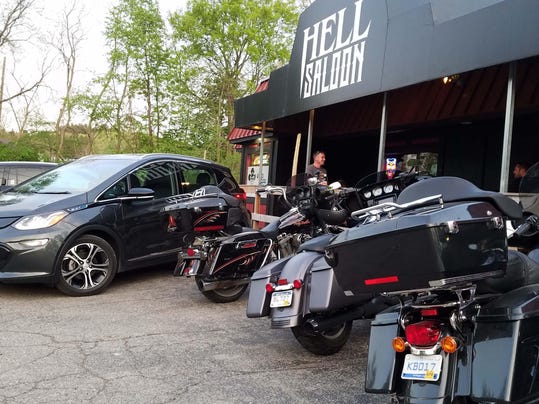
To Hell with Green. Hell, Michigan that is.
When a 200-mile-plus range, 60 kWh Chevy Bolt tester arrived in my driveway one Friday, my thoughts immediately turned to Hell’s twisty, driver’s roads. And local autocross clubs. And Woodward stoplight drag-races.
Forget your tree-hugging, lane-clogging hybrids. Big battery EVs are here, and as the Tesla Model S and Bolt EV prove, electrics are about much more than going gas-free — they are a hoot to drive.
They had better be. They ain’t cheap. Teslas are luxury goods, and my compact Bolt hatch’s $43,510 price tag puts it north of five-door toys like the VW Golf R and Ford Focus RS. No wonder GM assigned SCCA-racer, ex-NASCAR-crew Josh Tavel as its chief engineer.
I love the Bolt’s handling and drivetrain dynamics, and I was determined to drive the stuffing out of it like any other pocket rocket. Dour greens advertise electrics as a ticket to sainthood. I say EVs are a gateway drug to devilish fun.
With a 238-mile range, Bolt can reach just about anything I want in southeast Michigan. First on the menu: A Sunday afternoon autocross at Oakland University organized by the fun-loving folks at the Detroit Alfa Romeo Club.
Payne, have you gone mad? Autocross an EV?
I’ll admit, I got some curious looks as I pulled into the Oakland paddock. Tight, pylon-marked, parking-lot autocrossing is the domain of nimble predators like the Mazda Miata, Porsche Cayman and Pontiac Solstice. High-horsepower Corvette C7s or Dodge Challengers are out of their element here — like deploying the USS Nimitz in Walnut Lake.
It’s also home turf for hot hatches: VW Golf, Ford Fiesta/Focus ST, Honda Civic Si. The battery-laden, 3,580-pound Bolt appears a linebacker compared to these sub-3,000-pound sprinters — but the Chevy’s batteries are in the floor, making for a low center of gravity. Add instant torque and single-speed transmission, and the Bolt actually has inherent advantages over much of its competition.
In fact, Chevy’s sister Volt plug-in has been an autocross pioneer, showing respectable results in SCCA H Stock class. My biggest fear was tires.
Where my competitors would bring performance rubber to this knife-fight, my Bolt wears stock, 215/50/17, low-roll resistant Michelins. Maximized for fuel economy, they shrieked under duress in my California hills test last year.
My attempt to swap out the Bolt bagels for stickier Sumitomo performance rubber off my Civic Si was fruitless (holes don’t match), so the stock rubber it was. No matter. My 32-second times were very competitive in H Stock. With stickier tires I would have been breathing down some Ford ST necks.
Didn’t I tell you big-battery EVs were hot rods?
Torquey off the line, the Bolt stayed remarkably flat under G-forces. It pushed through slow corners, natch — but not as bad as an Alfa Giulia 2.0 Ti the factory brought for test runs. How good was the Bolt? My best time in the Giulia was only half-a-second quicker.
My four autocross runs sucked electrons. Each quarter-mile lap drank 3 miles of range. But with 200 miles on tap, that still left me plenty of juice to go drag racing on Woodward.
The beauty of Bolt is it’s also fun to drive slow. Select LOW gear and the electric motor goes into full battery-regen mode, braking every time I lifted off the gas (er, electron?). I coasted to a stop at lights without ever touching the brake pedal.
I watched my miles increase on the odometer’s range predictor. Try that in a gasmobile.
A good day of bad behavior under my belt, I retreated home with 148 miles of juice left. Metropolitan range anxiety may not be an issue, but recharging is.
I habitually plugged in whenever I returned home, but the payoff on a standard, 110-watt outlet is meek. Just 4 miles of range per hour took me 13 hours to get back the 52 miles I burned Sunday. A Level 2, 240-volt charger is preferred, but that will add another $2,500 to your bill.
My Monday trip to Hell (navigated via Google Maps thanks to Bolt’s Android Auto app) would be planned around an EVGo Level 3 DC-charging station — of which there are disappointingly few in the Detroit area. Also disappointing is the cost — a whopping $10.55 for each half hour of charge good for 40 miles. With $3-a-gallon premium petrol, the 25-mpg Golf R is a bargain by comparison.
I plugged in with 137 miles of range remaining, ate dinner across the street at the Macaroni Grill (love the fried cheese, folks) and was on my way to Hell at 7 p.m. with insurance miles depending on how much playtime I’d get.
I got plenty thanks to a frisky Audi TT sports car.
Sinister in black with black wheels, the 220-horse Audi (same engine as the hot hatch GTI) took the bait when I locked on his rear bumper.
I shifted from LOW to DRIVE and we both floored it down fabulous Hankerd Road. The thing about electrics is they GO RIGHT NOW. The Bolt stuck to the TT as we hit (censored to avoid self-incrimination) mph. Just at the speed where the gas engine would pull away, we hit a series of curves which the Bolt EV handled with aplomb, its low center of gravity hugging the crests like peanut butter on a banana.
The Audi never shook its Chevy shadow. My EV hatch was hot enough for Hell.
I reflected on the Bolt’s pros and cons on my fast trip home along the I-696 race track. Traveling at 80 mph didn’t degrade the battery, answering my lingering range anxiety questions even as the odometer dipped below 100 miles. The monostable shifter, while fashionable, is a mixed bag. It’s an easy toggle from LOW back to DRIVE (when I see, say, an eager Audi), but unpredictable when shifting to reverse out of a driveway. And GM missed an opportunity to badge the Bolt as a Cadillac. The pentastar beak would have lifted the car and brand — not to mention its styling.
Still, as I plugged in for another loooong night on the electron teat, my verdict was overwhelming: The Bolt EV deserves a place alongside other hot hatches. It’s quick. It’s got utility. And while it doesn’t have a stick, its LOW drive mode is plenty engaging.
Now, if I can just find some serious autocross tires …
Henry Payne is auto critic for The Detroit News. Find him at hpayne@detroitnews.com or Twitter @HenryEPayne.
2017 Chevrolet Bolt EV
| VEHICLE TYPE | BATTERY-POWERED, FRONT-WHEEL DRIVE, FIVE-PASSENGER
HATCHBACK |
| Powerplant | Single AC, continuous magnetic-drive motor powered
by 60kWh lithium-ion battery |
| Transmission | One-speed direct drive |
| Weight | 3,580 pounds |
| Price | $37,495 ($43,510 Premier as tested) |
| Power | 200 horsepower, 266 pound-feet torque |
| Performance | 0-60 mph, 6.5 seconds (Car and Driver); top speed, 93 mph |
| Fuel economy | EPA 110 city/128 highway/119 combined MPGe;
238-mi. range on full charge. Detroit News observed: 218 mile range (Maximum: 257 mi. if efficiency-minded. Minimum: 178 mi. with lead foot.) |
Report card
| HIGHS | ENGAGING DAILY DRIVER (ADDICTIVE LOW MODE); USEFUL
INSTRUMENTATION AND APPLE CARPLAY/ANDROID AUTO NAVIGATION |
| Lows | Charging time/expense; granola tires |
Overall: ★★★★
Toyota rolls out new Camry in SUV-crazed U.S.
Posted by hpayne on June 8, 2017
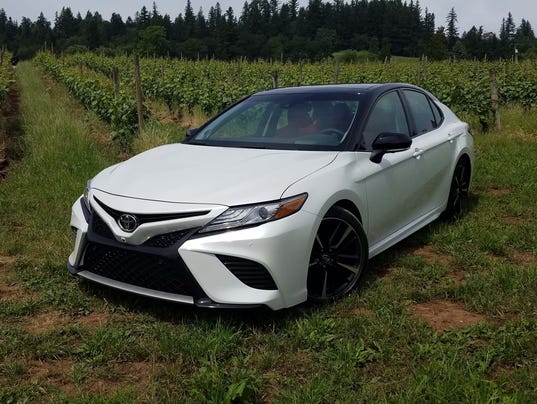
Portland, Oregon — Thirty-five years ago, Toyota exploited high gas prices and federal fuel-efficiency regulations to take a historic foothold in the U.S. auto market. Joined by other Japanese firms like Honda and Nissan, Toyota led the sea-change from big, American gas-hogs to the cars Americans craved: cheap, fuel-efficient sedans.
But today the U.S. market is in the midst of a seismic shift away from cars to bigger SUVs that, for the first time in decades, plays to Detroit automakers’ strengths. In 2016 Toyota lost 0.3 percent market share (to 14 percent) as buyers turned away from its traditional sedan mainstays.
As Toyota introduced a completely redesigned Camry sedan to the automotive press here this week, the automaker faces questions as to whether it is vulnerable in a U.S. market where SUVs rule amid cheap gas prices.
Despite the challenges, company executives and industry analysts agree that Toyota and other Japanese automakers are well-positioned for the shift. They are not the makers of small econoboxes of yore. Over the last four decades, Toyota, for one, has evolved with American consumer tastes not only as a dominant maker of passenger cars — but also a full-line maker of everything from SUVs to pickups.
Toyota’s product mix in the U.S. is about 60 percent SUVS and 40 percent sedans, said Jack Hollis, group vice president for North America: “No one would have predicted (the market) would move this far this fast.”
Hollis anticipates that the compact Toyota RAV4 — the No. 2-selling SUV behind Honda’s CR-V in the industry’s biggest segment — will outsell the Camry in 2017 for the first time. Camry sales declined 9 percent in 2016. Meanwhile, the Toyota Highlander is the No. 3 mid-size SUV (behind Detroit champs Ford Explorer and Jeep Grand Cherokee), and the Tacoma is the best-selling mid-size pickup.
“Over the years, (Toyota CEO) Akio Toyoda’s goal was to separate (global) marketplaces so there was self-reliance in every region,” says Hollis. “That is why we make the majority of our vehicles in the U.S. so we can adjust to the fluctuations in the market. We build where we sell.”
Toyota’s strength in small trucks belies the historic caricature of a brand that only built small cars. Sure, Toyota’s compact, sippy Corolla became a runaway hit in the 1980s followed by the Camry — the best-selling car in America for the last 15 years. But Toyota also sold the FJ and Land Cruiser sport utilities 40 years ago, and the Tacoma pickup has consistently eclipsed 150,000 in sales since the century’s turn.
“The company started with a fuel-efficient, sedan-heavy portfolio. But there were also early Land Cruisers and off-road products,” said Hollis. “So while we came out with Corolla at the same time, we had this off-road vehicle heritage.”
While Toyota has successfully kept up with American tastes, U.S. automakers have learned their lessons from the disastrous 1980s when Japanese makers gained a stunning 10 percent of market share. Part of that was the result of fuel-efficiency regulations that punished domestic makers for producing profitable big cars.
“Government rules hurt Detroit because they couldn’t meet government mpg standards with big Cadillacs and Pontiacs and Buicks,” says Auto Trends Consulting’s Joe Philippi, a former Wall Street auto analyst. “They were totally out of luck.”
But U.S. automakers also ignored market demand for higher quality that led to a historic shift in consumer loyalty. “The Japanese automakers’ loyalty advantage is formidable,” concluded a Brookings Institution study in 1991.
“The Japanese were in the right place in the right time on fuel economy in the 1970s — but they also began to focus on quality, and that was the great leap forward,” says Philippi.
While big vehicles remain Detroit’s cash cows, they have invested heavily in small cars should gas prices raise again — and to gain younger buyers with affordable products. General Motors’ Buick division, for example, pioneered the subcompact crossover. And Chevy has remade its Cruze compact and Malibu mid-size sedans to rave reviews from the automotive press.
The competition has caught the attention of Toyota which, despite its sales lead in mid-size sedans, had fallen behind in performance and styling. The stylish, 2018 Camry is a statement by Toyota that it intends to protect its turf.
“(This model) is the first completely new Camry since the first-generation vehicle was introduced to the American market in 1982,” says Camry chief engineer Masato Katsumata.
Based on Toyota’s all-new TNGA global platform, the Camry sheds its dour, vanilla image for a much more sculpted appearance. Just as the Chevy Malibu has imported styling cues from luxury cars like the Audi A7, the Camry shows much more aggressive front and rear styling reminiscent of its Lexus luxury brand.
More significantly, the Camry adapts a double-wishbone rear suspension more common to sports cars than family sedans. U.S. Camry production is sourced from its Kentucky production plant, with another 60,000 Camrys a year exported abroad. The car goes on sale in July.
“Everyone is putting their resources in SUVs,” says Toyota’s Hollis. “At the same time we’re investing in sedans. We’re always trying to keep balance in the market.”
‘Nines-with-light’: Behind the making of Dodge’s Demon
Posted by hpayne on June 2, 2017

Pontiac — Before it was a Demon, it was just the ADR.
Cloaked in secrecy for two years before it pulled a wheelie and exploded down Pier 94 and stole the New York Auto Show, the Dodge Challenger SRT Demon was known to Fiat Chrysler Automobiles insiders as the “American Drag Racer.” If the Dodge Viper ACR — “American Club Racer” — had thrown down the gauntlet as the fastest production car every built by setting lap records at 13 American race tracks, the Dodge Challenger ADR would be its quarter-mile equivalent. The fastest production car in a quarter-mile ever.
But Dodge Motorhead-in-Chief Tim Kuniskis and his merry band of mischief-makers wanted more. They wanted a Demon. A Hellcat on steroids that would not only wow the drag-strip faithful, but define Fiat Chrysler’s performance brand to every car shopper.
“Our mantra was ‘nines-with-light.’ It had to run under 10 seconds and it had to pull the front wheels,” Kuniskis explained to media at M1 Concourse on Thursday, six weeks after its jaw-dropping Big Apple debut. “Why? Because nobody had done it. And if you do it, then the Camry buyer reads the headlines and say, ‘They just built a car that pulls a wheelie. Now you got my attention.’ ”
The $84,995 Demon has had Americans buzzing since the first of 12 teaser videos leading up to the April debut in New York. On Thursday, Kuniskis & Co. filled in all the often-cryptic details (like “nines-with-light” — a purposely obtuse term so that even Dodge employees didn’t know the Demon’s performance details) on the top-secret project that now stands alone atop the automotive pyramid with an insane production-record 9.65-second quarter-mile and 2.3-second 0-60 time.
Then the devilish Kuniskis wowed his audience by personally taking the Demon off its leash for the first non-auto show demonstration of its distinctive engine audio as it accelerated down M1’s back straight.
Contrary to other muscle cars, the Demon doesn’t start with a roar so much as a shriek like, well, a demon. The eerie sound is the result of the car’s unique air induction process as the front fascia feeds the 840-horsepower, supercharged beast with air from every possible orifice. That includes both inside front headlights which create the unholy shriek by sucking air through narrow passageways.
The induction system is just one of numerous changes that transformed the already legendary, 707-horsepower Hellcat into Dodge’s demonic halo car.
Sixty-two percent of the Hellcat’s 6.2-liter, supercharged engine would be transformed, including a new block, crankshaft, pistons and connecting rods. A “chiller” box was added to reduce air temperature entering the engine by 18 degrees in order to add 15 horsepower. And the engine was designed to take 100-octane fuel. The resulting 840 horsepower and 770 pound-feet of torque meant that the transmission needed a transbrake and torque converter just to keep the power from overwhelming the car’s brake at a drag strip starting line. To hit its quarter-mile target, the car would be outfitted with narrow dragster tires called “runners.”
Despite concerns from FCA’s product approval committee that “we were crazy” — as Dodge SRT’s powertrain guru Chris Cowland put it — the Demon team got its production green-light in September 2015. The tight time frame excluded costly modifications like all-wheel drive or dry-sump systems. The world’s fastest production car would be a traditional wet-sump, rear-wheel driver.
“Every two weeks we would have a meeting. And every decision was driven by ‘nines-with-light,’ ” Kuniskis says. The money set designated for the interior money got repurposed into the transbrake and a chiller.
To keep the project secret from other FCA employees, it was named “Benny” — after engineer Cowland’s favorite “Top Cat” cartoon character. Dynamometer tests were done on weekends. And even then the dyno’s horsepower scale was calibrated to read the Hellcat’s 707 horsepower so no one would leak the Demon’s 840 horses.
To rocket down a drag strip in its record-breaking time, the Demon requires 100-octane fuel and the skinny drag tires. But even with its stock, 12.4-inch wide radials and 91-octane fuel, the Dodge will hit the quarter-mile in less than 10 seconds. That’s illegal under NHRA rules without a roll bar.
“If you do too many sub-10 second times at Milan (the famous Michigan drag strip), they’re going to kick you out to get a cage,” says Kuniskis.
The Demon has our attention.
Payne: BMW X4 M40i vs. Acura TLX A-Spec
Posted by hpayne on June 1, 2017
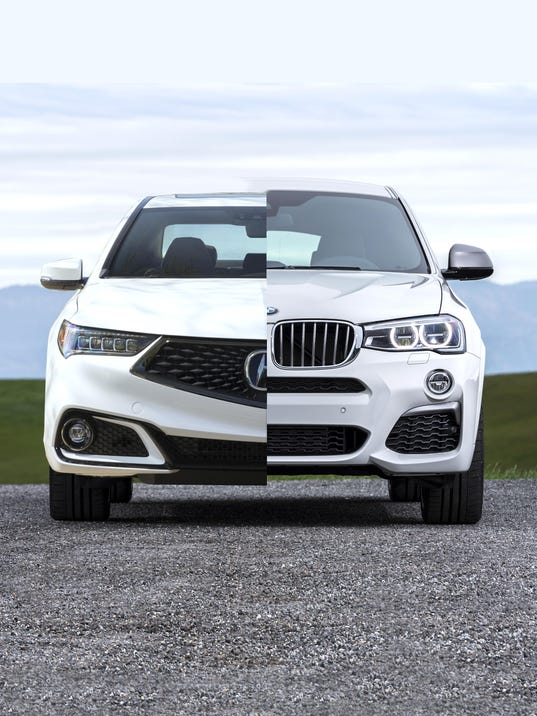
Whoooooo are you? Who, who, who, who?
I couldn’t get Pete Townshend’s lyrics out of my head as I hammered a 2017 BMW X4 M40i to Louisville as part of a comparison with the new 2018 Acura TLX A-Spec. Alphabet-soup badges aside, these brands are at opposite ends of the compact luxury department these days. The mighty Bimmer: most expensive, most purchased, most coveted — a brand at the peak of its powers. And the Acura: least costly, less purchased, less known — a badge rebooting its identity after a decade in the wilderness.
And yet, in the diabolically complicated premium market, both cars beg the question: Who are you?
Are these two vehicles representative of their brands? And would I — a middle-aged (can’t you tell by my musical proclivities?) motorhead shopper squarely in the cross-hairs of the marketing departments of these performance brands — want either one in my garage?
The Louisville convergence of this pair seemed appropriate. It was Kentucky Derby season and the town was abuzz with well-to-do gamblers scouring bloodlines for the best horse. If the thoroughbreds were named BMW and Acura, you would bet on the former, given the Bavarian breed’s extraordinary run of winners: 3-series, M3, 7-series sedan, i8 mid-engine supercar.
But with the TLX, Acura is plotting a comeback.
Acura exploded on the luxury scene in the late 1990s with its sure-fire trifecta: the halo supercar NSX, Legend sedan and sporty Integra. Fun, fast and hip, the brand attracted Formula One superstars like Ayrton Senna who flung the NSX around Japan’s famous Suzuka race track like a rag doll. Oh, how we groupies buzzed about that one. It also attracted talented designers like Jon Ikeda from the University of California’s Pasadena School of Design.
“They brought me to Suzuka and there’s Senna and the whole team and it was insane,” Ikeda recalled in Louisville. “I was like a girl going to a Beatles concert. I got weak in the knees. It really intrigued me, and inspired me to pack up everything and move to Tokyo.”
But Acura lost its way a decade ago. Blame the Great Recession. Blame the Japanese earthquake. Blame global warming. Whatever. It also infected parent Honda and the company began rolling out products with all of the sex appeal of vanilla cones.
Honda was the first to wake up with its swaggering 2015 Civic that was designed to take on the Audi A3.
Now Acura is returning to its roots with another promising trifecta: supercar NSX, Precision design concept and sporty TLX A-Spec sedan. The luxury-maker has even appointed child wonder-Ikeda — now all grown up at age 52 — as its CEO. He hasn’t disappointed.
Ikeda recognizes that Honda’s Gen X buyers are the perfect recruiting class for a youthful luxury brand. Hundreds of thousands of Civic fans may not be able to afford a BMW, but they can reach the Acura. Especially an Acura with the DNA of the track-carving NSX hellion and the sexy face of the Precision.
Meet the TLX A-Spec.
Importantly, it doesn’t look like past Acuras. Gone is the chrome beak that was derisively referred to as (take your pick) the bottle opener, parrot’s beak and buck tooth. It’s replaced by an all-new Precision-inspired “diamond pentagon” grille. Where the old chrome beak was too Honda, the new face is reminiscent of Mercedes with diamond-shaped flecks emanating from the Acura logo like ripples in a pond. Together with Acura’s signature LED headlights (heavy with black mascara to appeal to those Honda boy-racers) it’s a distinctive look.
I hope Acura learns from BMW and sticks with it. Generations of buyers have coveted Bimmer’s iconic, twin-kidney grille because it symbolizes prestige and performance. So, too, the Cadillac’s shield grille. And Audi’s giant cow-catcher grille.
What is Acura’s look? Whoooo are you? Like Lexus, Infiniti and Lincoln, it hasn’t had an identity. Here’s to the diamond pentagon.
Speaking of identity, my Louisville aunt’s (we Paynes are thick in the South) first reaction to the X4 M40i was: “That’s a BMW? It looks like everything else until you see the grille.” Ouch.
Welcome to the Age of the SUV when everything is a five-door hatch. It’s a conundrum for BMW which built its reputation on sleek, coupe-shaped sedans. Whoooo are you?
Thus the X4.
With its coupe-like roof, it’s supposed to make the boxy X3 crossover look more, um, sedan-like. Ask my aunt if it works. But BMW has more tricks up its sleeve to make the SUV feel like the ultimate driving machine. An M-Sport package adds stiffer springs, bigger anti-roll bars, adaptive dampers and a ferocious, 355-horsepower, turbo inline-six stolen out of my favorite Bimmer, the M2 coupe.
The results are stunning for a crossover, with the 4,272-pound X4 M rocketing to 60 mph in just 4.4 seconds and hitting 0.95 Gs on the skid pad. That’s a whole G more than the Acura sedan. Heck, it destroys the Porsche Macan ute’s 0.87 G.
So entertaining was the snorting, quick-shifting, dual-clutch automatic X4 M to drive that I almost called the boys at Pontiac’s M1 Concourse for some hot laps, but then caught myself: Hot laps in an SUV?
That’s the problem it. If I want M performance, I want it in a sedan with optimal physics. A sedan like, well, the TLX A-Spec. Alas, for its wicked styling and sophisticated torque-vectoring AWD system, the rebooted Acura can’t yet justify a performance version. CEO Ikeda suggests a Type-S — just like the glory days! — is in the offing. But Acura has to walk before it can run.
A big help is its value. For a segment bargain of $33,500 the base front-wheel Acura comes standard with safety-assist systems and Apple CarPlay/Android Auto. My alluring $45,000 A-Spec adds all-wheel drive and blind-spot assist.
At $20,000 north of the A-Spec, the Bimmer was barren of safety assists — not even adaptive cruise, a puzzling oversight for a $67,000 chariot. And with its coupe-style roof it had less backseat headroom than the four-door Acura.
Bottom line? I’d pass on both these cars in their current form. I love the x-plosive X4’s engine — but would buy it in the M2 first. And I’ll wait for a TLX Type-S with more power to match the A-Spec’s sexy design.
We shouldn’t have to wait long. Acura knows who it is again.
Henry Payne is auto critic for The Detroit News. Find him at hpayne@detroitnews.com or Twitter @HenryEPayne.
2017 BMW X4 M40i
| VEHICLE TYPE | FRONT-ENGINE, ALL-WHEEL DRIVE, FIVE-PASSENGER SUV |
| Powerplant | 3.0-liter, turbocharged, inline
6-cylinder |
| Transmission | Eight-speed automatic |
| Weight | 4,272 pounds as tested |
| Price | $58,100 ($67,495 as tested) |
| Power | 355 horsepower, 343 pound-feet torque |
| Performance | 0-60 mph, 4.4 seconds (Car and Driver) |
| Fuel economy | EPA est. mpg: 19 city/26 highway
/21 combined |
Report card
| HIGHS | SPORTS SEDAN HANDLING; SAME
355-HORSE HEART AS M2 |
| Lows | Still looks like an SUV; where are premium features? |
Overall:★★★
Grading scale
Excellent ★★★★Good ★★★Fair ★★Poor ★
2018 Acura TLX A-Spec
| VEHICLE TYPE | FRONT-ENGINE, ALL-WHEEL DRIVE,
FIVE-PASSENGER SEDAN |
| Powerplant | 3.5-liter V-6 |
| Transmission | Nine-speed automatic |
| Weight | 3,850 pounds (est.) |
| Price | $43,750 A-Spec base ($45,750 AWD
as tested) |
| Power | 290 horsepower, 267 pound-feet
torque |
| Performance | 0-60 mph, 5.7 seconds
(Car and Driver) |
| Fuel economy | EPA est. mpg: 21 city/31 highway/25 combined |
Report card
| HIGHS | GOODBYE BEAK, HELLO DIAMOND PENTAGON GRILLE; STATE-OF-THE-ART
AWD |
| Lows | Confusing, dual-screen infotainment system;
more power, please |
Overall:★★★