- Search Cartoons
- Comic Archive
-
Payne
Store



 Henry Payne RSS

Articles Blog
Payne: Big Subaru Ascent wants your family — and cups
Posted by Talbot Payne on October 25, 2018

The last time Subaru tried a family SUV it was going through an awkward phase with the three-row Tribeca wallflower and its geeky triangular grille, pricey sticker, and … Mrs. Payne and I walked right past it on the way to the handsome, 2006 Pacifica crossover on the Chrysler lot.
Well, two’s the charm.
A lot has changed for a new generation of ‘Ru families. For one, Subaru went out and got a proper stylist, and its family of handsome Imprezas and Crosstreks aren’t turning away customers with their homely looks. Take my wife — who is on her second Impreza hatchback after downsizing from her three-row Pacifica.
Young Subie owners who bought into the brand with a tidy Impreza or Crosstrek, on the other hand, finally have a proper, full-size family ute to, well, ascend into. Of course, they may have to swallow their tree-hugging ideals over the breakfast newspaper. “The World Is Embracing S.U.V.s. That’s Bad News for the Climate,” lectured a New York Times headline this year. Well, there’s always Fox News.
The faithful might be reassured that Subaru keeps the continuously-variable transmission and flat four-cylinder engine tech for which its famous in its smaller, granola crunchers. But in truth that requires real-world compromise, too, as the four-banger gets turbocharged to motivate its porky-for-the-class 4,583 pounds. That means the ‘Ru gets an EPA fuel rating of 22 mpg — no better than comparably-priced V-6s like the Kia Sorento looker I recently tested.
Indeed, in Car and Driver’s real-world test against another turbo-4, the alluring Mazda CX-9, the Ascent’s fuel economy descended to 17 mpg, 2 mpg shy of the Mazda hottie.
The new Ascent won’t win any beauty pageants over the CX-9 but it’s not unpleasant — it’s even charming with its signature long front end and thick, rugged roof rails. But just to make sure no one walks away before taking a closer look, the Ascent has …
NINETEEN CUP HOLDERS! NINETEEN!
That oughta get your attention. And after counting every single one, you realize that they’ve stuffed a lot of other stuff in there, too, for a very affordable price.
What Ascent lacks in curb appeal to the Sorento and CX-9 it makes up for in size, features and affordability.
Parked next to the Sorento in my driveway, the Ascent looks a class larger. Part of that is a face with a lantern jaw bigger than Schwarzenegger, but open the doors and the interior is roomier. Check out that boot. With 18 cubic feet of cargo room behind the third row, the Subie beats the Kia by 50 percent and the Mazda by almost 30.
Only the Chevy Traverse beats it in size with a palatial 23 cubic feet (GM’s ute also is a class leader in third-row seat room, making life comfortable even for your giraffe-legged reviewer). For the same $45K price, however, the Ascent is a Shoney’s buffet of features.
Standard all-wheel-drive, adaptive cruise control, auto brake assist, and Apple CarPlay/Android Auto — then panoramic sunroof, blind-spot assist, auto high beams, auto windshield wipers, power front seats, rear climate control, rear bucket seats, and a washer and dryer (just kidding about the last two).
Japanese companies like Subaru, Honda, Toyota and Mazda increasingly emphasize the electronic gizmos which drivers are increasingly coming to expect. Like a camera on your phone. The Chevy does not have adaptive cruise and auto high beams at $45K, and they are sorely missed.
Speaking of essentials, blind-spot assist is a must on big barges like Ascent, and Subaru obliged by putting the indicator — not waaaaay out on the starboard mirror edge where it’s often lost in sun glare — but on the inside mirror stem where you can see it all the time.
Subie may have supersized but it hasn’t forgotten its adventurous roots. Ascent gets ox-like, 5,000-pound towing ability. And the forward camera that (Tesla -like) allows you to see out the front of the vehicle. And the nearly nine-inch ground clearance, and hill descent control.
Touches like that endear folks to Subaru who will still be tempted to camp off-road in their three-row ute.
Subaru is not immune from cost-saving annoyances. The adaptive cruise control only goes up in 5-mph increments (what?!), which was awkward when I was trying to stay under 80 mph on speed-limited, 70 mph interstates. To set the cruise control, I would have to accelerate to exactly 77 mph, then deploy adaptive cruise.
My wife has to do the same on her Impreza. You get used to it.
Happily, unlike the Traverse and Sorento with their cost-cutting, access-the-third-row-only-on-the-curbside-of-the-vehicle, the Ascent allows you to get into the back on either side of the car with a simple, one-pull seat lever. The Honda Pilot is still the master of this with its single-push button magic.
It makes for a good, overall second-and-third row vibe. It seems Subaru cares about its coach-class passengers as much as first-class drivers.
There’s climate control for the second row, heated seats, that yuuuuge sunroof providing sunlight — and, of course, enough cupholders for the kids to have both a pop and milkshake with their fast-food burgers.
Still, when I pressed the starter button and pulled the shift lever into DRIVE, I feared the worst.
Despite the major improvement to my wife’s CVT tranny in the latest-gen Impreza, the ghost of droning CVTs past — attached-to-four cylinders — still haunts me. How could the combo possibly work in a two-ton ute?
Make that two tons and a half, and you feel every pound given the Subie’s higher, off-road ride height. After a week of driving a Corvette ZR1 at the Dream Cruise this summer — sweating every parking lot entrance with its low, carbon-fiber splitter (scraaape) — I admit the Ascent’s ride height was blessedly stress free.
But it also means it has no athletic pretensions like a Mazda. The turbo-4 and CVT, on the other hand, are surprisingly spry. The CVT is no droner — but shifts smoothly under duress thanks to electronic programming that makes it feel like a high-ratio automatic.
The 260-horsepower turbo-4 is a bull.
Subaru has left its awkward, geeky, Tribeca phase behind and produced a big, competitive, roomy three-row ute. Just in time for your growing family — awkward, geeky teens and all.
Henry Payne is auto critic for The Detroit News. Find him at hpayne@detroitnews.com or Twitter @HenryEPayne. Catch “Car Radio with Henry Payne” from noon-2 p.m. Saturdays on 910 AM Superstation.
2019 Subaru Ascent
Vehicle type: Front-engine, all-wheel drive, seven-passenger SUV
Price: $32,970 base, includes $975 destination fee ($45,670 Ascent Touring as tested)
Powerplant: 2.4-liter turbo, “Boxer” inline 4-cylinder
Power: 260 horsepower, 277 pound-feet torque
Transmission: Continuously-variable automatic
Performance: 0-60 mph, 6.9 seconds (Car and Driver); towing: 5,000 pounds
Weight: 4,583 pounds
EPA fuel economy: 20 city/26 highway/22 combined
Report card
Highs: Turbo-4 rows the big ship; lotsa standard features
Lows: Turbo-4 gets thirsty; better cruise control, please
Overall: 3 stars
Detroit area’s EV charging stations test planning and patience
Posted by Talbot Payne on October 25, 2018

Bloomfield Hills — The electric-car future is here — if you have time to spare, a second gas-powered car and good math skills.
The Jaguar I-Pace is the first direct challenger to the Tesla Model S and X, and the first in a wave of luxury EVs. Yet, for all their high-priced, technical prowess, vehicles like the Jag are entering a charging-station infrastructure in Michigan that is ill-equipped to keep them running.
I spent an anxious weekend in the I-Pace testing the limits of Metro Detroit’s charging stations — and the patience of my family. Jaguar and other EV-makers strongly advise wiring your house for a 240-volt fast-charger. Without it, plan on scheduling your life around your car.
With a Tesla Model 3 on order, my house is already wired with a 240-volt Tesla charger. But Tesla chargers are incompatible with other brands. Previous I-Pace, Chevy Bolt EV and Nissan Leaf EV tests have all involved a degree of range anxiety, but my packed Friday and Saturday would be a true test.
With a busy day of appointments, I had no time for my home’s standard 110-volt socket. EV-makers recommend it only as a last resort. A 110-volt charger returns a pathetic 4 miles per hour of charging at best (it took 19 hours to get back 30 miles of range on a Cadillac CT6 plug-in last summer).
So I plotted a strategy to charge on-the-go.
Metro Detroit charging options — like most states outside ultra-green California — are spotty. According to PlugShare, a smartphone app for locating charging stations, there are about 42,000 locations nationwide, one-third of them in the Golden State. They range from charging networks run by companies like EVGo, to obscure, individual outlets in parking garages.
Crucially, only 15 percent of EV stations are so-called fast-chargers — and about half of those are Tesla-exclusive. Fast-chargers can, in my experience, potentially deliver four times the juice of a common 240-volt Level 2 home-charger: A fast-charger can deliver about 80 miles of range in an hour.
In all of Metro Detroit, I counted 12 fast-chargers in locations as varied as parking lots and auto dealerships.
With an afternoon appointment at a radio station in Southfield —15 miles away — the Jaguar’s navigation system told me the closest charger was a 240-volt unit at a BMW dealership on Telegraph Road. I would have called the dealership to ask permission to charge a Jaguar, a potentially awkward conversation. But it moved to Pontiac months ago.
No matter. After taking care of radio business, I set course for Nissan’s Technical Center in Farmington Hills — 15 miles west — assuming they would have a bank of chargers for employees who drive Leaf EVs.
This is how many experienced EV owners charge — on fixed daily routes. Plug in at work. Plug in at home. I figured I could have the I-Pace charge while I conducted a Nissan interview.
Trouble is, all 14 Nissan chargers — including two fast-chargers — were occupied. My Jaguar sat. Range left: 65 miles.
Rapid-fire afternoon appointments followed. Back to the radio station: 15 miles. Back home: 15 miles. Range left: 35 miles. And I had a 7 p.m. movie date with my wife.
Lacking trust in the nav system for station status, I relied on the PlugShare phone app. Sadly, the Maple Theater (and surrounding shopping center) offer no charging ports. The closest 240-volt charger: West Bloomfield Library, seven miles away.
My wife and I hatched a plan. She would follow me to West Bloomfield at 6 p.m. in her gas-powered Subaru Impreza, and I would plug in the Jaguar for four hours (good for 20 miles per charging-hour — or 80 total) while we were at the theater and had dinner.
But the West Bloomfield charger didn’t work. I called station-operator ChargePoint, which tried a system reboot. No luck. Range left: 27 miles.
We left the Jaguar and arrived in the Subaru just in time for the 7 p.m. show. Afterward, we fetched the Jaguar, returning home with just 20 miles of charge.
Saturday dawned and I canceled my usual sports-club workout to preserve charge for my noon-2 p.m. radio show. Still, I wouldn’t have enough charge to get back from the station. I stopped at the Nissan Tech Center on the way and bellied up to the fast-charger only to realize it was a ChadMo station, a technology that supports the Nissan Leaf, not a Jaguar.
Plan B was right across the parking lot, where I plugged into a less-powerful 240-volt charger for nearly three hours while getting work done on my laptop. With 53 miles of range, I made it to the radio station, then back home with just 20 miles of range left. Back at Square One despite a morning of charging.
Next appointment: Meet friends for dinner and a play in Detroit.
We plotted the evening around the car. The only fast-charger in south Oakland County is at Woodward and Nine Mile in Ferndale, in a Dunkin’ Donuts lot. It was on the Fisher Theatre glide-path and three blocks from Pop’s for Italian, a family favorite.
But when we got in the car at 5 p.m. to head for dinner and the theater, the range had bled to 16 miles from 20. We had suffered the dreaded “vampire” energy loss when a cars sits. And Dunkin’ Donuts was 13 miles away.
My long-suffering wife followed the Jaguar to make sure I made it. To maximize range, I turned off the air-conditioning, selected Eco mode and crawled down Woodward using as little throttle as possible. A $90,000 Jaguar EV had been reduced to a mere appliance accompanied by a gas-powered tugboat. I made it to the Dunkin’ Donuts and plugged in.
When we emerged from dinner, I found the charger had cut off after a half-hour. But I had 60 miles of range — enough to get to the Fisher and back home.
When my Model 3 arrives later this October, the 240-volt charger in my garage will ease most of my range anxieties. Until I plan a long trip up north to EV-infrastructure challenged Lake Michigan.
My wife might kill me first.
Ford will build more $500K GT supercars
Posted by Talbot Payne on October 25, 2018

Dearborn – The super-exclusive mid-engine Ford GT supercar just a got a little less exclusive.
To meet global demand, Ford announced Thursday it is increasing total production of the coveted $500,000, 647-horsepower beauty from 1,000 to 1,350 – extending to the 2022 model year from the previously announced 2020.
“The Ford GT is one of the world’s most desirable supercars. We were blown away when we launched it in 2016 and received 6,500 applications – outstripping supply by more than 6-to-1,” said Hermann Salenbauch, head of Ford Performance, at Ford’s Dearborn Proving Grounds. “The excitement for this car continues to amaze us, which is why we love doing more.”
Built as a production homologation car so that Ford could return to the 24 Hours of Le Mans endurance race in 2016 – 50 years after it first won the event with the legendary GT40 race car – anticipation for the scissor-door 2017-2020 GT production rocket soared after the race version won the 2016 French race.
Despite its then-$450,000 base price, demand was fierce. Unlike the first GT supercar which saw limited U.S. production from 2005-2006, the state-of-the-art twin-turbo V-6 2017 car is available in the U.S., Europe and Mideast-Africa, and has brought interest from around the world.
“Because of its heritage as the Ford that beat Ferrari at Le Mans, the GT may be even more recognized internationally,” said Jim Owens, North American Ford Performance manager. The GT is the halo car of the Performance division which includes capable toys like the Mustang GT500, Raptor pickup truck, and Focus RS.
GT orders will open Nov. 8 at FordGT.com for the 350 additional cars; the ordering window stays open for 30 days. The extensive application process requires applicants to prove themselves worthy as owners. Approved buyers have included such notables as NASCAR superstar Kurt Busch, actor John Cena and electronic music producer and DJ Deadmau5.
The announcement brought mixed reaction from existing owners.
“I’m disappointed that they are building more than the 1,000 initially promised. It will depreciate the value of the cars,” said Lauren Fix of Buffalo, who bought a 2017 GT with special Heritage livery and titanium exhaust. Only 14 such cars were built of the 138 produced for that model year.
Ford’s Saltenbauch sought to relieve owner concerns that the production extension will hurt existing cars’ investment value. “The car is desirable. Even with a slight production increase, it won’t reduce exclusivity, and we think it will build excitement even more.”
While pricing starts at $500,000, owners say that options quickly put the car’s cost at north of $600,000 even before trims like the Heritage model are added on.
Under contract, GT owners cannot sell their GTs for two years – so few GTs have been resold into the market. Ford sued Cena late last year for contract breach after the actor flipped his GT to another buyer. Cena’s car has since sold to a couple of different owners for $1.32 million and $1.54 million.
While Ford ups production, the race car continues to compete in the international FIA World Endurance Championship (the sanctioning body for Le Mans) and the U.S.-based IMSA Weathertech series where the GT first captured the 2018 manufacturer’s championship.
The carbon-fiber GT, which has a 216 mph top speed and Formula One-style, “keel-wing” chassis, is hand-built by specialty manufacturer Multimatic in Canada. Multimatic makes one GT per day.
Payne: Jaguar’s E-Pace cub is cute ‘n’ porky
Posted by Talbot Payne on October 25, 2018

Open the compact Jaguar E-Pace at night, and a bright light pools on the ground below the mirrors. A graphic spells out J-A-G-U-A-R, and … what’s this? A silhouette of a Jaguar followed by its cub.
How appropriate.
Fifty years after Jaguar introduced the achingly gorgeous E-Type sports car and XJ sedan, the Brit brand is birthing a litter of profitable SUVs. The big cat’s DNA is evident in its I-Pace, F-Pace and E-Pace children: the brooding eyes, the soft nose, the muscled haunches.
Driving my Cesium Blue cub through northern Michigan, I got plenty of looks. The landscape is awash in lookalike five-door utes these days, but the little Jag has presence with its slanted eyes, pouncing logo and 20-inch wheels.
Like its cub siblings, the E-Pace only gets some of the Jaguar DNA. It’s an SUV, after all. Don’t expect a thoroughbred race-horse from Secretariat cross-breeding with an ox.
That’s Range Rover as in the off-road truck brand. Like I say, Secretariat flirting with an ox.
In short, you buy the E-Pace for its looks, not for its athleticism. Jaguar engineers seem confused on this point as they assist E-Pace passengers with a console “oh, crap!” handle — but only equip the R-Line performance model with the paddle shifters you would expect on a model descended from F-Type.
The added ponies don’t get you any better audio, either. This is no signature V-8 or V-6 Jaguar mill, but a familiar turbo 4-banger that motivates every small SUV from Chevy Equinox to Audi Q3.
Speaking of Mazda, the Jaguar felt less nimble than the CX-5 and BMW X1 — the best compact utes I’ve driven — through Michigan’s Route 32 twisties. Blame the E’s girth again, as it tips the scales at 600 pounds more than the Japanese model. Heck, it weighs 200 pounds more than the V-6 340-horsepower, aluminum-chassis F-Pace!
When the CX-5 gets its expected upgrade to a 250-plus horsepower turbo-4 next year it will run rings round the Jag. ZOOM ZOOM!
The Jaguar also sits more than 1.5 inches higher than its racy brethren — 8.8-inches versus the BMW’s 7.2, for example — which further penalizes its center of gravity.
At the end of my weekend in Charlevoix County, the E-Pace felt like every other five-door ute out there. Where was the growl? The athleticism? Like a zookeeper feeling sorry for his caged animal, I looked to take the E-Pace off-road into the unpaved wild.
The Jag’s high-riding Range Rover attributes, in fact, made it more fun off-road than on. Unafraid of rocky terrain, I grunted around farm landscapes. Turning the traction-control off, I attacked winding gravel roads, drifting across apexes with the all-wheel drive churning and throttle buried.
My female friends loved the Jag’s high stance for better visibility. Add its blue wardrobe and comfortable interior, and I suspect this cub will be adopted by a lot of women.
It’s also worth noting that the E-Pace — my tester cost $54,565 — is more practical than the other new cat, the all-electric $85,000 I-Pace.
With a 382-mile range on a tank of gas vs. the I-Pace’s 240-mile battery range, the E-Pace can easily make it the 260 miles to Charlevoix. When you get there, the I-Pace will be stuck for hours recharging, whereas the E-Pace can fill up in five minutes anywhere.
When it debuted for the 2017 model year, I pooh-poohed the bigger F-Pace for its subpar interior compared to German competitors. The E-Pace’s quiet cabin is a delightful place to be with stitched leather, wrapped console and options like a digital instrument panel and full moonroof.
Just as the chassis doesn’t live up to the sexy interior, however, so do the interior electronics lag the leather-wrapped luxury.
Engine stop/start — better known as that annoying engine stall at stoplights to satisfy federal mpg nannies — is relatively unobtrusive, but I still found myself turning it off every time I got in the car.
Lane-keep assist comes with a promising, digital instrument display to let you know what the windshield-based camera is seeing. But the camera’s eyesight isn’t 20/20, and the Jaguar winds up bouncing from one side of the lane (when it can see the lane) to the other like a bowling ball. The infotainment screen is often slow, too, and the voice-command navigation system is a chore.
Thankfully, Jaguar has equipped the E-Pace with Apple CarPlay and Android Auto so you can fill that big, beautiful 10-inch screen with Google Maps and get wherever you need to go easily. Blind-spot assist helps overcome rear blind spots bigger than Rhode Island.
The cub’s back seats won’t win any class awards for space, but they fit this 6-foot-5 giraffe more comfortably than rear seats of a Jaguar XE sedan — a big reason hatchback utes dominate sales today.
The bigger — or perhaps smaller — issue with the cub’s tidy, aerodynamic rear design is limited cargo space. E-Pace’s 24.2 cubic feet of storage lags the BMW X1 and Mazda CX-5 by three and six cubic feet, respectively. The better comparison is to the Cadillac XT-4 (pricier) or Audi Q5 SUVs, which offer comparable turbo-4 power and cargo room.
The Audi has sold well in the Age of Ute with its conservative styling and German engineering. The Jaguar is the anti-Audi — a cuddly cub with a sexy British racing lineage that stands out in a crowd.
Never mind that its turbo-4 all-wheel drive innards are unremarkable. What matters is that, 50 years ago, a British cat roamed the highways and byways purring seductively.
The seduction continues today in the unlikeliest of packages, an SUV.
Henry Payne is auto critic for The Detroit News. Find him at hpayne@detroitnews.com or Twitter @HenryEPayne. Catch “Car Radio with Henry Payne” from noon-2 p.m. Saturdays on 910 AM Superstation.
2018 Jaguar E-Pace
Vehicle type: Front-engine, all-wheel drive, five-passenger SUV
Price: $39,595 base, includes $995 destination fee ($54,190 E-Pace SE as tested)
Powerplant: 2.0-liter turbo inline 4-cylinder
Power: 246 horsepower, 269 pound-feet torque
Transmission: 9-speed automatic
Performance: 0-60 mph, 7.2 seconds (Car and Driver est.); top speed: 135 mph
Weight: 4,223 pounds
EPA fuel economy: 21 city/28 highway/24 combined
Report card
Highs: Cute cub; sure-pawed off-roader
Lows: Lacks Jaguar fun-DNA ; tech quibbles
Overall: 3 stars
From Honda to Volvo: New U.S. auto transplant transcends tariffs
Posted by Talbot Payne on October 17, 2018

Sweden’s Volvo is the latest foreign manufacturer to open a “transplant” in the United States. Production of the 2019 S60 sedan northwest of Charleston, South Carolina, ramped up this month just as America goes through another spasm of protectionism. President Donald Trump’s nationalist crusade for tariffs mirrors Michigan Congressman John Dingell’s call for import quotas that inspired Honda’s first U.S. plant in 1982.
But Volvo’s choice has little to do with trade politics.
Learning from successful Japanese and European manufacturers over four decades of expansion, Volvo’s Charleston plant is the 17th non-union transplant to embrace American-made production advantages: lower costs, expanded global capacity, massive supplier infrastructure and proximity to the richest auto consumers in the world.
“Absolutely not trade because the tariffs did not exist on the radar,” says Volvo North America boss Anders Gustafsson, explaining Volvo’s May 2015 announcement — well before the 2016 election — to locate in the South after years of planning. “It’s a long process to decide and there are a lot of countries around the U.S. that you could go for a plant that would be cheaper. The company took a decision for Charleston and it was really a strategy to build where we sell.”
Even as retaliatory 25-percent Chinese tariffs have stymied plans to export S60s there from South Carolina, Volvo’s plant is running full steam ahead.
“We are in full ramp-up now,” says Volvo North America spokeswoman Stephanie Mangini, citing Volvo’s hiring of 1,000 employees with another 2,900 planned in five years. “By 2021 we will also be building the XC90 SUV, our most popular vehicle, here.”
“The transplants started with the 1980s trade war,” says Auto Trends consultant Joe Phillippi, a Wall Street auto analyst at the time. “It was a way — a chess play — for the Japanese to get around our import quotas.”
The Trump administration’s rhetoric today mirrors that of Michigan’s influential Rep. John Dingell, who in 1981 successfully lobbied the Reagan administration to impose foreign import quotas – the so-called Voluntary Restraint Agreement – on Japanese imports.
“I felt it was absolutely necessary, in view of the grotesquely unfair trade practices of our trading partners — especially the Japanese — that real quotas, and domestic content requirements equal to those of other nations should be laid in place by the United States,” Dingell said at the time, “while the United Auto Workers union estimated tens of thousands of jobs a year were being lost to imports.
“Of our $173-billion trade deficit in 1986, Japan alone accounted for more than one-third,” Ford CEO Harold Poling wroite in The New York Times in 1987. “Of that, more than half was due to automobiles. The arithmetic is compelling. You cannot lower the trade deficit unless you address the automotive component.”
Chrysler CEO Lee Iacocca raged against imports, even as US transplants grew to eight by 1992: “They say all of our problems are our fault. That’s like blaming our army and our navy for Pearl Harbor because they weren’t ready. I mean Japan . . . targets this market.”
But with the Japanese transplants came hundreds of auto supplier firms and tens of thousands of new American jobs and auto dealerships down the I-75 corridor. Foreign automakers were not only popular with American consumers, they became integral to American communities and the revival of U.S. manufacturing.
“By establishing a viable new model of production organization in the U.S., (transplants) are contributing to the re-industrialization of American manufacturing,” wrote University of California professor Martin Kenney and Carnegie-Mellon’s Richard Florida in 1992.
Auto analyst Phillippi says the transplants’ huge Midwest steel, rubber and manufacturing spine grew a key Southern spur with the opening of BMW’s Spartanburg, South Carolina transplant in 1994. BMW’s goal: be closer to its rich U.S. customer base and farther from expensive European unions.
“By now, trade was well down on the list for automakers’ reasons to locate here,” says Phillippi. “Just look at the costs of building in Europe. The facilities here are non-union.”
Today, BMW Spartanburg is one of the largest plants in the U.S. with 9,000 employees producing 1,900 SUVs a day. It supports 235 local suppliers; 70 percent of production is exported via Charleston’s port to 140 countries.
BMW’s success attracted other luxury makers like Mercedes and Volvo (the latter also manufactures in Sweden, Belgium, India and China) to the region with its infrastructure, trained non-union workforce and major port. Hyundai and Kia transplants have also located nearby in Alabama and Georgia.
“The most important thing is the harbor, the logistics and of course, the suppliers,” says Gustafsson, who acknowledges BMW’s pioneering role. “There is the competence in the area and that is the most precious thing in this industry. We need to hire extremely competent colleagues.”
Still, Volvo has protested government tariffs and says it’s been thrown “a curveball” with China’s import duties (ironically, the Swedish company is Chinese-owned). Volvo had planned to export 50 percent of S60 production to China and Europe (which has a 10 percent tariff).
Gustafsson shrugs off the trouble as a near-term glitch.
“We have learned there are things that we cannot do anything about, we don’t spend time on,” he says. “When we took a decision to go for a plant in the U.S., there is always plus and minus. I think we will find a good solution.”
Phillippi agrees: “China tariffs are a temporary hiccup. If you design from day one to build three or four models in a plant, then they can move capacity where they need it.”
Big Three automakers have become less protectionist as they, too, have built flexible, global capacity.
With Volvo’s Scalable Product Architecture (SPA) platform, Gustafsson says South Carolina can build everything from utes to sedans. “Eighty percent of our sales volume here is XC90, XC60, and XC40 (SUVs). So we have the right ice cream in our box. But consumer behavior changes now much faster … so you need to stand on your toes and have ice cream for everyone.”
Payne review: Ford Edge ST, the family hot-hatch
Posted by Talbot Payne on October 11, 2018
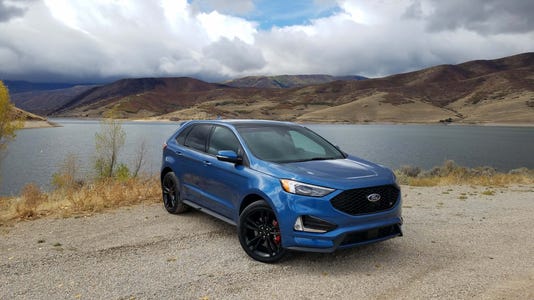
Performance SUVs aren’t as crazy as I thought. I caught up with some of my pocket-rocket brethren at the Ford Edge ST’s media debut in Utah last week. Like me, they love Ford’s compact ST (short for Sport Technologies) hatchbacks. Like me, they think hot hatches are the best combo of fun and utility. And like me, they are stoked about the Ford Edge ST sport utility vehicle.
Think of it as a giant hot-hatch for motorheads with kids.
“The cornering on the autocross course was phenomenal. I would never have expected a big vehicle to handle so well,” said Karl Weber, 30, father of two and owner of a Ford Focus SVT (ST’s predecessor badge). He wants an Edge ST. Now.
“I’ve got two boys and I’ve got an Escape, and this would make a good jump for more space,” said Ben Richter, 32, father of two boys from Nebraska who owns a Ford Focus ST and recognizes its DNA in the Edge ST.
Every ST generation has to grow up. Young leadfoots whose first hot hatch was a VW Golf GTI (me) or Honda Civic Si (my sons) or Hyundai Veloster R-Spec or Nissan Juke NISMO.
With kids and disposable income, they have graduated to the diaper-changing, soccer-game-shuttling, upstate-vacation phase of life. But they haven’t been neutered of their auto enthusiasm: The growl of dual pipes. The Woodward stoplight drag. The call of a country road.
Ford has found the right horse for the job.
While the Ford Escape compact ute would seem the logical SUV for the job — starting at $25,000, it is the next hatch in the lineup after the Focus – but the upright ute is more Barbie than Ken. And hot-hatch demographics are decidedly male.
The mid-size Edge is, well, edgier. Its sculpted looks are more butch than the Escape. Edge sales skew male. And then there’s the chassis: Where the Escape is an SUV platform, the Edge shares its toned bod with Fusion and Taurus cars.
The Edge is a big athlete, an advantage Ford has previously recognized with a Sport version. The last-gen Sport got a substantial engine-upgrade from the base Edge, putting out a healthy 315 horsepower and 350 foot-pounds of torque.
The Edge ST takes the Sport and pumps it with steroids.
At speed over the undulations of Utah country roads outside Salt Lake City, my ST gulped the landscape, setting fire to the fall leaves. WAAAAUGHHH! wailed the V-6, while the two-ton chassis stayed remarkably true to my direction. Make no mistake, this is a rhino compared to the Focus/Fiesta pitbulls. But it’s a rhino in tennis shoes.
Ford achieves this feat the old-fashioned ST way: more power from the twin-turbo V-6 (335 horses and a whopping 380 pound-feet of torque), bigger sway bars, and stiffer shocks and springs. The Frankenstein surgery of ST and ute (Ford performance engineer: “Let my creation live!”) is aided by some fundamental changes to the base Edge for the 2019 model year.
Credit upgrades like a smooth, eight-speed automatic transmission that delivers silkier shifts and 2 mpg better fuel economy on the highway. Also an all-wheel drive system with better traction that can throw torque front-to-rear as well as side-to-side in order to avoid getting stuck in snow ruts.
I drove an Edge Titanium back-to-back with the ST (like other ST models, the Edge ST pricing starts close to where the upper-trim Edge Titanium tops out — $45,000 vs. $42,000 for the ST). I appreciated the hatch utility that makes ST such a versatile vehicle. Signature Ford tech is everywhere. The brand that first brought you the kick-open trunk, panoramic sunroof and self-park assist offers all those features here and more.
Standard on the $29,999 base Edge are camera and connected systems that offer essentials like blind-spot assist, collision-mitigation braking and remote start (“Alexa, start my car”). There’s more on offer from adaptive cruise-control to smartphone apps to a nifty rotary dial.
“With the technology and space and everything you’re getting, it’s a good bargain,” hot-hatch brother and Fiesta ST owner Lou Rivera, 29, raved.
And once you go ST, you’ll never want to go back.
It’s not just the power and rock-solid handling, the ST brings presence to an SUV segment that sorely needs it. Handsome as the Edge is, it has melted into the SUV field. Hyundai’s utes have copied its pentagon grill and LED rear-lighting.
If an Edge ST looms in your mirrors, you’ll know it. Like Patriot tight end Rob Gronkowski smeared with black face-paint, the Edge comes ready for battle. The front clip has been swapped for a new, blacked-out grille and lower intakes. Wheel wells are engorged with black 20-inch wheels (21-inch optional). And all the trimmings – from window sills to rear diffuser have been wrapped black.
Paint it in ST-exclusive Metallic Blue and the big ute reminds of my other favorite blue-devil performance car, the BMW M2.
Living with the Edge ST, like its brother Focus, will require putting up with flaws (but not the Fiesta ST, which is a consistent member of my Top 10 cars list). Despite the added torque and twin turbos, the Edge ST exhibits noticeable turbo lag under the cane. That sluggishness isn’t helped by the eight-speed tranny’s odd lack of urgency when called upon to shift. At full flog, I was constantly tempted to use the shift paddles.
These negatives would be more annoying if they were in track-day cars like the Focus or Fiesta. But a track-focused vehicle this is not, which Ford telegraphs by not offering heavily bolstered Recaro seats or a manual shifter. Still got the need for track days? Keep your old Fiesta ST around.
Especially since the Fiesta and Focus are exiting the U.S. market after 2019 – along with other Ford cars. Which begs the question, is the Edge ST about to lose its buyer base? We’ll see.
For now, hot-hatch graybeards rejoice – the Ford Edge ST means you don’t have to leave ST performance behind when you graduate to a family ute. Performance SUVs are no longer just for the $100,000 Jeep Trackhawk or BMW X5 M jet set.
A new segment is born. What are you waiting for, VW and Nissan? Will we see a Tiguan GTI or Murano NISMO soon?
Henry Payne is auto critic for The Detroit News. Find him at hpayne@detroitnews.com or Twitter @HenryEPayne. Catch “Car Radio with Henry Payne” from noon-2 p.m. Saturdays on 910 AM Superstation.
2019 Ford Edge and Edge ST
Vehicle type: Front-engine, front- and all-wheel drive, five-passenger SUV
Price: $30,990 base Edge, $43,330 base ST include $995 destination fee ($44,890 FWD turbo-4 Edge Titanium and $46,540 AWD Edge ST as tested)
Powerplant: 2.0-liter turbo inline 4-cylinder, 2.7-liter twin-turbo V-6
Power: 250 horsepower, 275 pound-feet torque (turbo-4); 335 horsepower, 380 pound-feet torque (V-6)
Transmission: 8-speed automatic
Performance: 0-60 mph, 5.5 seconds (Car and Driver est.); top speed: 130 mph; tow capacity: 3,500 pounds (V-6 ST)
Weight: 3,959 pounds base FWD (4,477 AWD ST as tested)
EPA fuel economy: 22 city/29 highway/25 combined (FWD turbo-4); 19 city/26 highway/21 combined (Edge ST)
Report card
Highs: Aggressive look; sure-footed power
Lows: Turbo lag; upshifts too casual
Overall: 4 stars
Robbie Buhl’s free teen-driving course goes way beyond driver’s ed
Posted by Talbot Payne on October 5, 2018

With its purchase of the Michigan Central Station, Ford Motor Co. put Detroit’s Corktown neighborhood on the map as an epicenter of the autonomous car revolution. Futurists have sci-fi visions of driverless cars zipping down Michigan Avenue, their sensors negotiating obstacles while smart-city infrastructure helps them communicate with one another.
That’s the future. But until then, Robbie Buhl wants to make Corktown the epicenter of hands-on driving.
The 55-year-old Detroit native and ex-IndyCar driver has located his Teen Street Skills program and rally race-team right next to the train station. Driving doesn’t get much more hands-on than racing – and until autonomous cars deliver on their promise to save lives, Buhl wants to make sure young drivers are saving themselves.
Buhl’s program is similar to other programs around the country – ex-Corvette driver Andy Pilgrim’s Traffic Safety Education Foundation at Bowling Green, Kentucky, and Honda Teen Defensive Driving School at Mid-Ohio, for example – in its efforts to teach teens safe driving skills.
But where these programs are generally run at race tracks in rural areas, Buhl is locating his school in the heart of Detroit on a 2.5-acre parking lot next to Ford’s train depot. He’s recruiting young people from around Metro Detroit to show off Detroit’s revitalization and brand his Corktown headquarters as “Detroit’s race team.”
“People thought we were crazy, (but it’s) amazing what’s happened to Detroit and Corktown in the last three years. It’s fun to bring people down here – we have kids coming down from Utica schools, Troy schools, Grosse Pointe schools.”
Except for the instructor sitting in the right seat, Teen Street Skills has nothing in common with the average driver’s education program.
Rather than nerve-wracking drives at the speed limit followed by sweaty-palm parallel parking drills, the Buhl program encourages teens to push cars to the limit to simulate panic driving situations they’ll encounter in the real world.
“They come away with more confidence and more awareness,” says Buhl. “When they have that panic situation on the road, it’s going to help them. We’re putting them in awkward situations.”
At another driving station, the kids jump behind the wheel of Ford Fusions equipped with “drift lifts” that lighten the rear suspension, inducing instant oversteer in a turn. The young drivers learn to slide the car through corners, modulating steering and throttle to keep the car straight. It’s fun – and instructive.
Like most attendees, Sam Russell, 16, of Grosse Pointe Farms, came to Buhl’s program with the encouragement of his parents.
“I’m really having fun learning about how the car reacts,” he said between sessions on a Saturday morning. “This will help make me a better driver in the long run. I drive every day to school and this school will help me analyze situations.”
One of those situations includes time with a police officer who explains to them how to handle getting pulled over: What to say. What not to say.
“This is all about the eyes – if you’re looking down at a text or looking to play Spotify, the average text is 5 seconds — five sedans at 60 mph is over the length of a football field. A lot can happen,” says Buhl. “We don’t want to scare kids. At driver’s ed they use the crashed car videos and all that. But that’s not working.”
Buhl puts on his program for free; he credits donors and sponsors who finance his program. One of those sponsors is Ford, which provides the Focus compact, Fusion sedans and Escape SUVs for the program.
There’s not a self-driver among them. For now, in the shadow of Ford’s future autonomous headquarters, Robbie Buhl wants to make sure drivers have both hands on the wheel.
Details are at www.teenstreetskills.org.
Payne: Lincoln Nautilus vs. Mercedes-AMG GLC, SUV opposites
Posted by Talbot Payne on October 5, 2018

The difference between the new Lincoln Nautilus and Mercedes-AMG GLC 63 S Coupe SUVs is as vast as the American cities where I tested them: Santa Barbara, California and Watkins Glen, New York, home of Watkins Glen International Raceway.
If you just got back from an extended stay on Mars, the sport ute has taken over autodom in the 21st century. Nautilus and AMG represent bookends of a luxury class that has rapidly expanded to offer Americans a choice of everything from all-wheel drive family utility to high-horsepower performance weapons. Just as the sedan segment has done for decades.
Every fall I take my wee Lola sports racer to the Glen’s SCCA Regional event in western New York. At lunch-hour, the track offers car clubs and spectators pace car-led laps around the epic 3.4-mile road course for $30. I usually participate — not just to take a carload of my teammates around the track to discuss the line, shift points and so on, but also to feel the driving dynamics of the production tester I’ve scheduled that week.
The track lap line in front of us contained an assortment of vehicles: Mazda Miata, Subaru Crosstrek, Ferrari Portofino. “We’re just a couple of slow ladies in our Ferrari,” said the kindly gray-haired owner, walking up to me. “Why don’t you boys go on ahead of us. I don’t think we can keep up.”
Yes, the auto world has gone mad.
Over the last year I’ve track-tested a 505-horse Alfa Stelvio SUV at Austin’s Formula One track and a 707-horse Jeep SUV at Club Motorsports in Maine. And here I was at the Glen with the driver of one of the most coveted sports cars on the planet deferring to me in a 4,500-pound ute as if it was the most normal thing in the world.
The luxury SUV has come a long way from its humble Lincoln Navigator roots of 20 years ago. I was impressed that our new Ferrari friends had so much respect for an SUV, but the AMG is not your average grocery hauler.
Carrying a racy front grille right off the beastly Mercedes-AMG GT coupe and lower air intakes so big they could ingest a flock of geese, the compact GLC enters the room with authority. Aft of the facia, things get weird.
The AMG (or is that OMG?) GLA 63 S is based on the standard GLC compact ute. Just add steroids. Merc drops a twin-turbo V-8 behind in the engine bay — the same 4.0-liter mill that motivates the two-door S560 coupe I recently tested. Determined to continue the family resemblance, the AMG coupe tapers the roofline, complete with carbon-fiber tail spoiler.
The Lincoln, too, is based on another vehicle: its cousin, the Ford Edge.
Rather than take on formidable German performance brands like Mercedes and their endless waves of alphanumeric infantry — GLC, AMG GLC 45, AMG GLC 63, AMG GLC 63 S Coupe and so on — Lincoln has focused on a more-affordable pampered experience. From its signature Jaguar-like grille to its sleek flanks to its elegant wrap-around tail lights, this is a transcontinental train.
No performance mutants here. No GTs. Heck, Lincoln doesn’t even have an alphanumeric equivalent to Ford’s GT or ST performance badges. Nautilus fits the brand’s lineup of travel names: Navigator, Aviator, Continental and the forthcoming Corsair.
The names are serene, not sporty. It’s like a Mozart concerto versus Merc’s rumbling AC/DC.
Turn on the Mercedes and you’ll scatter wildlife like a shotgun blast. BRAAAP. The center console looks like a Porsche with a sleeve of buttons wearing graphics that illustrate exhaust tips or shock absorbers to encourage you to explore the vehicle’s capabilities.
At Watkins Glen, I toggled the exhaust button for maximum sonic experience — then selected Race mode. Yes, Race mode (in addition to Sport and Sport-Plus). I disappeared from the Ferrari, clicking off lightning-quick shifts with steering-wheel mounted paddles that control the 9-speed dual-clutch tranny. BAP BAP BAP.
In the New York Finger Lakes region around the Glen, the AMG Coupe didn’t carve rural roads so much as obliterate them. Traffic kneeled to its power. Cornfields burned in its wake. The V-8’s low end torque is ferocious, propelling the all-wheel drive, 4,500-pound bomb forward with claw-like 20-inch tires.
My Nautilus tester also featured 20-inch rims, but they are sculpted dishes meant to be admired as the Lincoln saunters through the tight streets of Santa Barbara. Or Detroit. Or Chicago.
The top-of-the-line Black Label trim offers a signature pinwheel-style wheel. Plying the roads and streets of north LA I was never tempted to blow anyone’s doors off. The Nautilus is a magic carpet. Push-button shifter. Front, 22-way, massaging thrones.
It features a more livable interior than the German beast with best-in-segment rear seat room, deep console cubby space and a crafted, button-controlled console that may not match Merc’s black, high-gloss finish — but better integrates its touchscreen in the long dash.
Extensive sound-proofing makes it difficult to tell the difference between the 245-horse, 2.0-liter turbo-4 and 335-horsepower, 2.7-liter turbo-6 under the hood.
The turbo-4 will do just fine, its quiet torque effortlessly pushing the train along. That will keep your cost to about $45,000 for an all-new Nautilus, nearly half the price of the Mercedes OMG. And if you don’t feel like driving, Lincoln offers a chauffeur service. For your own car. So you and your mate can cuddle in the back seat on the way to dinner listening to Mozart on the 19-speaker Revel stereo system.
It’s a different audio experience than a V-8, no doubt.
The Lincoln may not have the cachet of a Mercedes-AMG. Or a Ferrari Portofino. But it will effortlessly get you where you want to go in the same time … unless you plan on buying a lot of lunch laps at Watkins Glen.
2019 Lincoln Nautilus
Vehicle type: Front-engine, front- and all-wheel drive, five-passenger SUV
Price: $41,335 base includes $995 destination fee ($58,865 AWD turbo-4 and $64,400 AWD Reserve V-6 as tested)
Powerplant: 2.0-liter turbo inline 4-cylinder, 2.7-liter turbo V-6
Power: 250 horsepower, 280 pound-feet torque (turbo-4); 335 horsepower, 380 pound-feet torque (V-6)
Transmission: 8-speed automatic
Performance: 0-60 mph, 5.9 seconds (Car and Driver); tow capacity: 3,500 pounds (with tow package on V-6)
Weight: 4,305 pounds (AWD as tested)
EPA fuel economy: 20 city/25 highway/22 combined (AWD turbo-4); 19 city/26 highway/21 combined (AWD V-6)
Report card
Highs: Improved British styling; comfortable interior
Lows: Can get pricey with options; head-up display, please?
Overall: 3 stars
2018 Mercedes-AMG GLC 63 S Coupe
Vehicle type: Front-engine, all-wheel drive, five-passenger SUV
Price: $81,745 base includes $995 destination fee ($96,895 as tested)
Powerplant: 4.0-liter twin-turbo 8-cylinder
Power: 503 horsepower, 516 pound-feet torque
Transmission: 9-speed automatic
Performance: 0-60 mph, 3.3 seconds (Car and Driver); top speed: 174 mph
Weight: 4,511 pounds (mfr. est.)
Fuel economy: EPA fuel economy: 15 city/22 highway/18 combined
Report card
Highs: Atomic speed; intimidating grille
Lows: Atomic price; bulbous shape
Overall: 3 stars
Goodbye MK, hello Nautilus: Lincoln names its children by proper names
Posted by Talbot Payne on October 5, 2018

Santa Barbara, California – Premium autos these days are an alphabet soup of confusing vehicles names. There’s the QX60, XC90, RX450 and RDX from Infiniti, Volvo, Lexus and Acura respectively. Cadillac is changing its alphanumeric lineup from ATS, CTS and XTS to CT4, CT5 and CT6. BMW’s compact lineup alone offers a 320i, 330i X-Drive, 440i, M3 and M4. And Mercedes now offers a performance SUV called the AMG GLC63 S Coupe.
It’s enough to make your brain hurt. So Lincoln has shelved its MK-based soup and moved back to good ol’ proper names. Say hello to the Nautilus, a brand new name for the former MKX midsize SUV on sale later this month.
“Vehicle names made more sense for us to distinguish ourselves,” said Lincoln Global Director of Sales and Service Robert Parker. “Because at the end of the day, we get data back, and the data was signaling to us that people were confused.”
Save for ultra-luxury brands like Rolls Royce and Lamborghini, the only full-line premium brands to name their vehicles are Lincoln, Alfa Romeo (Giulia, Stelvio, for example), Range Rover (Discovery, Evoque), and Maserati (Ghibili, Levante). The newest brands in luxury — Tesla (Model 3, Model X) and Genesis (G70, G80) — have both chosen alphanumerics.
Alphanumeric naming convention has been driven by German automakers. And as their models dominated international markets, other automakers followed, seeking the same clean, technical brand identity that alphanumerics convey.
Concise badges with letters and numbers also translate well across different languages and cultures, industry insiders say.
Among mainstream brands, the Chevy Nova, Mazda LaPuta, and Kia Stinger also ran into translation issues. Nova means “it doesn’t go” in Spanish. Laputa translated as “whore.” And in Britain, “stinger” can refer to — well, ahem, look it up.
Lincoln began using the alphanumeric MK badges — short for “Mark” — on its vehicles beginning in 2007. But the nomenclature failed to resonate.
“Lincoln was one of the most confusing (nomenclatures) of all the brands. Everything started with MK and then some random third letter that had no rhyme or reason to it,” said Abuelsamid. “People didn’t know the difference between and MKC and MKX and MKT. So going back to names will be more memorable to people.”
Lincoln says the journey-themed names also represent the brand’s journey to a new place in luxury — away from apex-carving, Nürburgring-tested, German-benchmarked athletes and toward an effortless driving experience that pampers passengers.
Lincoln calls it “quiet luxury.” The Nautilus takes its cues from the iconic, three-row Navigator, a majestic land yacht with optional 30-way massaging seats, sumptuous digital displays, and cavernous interior that has everything but third-row Jacuzzi.
The Navigator — like Cadillac’s Escalade — never succumbed to the brand’s alphanumeric naming strategy. Now remade for 2018 to rave reviews in the automotive press (and hot sales for its upscale Black Label trim), the Navigator is the perfect patron for a family of cars with fresh names.
“There is a lot of continuity with Navigator,” smiles Parker. “That was a big opportunity for us in 2012 when we really put together a 10-year strategy. The details (of how you interact with the Navigator and Nautilus) bring continuity in appearance and functionality that it important to people.”
The Nautlius comes new standard with a 245-horsepower, 2.0-liter four-cylinder engine and an optional, 335-horse 2.7-liter V-6 mill. But such specs seem as unimportant to the Lincoln as technical, alphanumeric badges.
Instead, Lincoln wants the Nautilus judged on different standards like 22-way, massaging front thrones or a vehicle “handshake” that welcomes the driver with a lit, Lincoln logo welcome mat projected on the ground.
“We pay attention to details. The knobs, the leather, the detente into the switches is all about creating an environment that you look forward to after a hard day’s work,” says Parker. “That encapsulates what the Lincoln brand stands for. And then the names drill down on it.”
Picking new names was an extensive process, but at least translation challenges were limited.
“Lincoln is not a brand generally available globally — it’s sold in North American and China,” said Abuelsamid. “With just those two it will be easier to find names that don’t have problematic meanings.”
Once his team settled on a unifying principle of journey and travel, Parker and his team drew inspiration for its naming strategy both internally and from an outside company with success in non-automotive naming strategies.
“You could a write a book about choosing names,” he said. There are names that are important to us — that are important to our history. Continental was one of those names that started back in the late ‘30s. We retained it as part of our portfolio. Our theme inspired some of the contrived names like Nautilus.”
Then Lincoln tried the names out on focus groups. Audiences were told what age range a particular vehicle was meant to appeal to, then given a list of names, and a picture of the vehicle.
Which names best applied to the vehicle?
“For some of us it was that way with our kids,” chuckles Lincoln’s Parker. “You had a short list of names but you wanted to see the kid before you picked the name. Cars are the same way — you really have to see the car before you land on the name.”
Payne: Hail Goliath, the Silverado-based, 6×6 pickup
Posted by Talbot Payne on October 1, 2018

For those who don’t think the all-new, 2019 Chevy Silverado pickup’s earth-chewing, four-wheel-drive, high-strength steel, off-road-trimmed Trail Boss Z71 is tough enough, say hello to Goliath.
David’s sling may have met its match.
Texas-based, performance automaker Hennessey unleashed the six-wheel-drive mega-truck this week with 37-inch off-road tires, an eight-inch suspension lift, and enough firepower to scale the Grand Canyon. The six wheels are driven by a Hellcat-like 705 horses from a blown, 6.2-liter Chevy V-8. Mercy.
Only 24 copies of this biblical beast will be built at a price of $375,000.
“We are very excited to offer our new Goliath 6X6,” said company boss John Hennessey, adding that the vehicle “makes a huge statement anywhere our clients go — whether its Rodeo Drive or the sand dunes of the Sahara Desert.”
It’s not Hennessey’s first six-wheel rodeo. The Goliath follows the mod shop’s 6X6 version of Ford’s ferocious F-150 Raptor pickup — Hennessey calls it the VelociRaptor, naturally — which packs 605 horsepower and a sticker price of (just) $349,000. Mercedes also offers a 6×6 pickup — but it’s not available on U.S. shores.
Like the latest evolution of the gigantic robots out of the movie “Pacific Rim,” Goliath ups the VelociRaptor’s pony count with a supercharged 705 making 675 pound-feet-of torque. With all six wheels churning, Goliath will sprint to 60 mph in just over 4 seconds — quicker than David can load a single rock. And about the same time as a V-8-powered Dodge Challenger coupe.
It’s not as quick, however, as Hennessey’s upgrade to Chevy’s Alpha male Corvette ZR1, which makes 1,200 horsepower and sprints to 60 in an eyeball-flattening 2.2 seconds.
The Goliath is based on Chevy’s lightweighted (by 450 pounds), 420-horsepower, V-8 Silverado with all the tech trimmings: hydraulic engine mounts, smartphone app connectivity, rear seatback storage. The Hennessey version is distinguished by the “Hennessey” logo stamped across the front fascia and rear tailgate, by quad tailpipes, and by — well, its six wheels.
To accommodate the third axle in the rear, Goliath gets a special 6-foot bed with a roll bar. But wait there’s more: Goliath can be upgraded to a bonkers 808 horsepower with Brembo brakes to make sure you can stop the thing after breaking the sound barrier.
The Silverado hit dealerships this fall as Chevy’s full-size pickup goes head-to-head against new entries from archrival Ford and RAM’s 1500. The 6×6 Hennessey Goliath can be ordered through select Chevrolet dealers — or directly from Hennessey Performance Engineering.
Payne: Fab 4-cylinder face-off, Mustang vs. BRZ vs. Miata
Posted by Talbot Payne on September 30, 2018

This summer, Detroit flexed its muscles: $70,000 Corvette V-8s rattled Ferndale windows; $60,000 Hellcats turned Woodward’s asphalt black with Roadkill Night burnouts; $60,000 Mustang GT350s pounded down Waterford Hills’ back straight.
But for half the price and half the cylinders, you can have just as much fun. Maybe more.
For under $40,000 there is a buffet of treats for the casual motorhead — tiny sports cars, hot hatches and four-banger pony cars that are not only easy on the wallet, but can be rowed hard on local byways without waking every cop in town.
I sampled three of these feisty fours this summer: the $38,970 turbo-4 Ford Mustang convertible, $38,335 Mazda Miata MX-5 RS and $34,455 winged Subaru BRZ tS.
As regular readers of this column know, my favorite budget performers are hot hatches with pep, utility and grins: VW Golf GTI, Honda Civic Type R, Hyundai Veloster N, Ford Focus ST and Fiesta ST. But these rowdy pocket rockets lack one thing — rear-wheel drive.
Our contestants for this test are all rear-wheel drive manuals, so they can be drifted, tossed and smoked out of stoplights just like their more expensive V-8 brethren. Beyond RWD their DNA is all over the map from the original pony-car ‘Stang to the iconic Miata to the new-kid-on-the-block, flat-four Subie.
I flogged them all over Metro Detroit to determine the best of the Fab Fours.
Ford Mustang EcoBoost
Mustang and EcoBoost don’t seem to belong in the same sentence, but Ford is determined to make its EcoBoost engines an international brand. It won the 2016 LeMans 24-Hour with the EcoBoost twin-turbo, V6-powered Ford GT supercar and began exporting 2015 Mustang fours to foreign continents choking on strict government emissions regulations.
For 2018, Mustang shelved its 6-cylinder engine to rely entirely on the inline-4 and V-8.
My red 2018 convertible is easy on the eyes. Ford’s designers got it right with an updated design that maintains signature touches like athletic haunches and a modern Focus-style nose.
Alas, the EcoBoost Mustang also sounds like a Focus. Which is say, it feels like it’s lost its voice. Like Mike Tyson, the Ford’s vocals don’t match its muscled bod. REV IT UP!bystanders urged at the Woodward Dream Cruise, expecting a V-8 roar. I would sheepishly rev it to disappointed looks.
“It just doesn’t sound like a Mustang,” colleagues said after handing back the keys.
I’ve driven the turbo-4 in anger on country roads, and without the big V-8 boat anchor up front it rotates more easily into corners, its independent-rear suspension proving more nimble than previous generations. Nailing the four-holer out of a corner, I think of the $41,000 Focus RS hot hatch with which the Mustang shares its 310 horse 2.3-liter mill. But the bad-boy RS engine is tuned for more emotion than the stealthy ‘Stang.
Worse, the RS and its ST stablemates are being axed in the U.S. market as Ford abandons small cars, meaning the only 300-plus-horsepower four you’ll find will be buried under the hood of a Mustang. These are dark days for Ford motorheads. At least you can still get a Mustang V-8.
Subaru BRZ tS
Since I first drove them in 2015, the BRZ and its Toyota 89 twin brother have been on my short list of sports-car favorites. With its low profile and flat-4 boxer engine, it has the lowest center-of-gravity of any production vehicle, along with the battery-powered Tesla Model S.
Combine that with a taut chassis and precise shifter, and the BRZ is Porsche-like (the Stuttgart legend also uses boxer engines) in its handling. Predictable, neutral, maneuverable on the limit.
For 2018, Subaru engineers pushed the envelope even further with the limited-edition tS, the ultimate, track-tuned BRZ. The tS gets a high rear wing for added downforce, stiffer suspension, and most significantly, sticky Michelin Pilot Sport 4 tires for added grip — an improvement over the standard skinnies which may be fun for drifting, but take time away at a Waterford track day.
But better handling is not what the athletic ‘Ru needs.
The 205-horsepower 2.0-liter four is the most anemic 200-horse engine I’ve driven. A 201-horse Honda Civic Si feels much more engaged. Floor the BRZ out of corners, and it has all the urgency of Heinz ketchup.
Full torque doesn’t come on until 6,200 rpms, meaning you’re rowing the box all the time to stay in the torque band. Maybe the peppy 260-horse Ascent SUV will lend its turbo-4 someday.
Mazda MX-5 Miata RF
Though its 2.0-liter four pumped out just 155 ponies, the 2018 Mazda beat the Subaru by nearly half a second: 5.9 seconds compared to 6.3 (courtesy of our friends at Car and Driver). Credit MX-5’s weight. At 2,453 pounds, it is by far the lightest in this test.
Yet, Mazda isn’t resting on its laurels. For 2019 it has increased horsepower by 17 percent to 181 by extending the rev range to 7,500 rpms. Mazda maniacs have pined for the carmaker’s torquey 260-horse turbo-4 (stuffed into the Mazda 6 and CX-9). But corporate is insistent that its halo remain a purists’ sports car — no forced induction allowed.
My 2019 RF will satisfy the purists, and the aesthetes as well. Its Targa roof and racy rear pillars make for the sexiest Miata ever. Looks will cost you: the RF starts $2,600 north of a regular, soft-top MX-5 roadster at $33,675. My RF manual was loaded with carbon-fiber trimmings and leather thrones to the tune of $38,335.
As with Mustang, I’m a fan of the Miata’s new, next-gen styling and the RF brings a touch of luxury as well. The hard top folds up automatically with the touch of a button — where the Mustang is only partially automatic.
Whether on an interstate cloverleaf, parking-lot autocross course or Waterford Hills track day, drivers can really explore the limits of the MX-5.
At 6-foot-5, I explore the limits — head in roof, knees in dash — of the Miata’s tiny cockpit compared to the more comfortable ‘Stang and BRZ. But Mazda’s recipe of styling, playfulness and power-to-weight ratio make it the best pure, under $40,000 4-banger on the market today.
All hail the Fab Four-banger MX-5. It’ll put a smile on your face as wide as its smiley front grille.
2019 Ford Mustang Ecoboost
Vehicle type: Front-engine, rear-wheel drive, four(ish)-passenger convertible/coupe
Price: $26,580 base ($38,970 convertible as tested)
Powerplant: 2.3-liter turbo-4 cylinder
Power: 310 horsepower, 350 pound-feet torque
Transmission: 6-speed manual
Performance: 0-60 mph, 5.3 seconds (Car and Driver); top speed, 123 mph
Weight: 3,676 pounds
Fuel economy: EPA fuel economy: 20 city/29 highway/23 combined
Report card
Highs: Most powerful car in comparo; more nimble handling than the V-8
Lows: Going topless still requires manual labor; 4-banger doesn’t fit muscle car looks
Overall: 3 stars
2018 Subaru BRZ tS
Vehicle type: Front-engine, rear-wheel drive, four(ish)-passenger coupe
Price: $26,455 base ($34,355 as tested)
Powerplant: 2.0-liter “Boxer” flat-4 cylinder
Power: 205 horsepower, 156 pound-feet torque
Transmission: 6-speed manual
Performance: 0-60 mph, 6.3 seconds (Car and Driver); top speed, 135 mph
Weight: 2,850 pounds (est.)
Fuel economy: EPA fuel economy: 20 city/27 highway/23 combined
Report card
Highs: Best-handling car in comparo; roomier than the Miata
Lows: Lack of punch; smartphone apps, please
Overall: 3 stars
2019 Mazda MX-5 Miata RF
Vehicle type: Front-engine, rear-wheel drive, two-passenger roadster/coupe
Price: $26,190 base ($38,335 as tested)
Powerplant: 2.0-liter inline 4-cylinder
Power: 181 horsepower, 151 pound-feet torque
Transmission: 6-speed manual
Performance: 0-60 mph, 5.7 seconds (Car and Driver); top speed: 140 mph (est.)
Weight: 2,453 pounds
Fuel economy: EPA fuel economy: 26 city/34 highway/29 combined
Report card
Highs: Most fun of the bunch; auto drop top
Lows: Six-footers need a shoehorn to get in; RF gets pricey
Overall: 4 stars
‘Brighton Bandit’ leaves an auto auction treasure chest
Posted by Talbot Payne on September 26, 2018

Whitmore Lake – Metro Detroit is America’s capital of auto entrepreneurs, tinkerers, and motorheads. For every legendary engine shop like Roush or Lingenfelter there are dozens of small shops with men and women obsessed by the horseless carriage. And when they pass to that great garage in the sky, these enthusiasts leave behind automotive treasure chests to remember them by.
Jack “The Brighton Bandit” Conely’s chest is a bit bigger than most.
This Saturday Conely’s massive automotive belongings will be auctioned off here in Whitmore Lake. Conely died in 2017 at the age of 87. He left behind a trio of open-wheel racers, a Supermodified oval beast, dozens of production vehicles, Dream Cruisers, trucks, jalopies, as well as hundreds of engine blocks, heads, and exhaust manifolds (even an engine dynamometer) that he collected over a lifetime.
If metal could talk, they’d tell the colorful story of a self-made, Michigan Hall-of-Fame driver and engineer whose automotive passion built a career, raised a family, lifted him from the Great Depression to Indianapolis Motor Speedway, and introduced him to automotive royalty like Petty and Parsons.
It was a wonderful life. It was a classic Detroit life.
“If you’re into automotive, it’s neat. There are rare things that we’re not even sure what they are,” said Conely’s daughter, Jeri, sitting in front of two warehouse rooms packed with cars and parts. “There was no will, there was no trust, there was no list. We just don’t know what it’s worth. My dad was working right up until he died.”
Jeri and her three siblings have been assembling their father’s estate for months — all of it going up for bid Saturday in an auction supervised by Tim Nahri and Associates. The auction will be simulcast on the worldwide web.
“There are estate auctions like this all over the country every year,” says Ken Lingenfelter, owner of Lingenfelter Performance Engineering, a successful Chevy mod shop that, like Conely, has its roots in racing. “There are small treasures in these collections for someone who is looking for a car and has the passion to restore it.”
Dusting off their father’s collection has given the Conely family a comprehensive look at a man who was both well-known and intensely private.
Conely’s children say he never spoke of his difficult youth. In his 20s, Jack flew planes in the Korean War, returning to his home state to raise four kids on his own.
All his children knew growing up was the race track. One of the race cars on auction is Conley’s 1962 Supermodified Roadster, a ferocious-looking monster with slick tires as wide as steamrollers.
“We were at the track as soon as we were born,” chuckles Jeri. “We lived in the pickup. We left Thursday night and got home Monday. We all grew up working in the shop. My sister Jackie sorted (connecting) rods, I sorted pistons, and Kimberly was the parts washer.”
That was the racing life of the 1960s, long before the posh, infield motorhomes and big TV contracts of today. A talented driver, Conely raced wheel-to-wheel on oval tracks with future NASCAR legends while the kids slept pickup-to-pickup at night with their families.
“He was good friend with Benny Parsons, and (Richard) Petty was in the same series — they also slept in their pickups and brought the whole family,” recalls Jeri.
Back home in Brighton, the kids worked at Dad’s race shop when they weren’t in school. “The shop was our baby-sitting service,” says Jeri.
One of the auction warehouses is knee-deep in Chevy small blocks — next to rows of heads and intake manifolds. With a dozen employees at its height, the Conely Speed Shop on East Grand River pumped out hundreds of race engines.
“When I was a little girl, (the police) would just shut down Grand River in Brighton and my Dad would test the cars,” remembers Jeri.
Popular in the pits for sharing his engine expertise, the straggly-haired Conely was known as the “Brighton Bandit” for stealing the show wherever he went. He set track records and won races across the eastern U.S. from Jackson to Sandusky to Toledo to Oswego, New York.
He took a shot at the Indy 500 twice but failed to make the 33-car field with an engine he built himself. That #89 car will be on auction Saturday — sans engine. Next to it in the warehouse is one of Gordon Johncock’s (another Michigan original) Indy cars, and perhaps the most valuable car in the collection — an Eagle Mk 5, made by legendary American driver/engineer Dan Gurney for the 1970 F5000 series.
Nahri and Associates says bidding will start at $50,000-$100,000 for the open-wheel racers. The Eagle needs a lot of work, but rare finds pop up in the strangest places. Renowned collector Miles Collier found an abandoned, 1968 Porsche 907 family heirloom in Europe in 2014, and — after three years and 3,000 hours of labor — restored it to original form. Estimated value? North of $3 million.
There are hidden gems here for Dream Cruisers, too: a 1963 Corvette Stingray, a ’67 Camaro, and a ‘34 International pickup truck.
“I’d like them to see (Dad’s cars) restored. I’d like to hear them again,” smiles Conely’s daughter Jeri.
Her father’s exploits took him to African desert rallies for Ford — and to Daytona where he drove for the Mercury Comet Durability run, a grueling test covering 100,000 miles around the steeply-banked oval for 40 straight days.
He always returned to Brighton. After his race career ended in 1974 — his right arm pained from a somersault crash down Jackson’s back stretch — he continued to build engines for IMSA, McLaren, and his son’s NASCAR truck team. In 1987 he was inducted in the Michigan Racing Hall of Fame.
“He gave a great speech,” recalls Jeri who attended the ceremony. “They gave him the microphone and they couldn’t get it back. He had no fear of public speaking.”
Payne: Cadillac XT4 finds the sweet spot
Posted by Talbot Payne on September 20, 2018
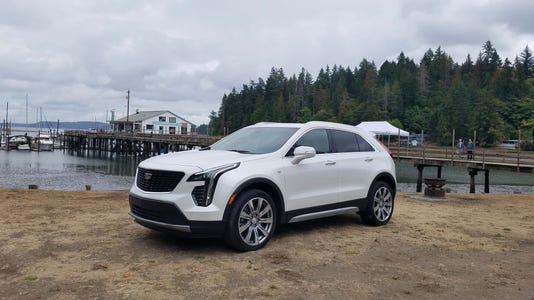
Small utes are all the rage. Since Buick innovated the segment with its Encore cutie in 2013, everyone jumped into the pool: BMW X1, Infiniti QX30, Mercedes GLA, Mazda CX-3, Jaguar E-Pace, Audi Q3. Everyone, it seemed, but that icon of American luxury, Cadillac. While the Encore reinvented Buick — That’s a Buick? — as an SUV brand, Cadillac focused on building an image of style and performance from a sedan foundation.
Now at last comes the 2019 Cadillac XT4 subcompact crossover, and it was worth the wait. Right out of the nest, it’s a serious contender.
Flogging the XT4 all over Seattle I found the wee ute has learned from its class peers to deliver the sweet spot in size, handling and ergonomics. To my friends who embraced Caddy’s edgy style, but then ran screaming from its knobless, slider-controlled CUE (Cadillac User Experience) infotainment system — you can come back now. The new rotary remote-and-knob controlled touchscreen is a thing of beauty.
When I first shook hands with the little ute at the New York auto show earlier this year, I wasn’t sure the XT4 was up to the task. In the shadow of celebrity debuts like the mighty turbo-V8 CT6 V-Sport, bling-tastic Ford Aviator and luscious Maserati Levante, the XT4 seemed overwhelmed.
But in its natural, road-going habitat, Cadillac’s pup has presence.
“Where can I get one of those?” a passerby asked as I emerged from the XT4 near Seattle’s downtown farmers market. The XT4 is a mature expression of Cadillac’s distinctive Art & Science design — handsome, but with a dose of Motown swagger.
The XT4 wants to be noticed. Its face features a big, grinning grille framed by LED-studded, vertical peepers that would make Elton John proud. The XT4 went into big-brother Escalade’s huge walk-in closet and pulled out the neon “tornado lights” that are the three-row SUV’s signature.
My favorite trim is the wicked Sport model in all-black with big 20-inch wheels, black grille, black suit, black rocker panels — and those white, vertical LEDs in front and white verticals in the rear. Hello, X-Man, shall we go fight some bad guys?
The Sport’s brooding intensity contrasts nicely with the other “Y” spoke in the Cadillac trim-tree — the Premium Luxury with its chrome accents, shimmering grille and red taillights.
Branching, Y-like, from the competitively priced $35,790 front-wheel drive base model, the contrasting PreLux and Sport trims both gain all-wheel drive for the same $40,290 price. Look for the Sport “branch” to sprout a V-series twig to take on BMW’s M performance badge.
The XT4’s gym-toned bod is a good foundation for such future aspirations.
Mind you, this is no rear-wheel drive based, longitudinal-engine Baryshnikov. Such SUV athletes (Jaguar F-Pace or BMW X3) are found only in the bigger, compact segment. Space is at a premium in subcompacts, so even Jaguar and BMW have succumbed to front-wheel drive platforms with transverse engines.
For all-out athleticism, the X1 leads the subcompact pack, but the XT4 is at its heels.
Over the undulating rural hills and valleys of Seattle’s Bainbridge Island, my X-tester was sure-footed and fun to drive even as the Pacific Northwest’s persistent cloud-cover slickened the roads. When the rain turns to ice and snow, Cadillac has fortified the all-wheel drive DNA of the ATS with dual rear clutch-packs.
The clutches can throw 100 percent of rear torque to either side to prevent one wheel from spinning helplessly — in a ditch, on ice or on snowpack — and get you moving again.
Acceleration from the 2.0-liter turbo four-banger is brisk as the XT4 puts down a class-competitive 258 pound-feet of torque eclipsed only by the Jaguar. That also means impressive 3,500-pound towing capacity for a segment in which some wee competitors don’t encourage towing. Go ahead, hook up a couple of ATVs for a weekend up north. Or throw two golf bags into the raked, tornado light-equipped hatch if that’s your sport of choice.
But it’s the interior’s attention to detail forward of the cargo bay that really wows.
The entry-level ATS sedan was small in the back seat. Cadillac learned from its mistake. The XT4 is roomiest in class and your basketball-playing 6-foot-5 reviewer could easily sit behind himself — and sit up straight under a full-length, optional moonroof that brings welcome light to the rear cabin.
Speaking of which, engineers nixed the rear-quarter glass to improve driver visibility with one seamless window aft of the b-pillar. More clever details? The front doors are designed to store umbrellas (shades of Rolls-Royce) for the Seattle rains. Only in standard features does the XT4 (like its Chevy and GMC kin) come up short as it fails to offer standard adaptive cruise-control or blindspot-assist that can be found on mainstream cars under $30,000.
If buyers shop up to the compact ute class and the sensational new, larger but just-as-sporty Acura RDX, they’ll notice it offers standard all-wheel drive, full moonroof and adaptive-cruise for just $38,325.
Cadillac has turned its Achilles heel, CUE, into an advantage here. Rather than reinvent the wheel (Acura chose a complicated, mouse-pad solution), Caddy’s infotainment system brings the best from the touchscreen and remote rotary-dial camps. Like Jeep’s Connect system, the screen is fast and easy to navigate when stopped — then easy to control by rotary dial when moving.
Throw in a space-saving monostable shifter and the console offers a storage cubby for your phone or fries. This slavish attention to detail reminded me of another stylish subcompact, the Volvo XC40. But ride the Swede hard and its uneven transmission and pedestrian chassis can’t keep up.
The XT4 is the total package. It offers first-class amenities for long drives with smooth power and handling for when the road gets twisty.
The roomy, user-friendly, nimble BMW X1 took two generations to become the class standard. The XT4 finally offers a no-compromise competitor — and Cadillac got it right on the first try.
2019 Cadillac XT4
Vehicle type: Front-engine, front- and all-wheel drive, five-passenger SUV
Price: $35,790 base ($52,285 Premium Luxury AWD and $56,835 Sport AWD as tested)
Powerplant: 2.0-liter turbo 4-cylinder
Power: 237 horsepower, 258 pound-feet torque
Transmission: 9-speed automatic
Performance: 0-60 mph, 7.0 seconds (mfr.)
Weight: 3,660 pounds (FWD, mfr. estimate)
Fuel economy: EPA fuel economy: 25 city/30 highway/27 combined
Report card
Highs: Sculpted good looks; CUE goes to head of class
Lows: Big back seat squeezes cargo room; more standard features, please
Overall: 4 stars
GMC Sierra pickup moves uptown
Posted by Talbot Payne on September 18, 2018

St. John’s, Newfoundland – With the all-new, 2019 Sierra pickup, GMC is moving uptown, putting significant room between itself and working-class sibling Chevrolet Silverado.
Boasting unique features, a flashy wardrobe and transaction prices that would make Mercedes green with envy, GMC is effectively establishing itself as America’s only premium truck brand. At a time when fat truck profits are crucial to Detroit Three investments in autonomous and electric vehicles, GMC is complementing its deluxe Denali and SLT menu with an expensive, off-road offering called the AT4.
“We’re finding customers stepping out of Mercedes and BMW sedans and wanting to get into this beautiful, premium, high-powered truck,” said GMC design chief Matt Noone in Newfoundland’s port of St. John’s where the Sierra was introduced to media. “The success for Denali has outstripped all our expectations. The (market) appetite for premium trucks is something we’re focusing on.”
General Motors’ success in promoting GMC and its Denali badge, say analysts, is a shrewd reading of a market where truck customers demand luxury – but still value the ruggedness of trucks.
GMC is succeeding where Cadillac and Lincoln failed in the early 21st century by providing a pickup truck that rivals German luxury automakers in profit margin.
Named after the largest mountain peak in the United States (also known as Mt. McKinley), the Denali trim was introduced on the GMC Yukon SUV in 1999 to compliment the palatial Cadillac Escalade SUV launched a year prior. The badge was added to the Sierra lineup in 2001.
As the market has moved to SUVs after the Great Recession, the General positioned GMC — and Denali — to catch the wave with its midsize Acadia and compact Terrain utes.
Denali growth has been meteoric.
Since 2013, sales have nearly doubled from 74,795 units to 140,403 last year. The average Denali transaction price in 2017 was a stratospheric $55,656 — higher than Mercedes, BMW and Audi.
Ford and Ram compete against the Sierra with successful, premium trims like the F-150 Platinum and Ram 1500 Limited.
So coveted is GMC’s premium image that it has transformed the brand. Where the standard, $40,000 SLE retail trim was once 40 percent of sales, it has shrunk to just 9 percent of Sierra volume. Meanwhile, the posh SLT and Denali trims now account for 75 percent of sales, says marketing boss Phil Brook. Denali alone – which starts at an eye-watering $59,495 – accounts for 20 percent of Sierra sales.
Noone says the clean-sheet, 2019 Sierra gave the truckmaker the chance to push the envelope over its Chevy kin.
“Customers told us – you have this great brand, you need to do more with it. We would like the truck to look different, feel different. It has features you can’t get on a Chevy – or any other truck.”
GMC is following a path familiar to luxury carmakers like Lincoln, Acura, and Lexus: It shares a base architecture with the mainstream Chevy Silverado pickup – then enhances its with styling and unique features.
“This is the biggest separation between GMC and Chevy we’ve seen,” says analyst Brinley. “The only sheet metal they share is a rear door, roof and rear bumper — and GMC is getting technology ahead of Chevrolet.”
The Sierra’s exclusive MultiPro tailgate is an engineering marvel – essentially two tailgates in one that can be configured into a stand-up desk, lumber load stop, or entry staircase into the pickup bed.
The new AT4 off-road trim gains a 6.2-liter V-8 over its 5.3-liter V-8 Chevy Trail Boss cousin. It will also be optioned with a carbon-fiber bed, a light, durable material usually found on exotic performance cars.
“With Denali, we have focused on premium, on luxury,” said Noone. “But we also have 100 years of delivering ruggedness, so we’re bringing an AT4 that focuses on capability. The carbon-fiber bed is the strongest box we’ve ever done. “
While Cadillac has struggled to gain traction against German lux-makers, GMC is racking up luxury-like sales. Denali sales alone were just 14,000 units shy of the entire Caddy division. According to Bloomberg News figures, the average GMC vehicle sells for about $44,000, almost 40 percent higher than the average US transaction.
The Sierra Denali pickup will top out at over $67,000. But while the Cadillac Escalade SUV can push $100,000, don’t expect luxury makers to move into the pickup space anytime soon.
Both Cadillac (the Escalade-based EXT) and Lincoln (the Blackwood and Mark LT) introduced pickups in 2002. They were discontinued earlier this decade after poor sales.
“When it’s been a luxury brand trying to deliver on a pickup truck, it hasn’t been successful,” said IHS Market’s Brinley. “Pickup buyers want to have faith in their capabilities, but they don’t want a Cadillac truck. They want their truck brand, and then they want to reward themselves.”
Even Mercedes, which sells its mid-size X-Class pickup truck in Europe and Latin America, has no plans to compete against Detroit’s premium titans in the US market.
“I think Mercedes would struggle here,” says Brinley.
Henry Payne is auto critic for The Detroit News. Find him at hpayne@detroitnews.com or Twitter @HenryEPayne. Catch “Car Radio with Henry Payne” from noon-2 p.m. Saturdays on 910 AM Superstation.
Payne: Hyundai Kona is nutty outside, meaty inside
Posted by Talbot Payne on September 13, 2018
For those of us who mourned the passing from the American market this year of the defiantly funky Nissan Juke, there is good news — the Hyundai Kona is here.
The frog-eyed, multi-colored, fun-to-drive Juke was an early entrant in the subcompact ute-stakes along with other quirkboxes like the Kia Soul, Nissan Cube and Scion xB. The Juke thrilled us with its taut chassis, 188 horses, and — um — unique wardrobe. Remember the mustard interior?
But as we Yanks have gone whole-hog for SUVs, the subcompact class is no longer an outlier but a full-blown, entry-level mainstream class.
It’s now populated by respectable five-doors like the Ford Ecosport, Honda HR-V, Subaru Crosstrek and Chevy Trax. These latest cute-utes carry familiar family DNA. Even Nissan has gotten the mainstream fever by ditching the alternative R&B Juke box for the more mainstream classical Kicks.
I get it. Mass audiences require a broader taste. No mainstream station survives on a steady diet of Devo. Ya gotta play the Beatles and Springsteen and Swift. Is there still room in subcompact utes for outrageous?
Well, slip into a Lime Twist Hyundai Kona, crank up “Whip It” on Apple CarPlay, dial in all-wheel drive, and let’s play in the twisties.
Whip it! Whip it good!
To be honest the sub-ute class is hardly devoid of character despite the dropouts. The class has a bit of everything from the aforementioned mainstreamers to the athletic Mazda CX-3 to the funkadelic Toyota CH-R.
“It’s a wild, wild west segment,” says Hyundai chief engineer Mike O’Brien. “It’s all over the place in size and capability. What is the ideal set of attributes?”
For Hyundai, the ideal – to squeeze my music metaphor one more time – is to borrow from different genres to create a pleasing whole. The Kona is classic Hyundai set to a hip-hop dance beat.
But where Kia’s halo car trickles down to smaller fish like the Forte and Sportage, Hyundai’s halos bubble upwars like a ground spring. Like Mazda and its MX-5 Miata.
Credit elves like O’Brien, a serious motorhead restoring his own open-wheel race car, who has a passion for performance and has used every tool in Hyundai’s box to make Kona worthy. Kona joins the three-door Veloster quirkster I reviewed in June as entry-level, $20,000-somethings that introduce customers to the brand with funk ‘n’ spunk. They share drivetrains, value and attitude. Lots of attitude.
My Kona tester looked like a supersized Hot Wheels tester with its lime paint job and show, five-spoke wheels. The front end isn’t shy either, adopting a three-shelf headlight stack – last seen on the 2014 Jeep Cherokee – that glues on the running lights where the headlights usually sit.
The rear is no less radical with two stacks of taillights framing the license-plate stamped rear hatch.
With the white, front running lights ablaze next to a gaping, Veloster-like grille, the Kona looks like the demonic Chernabog from Disney’s “Fantasia” (look it up). Which would fit with O’Brien’s anthropomorphic description of the styling as “urban smart armor that shows the bones — the exoskeleton of the vehicle.”
Makes ol’ froggy Juke seem downright cute by comparison.
The Hyundai’s slashing lines and heaping dose of cladding does indeed give the appearance of skin stretched over a carcass. There is no mistaking this car on the road – if you can keep up with it.
The Kona may have spent a lot of time dressing up in front of a mirror, but it put in the hours at the gym, too. Although its sits higher off the ground than cousin Veloster, Kona is eager to tackle curvy roads. It is quite comfortable chasing other athletes in the class like CX-3 and CH-R, but Hyundai has gone them one better – it’s has provided the driveline to match its chassis ambitions.
Where Toyota and Mazda stop with 2.5-liter 145-horse four-bangers, Hyundai offers the same pair of engines offered with the sporty Veloster – a 143-horse, 2.0-liter 4-banger and a stonkin’ 175-horse, 193-torque, 1.6-liter turbo.
My tester came equipped with the latter, turning the lime into a red hot chili pepper out of corners, the smooth, seven-speed automatic downshifting in sync with my lead foot. This turbo is mated to a standard all-wheel drive system — standard, because that’s what you want out of an SUV, after all.
What I wanted was maximum traction with the four’s pony-power, so I kept the system set to “full-time all-wheel drive.”
This lovely drivetrain is controlled from a startlingly mature cockpit. The transition from the fan boy exterior to the cabin is abrupt. Green accents are tastefully distributed around the push-button starter and console, but otherwise the inside is all grown up with iPad-like touch-screen and silver-ringed instrument dials. Console space is ample, the seats comfortable, the value impressive.
Like fellow mainstream brands, Hyundai loaded my $29,775 tester with electronic features that would challenge some luxury marques costing twice as much.
Automatic windshield wipers and high beams, smartphone connectivity (who needs a nav system?), head-up display, auto braking, blind-spot assist…
(Pause to catch breath)
… dual-climate control, heated seats, sun roof, Amazon Echo remote start/commands, and best-in-class 10-year/100,000 mile drivetrain warranty. Options aside, buyers at the starting price of just $20,480, get good fundamentals like best-in-class cargo room.
The Kona – which at first appears a green-hair Dennis Rodman shock jock – turns out to be a well-rounded, Grant Hill all-star.
While Mrs. Payne wouldn’t be caught deal in Lime Twist, she did concede that the loaded Kona reminded her of her equally value-rich Subaru Impreza hatchback. All-wheel-drive, Apple CarPlay, heated seats — all the stuff she counts on day-to-day.
And she wasn’t bothered by the higher seating position, perhaps because – like her lower Subaru – the Kona is so well screwed together.
The Kona is reminiscent of the Subaru Crosstrek, the Impreza hatch’s body double – just raised a couple inches and layered with fender-cladding to give off that coveted crossover vide. Paint the Kona more conventional Surf Blue or Thunder Gray and it might almost seem conventional compared to the more conservative Subaru.
But for those of you in Juke withdrawal, you’ll want the Lime Twist.
Henry Payne is auto critic for The Detroit News. Find him at hpayne@detroitnews.com or Twitter @HenryEPayne. Catch “Car Radio with Henry Payne” from noon-2 p.m. Saturdays on 910 AM Superstation.
2018 Hyundai Kona
Vehicle type: Front-engine, front- and all-wheel drive, five-passenger SUV
Price: $20,480 base ($29,775 Ultimate AWD as tested)
Powerplant: 2.0-liter inline-4 cylinder; 1.6-liter Turbo-4
Power: 147 horsepower, 132 pound-feet torque (2.0-liter); 175 horsepower, 195 pound-feet torque (1.6-liter Turbo-4)
Transmission: 6-speed automatic (2.0-liter); 7-speed, dual-clutch automatic (1.6-liter)
Performance: 0-60 mph, 6.67 seconds (Car and Driver); top speed: 135 mph
Weight: 3,344 pounds (Ultimate AWD Turbo-4 as tested)
Fuel economy: EPA fuel economy: 25 city/30 highway/27 combined (4WD 2.0-liter); 26 city/29 highway/27 combined (4WD 1.6-liter)
Report card
Highs: Versatile cargo space; fun to flog
Lows: Quirky styling; more console cubbies, please
Overall: 4 stars
Roush JackHammer Mustang joins the 700 (hp) Club
Posted by Talbot Payne on September 10, 2018

Plymouth — In the Detroit horsepower wars, the 2015 Dodge Hellcat was the first to unbridle 700 ponies, followed by Chevy’s 755-horsepower Corvette ZR1 this year. Ford is expected to join the club with its earth-pawing, 700-plus horsepower Mustang GT500 early next year.
Call it the Meg. But for those who can’t wait, Ford mod shop Roush has dropped a 710-horse Snake on dealerships for 2018: the supercharged JackHammer Mustang.
Based on the GT model, the new JackHammer makes 710 horsepower and 610 pound-feet of torque thanks to a massive supercharger mounted on top of the already capable 5.0-liter V-8.
A rocket ship on wheels, I tested the beast in its native Plymouth habitat. Armed with a 6-speed manual transmission, smoky burnouts are easily induced out of stoplights (a 10-speed automatic is also available). The added horsepower overwhelms the rear tires even with the nanny systems turned on. Merge with authority onto I-96 and the Jackhammer gulps traffic like a whale ingests krill.
The JackHammer, named after the mad doctor Jack Roush himself, is the latest Frankenstein’s monster to emerge from the legendary mod shop here. Roush has a special partnership with Ford that allows customers to order a Roush-modified Mustang for dealer delivery with other trims like the turbocharged 4-cylinder Ecoboost or movie-inspired Bullitt.
Customers can choose a Stage 1 kit that modifies the suspension and exterior of an turbocharged-4 cylinder Ecoboost — or a Stage 2 kit that does the same to a Mustang GT. But the JackHammer is the only package that comes with the Full Monty: body mods, suspension tuning and supercharged mill.
Both Suburban Ford of Ferndale and Hines Park Ford in New Hudson are certified Roush dealers in the Metro Detroit area.
The JackHammer is not the first time Mustangs have eclipsed 700 horsepower. Roush entered 700-horsepower territory with its 727-horse P-51 special edition last year. The package cost over $42,000 and only 51 were built. In even rarer air is the $113,445 Super Snake from Shelby’s Vegas tuner shop which buys you 710 horsepower with an upgrade option to a claimed 800 horsepower.
Roush will make 200 Jackhammers for 2018. But if they run out, don’t panic because the company begins manufacture of a 2019 model Stage 3 Mustang this October. It will carry similar specs right down to the 710-horse engine, adjustable shocks and sticky Continental ExtremeContact Sport tires.
Though the Corvette ZR1 is king of the 700 horsepower club, the Roush ponies are clearly aimed at the 717-horse Dodge Challenger SRT Hellcat.
The Hellcat is already legend, but its aging chassis weighs in at a porky 4,439 pounds. Even when outfitted with supercharger and additional cooling equipment, the JackHammer should weigh less than 3,800 pounds on Mustang’s new sixth-generation architecture.
Pushing the Jackhammer around interstate cloverleafs, that lighter weight is noticeable as the rear-drive Mustang rotates beautifully under throttle. Beware full throttle, however, as 710 horses easily induce wheelspin.
Roush claims the JackHammer is capable of 1.07 Gs in cornering loads, which puts it in good handling company with the track-tuned factory Mustang GT350 and Chevy Camaro ZL1. Based on the same, nimble platform as the sensational Cadillac ATS sedan, the Camaro is in another league in handling, rivaling luxury performance weapons like the BMW M4.
But there is nothing as distinct as a Mustang V-8 soundtrack, and the JackHammer roars under throttle like a T. rex after Jeff Goldblum. Roush offers an Active Exhaust tuning option that allows drivers to turn up the sound to Touring, Sport, Track and Custom modes.
That ought to keep us occupied until the Meg arrives.
Payne: GMC Sierra wows with Swiss Army tailgate
Posted by Talbot Payne on September 6, 2018

ravel to Newfoundland, and the friendly locals will adopt you as a “Newfie” after a “screech-in” ritual that includes the kissing of a cod.
“Are ye a screecher?” demanded the chief of ceremonies as I wiped my lips of the fish.
“Indeed I is, and long may your big jib draw,” I responded, reciting the required vows. “Big jib” is a large boat sail. Translation: May the wind always be at your back.
GMC brought members of the automotive press to this rocky North Atlantic isle this summer for the launch of its totally re-imagined Sierra. The big pickup has long been an honorable Newfie with its handsome looks, rugged capability and smooth ride. It’s going to be adopted by a lot of customers around the rest of North America, too.
This is the Year of the Truck and each of the Detroit Three is bringing new pickups. Ford has it first diesel F-150. From Ram comes a stylish 1500. And from GM, the brawny Chevy Silverado/GMC Sierra identical twins.
Except, the twins aren’t so identical anymore.
As the years have gone by, Silverado and Sierra have diverged to the point where they are fishing for different customers. Chevy is the populist choice, populating worksites with work trucks for working stiffs. GMC is the managers’ brand, delivering architects, construction foremen and company owners to the site — its big, chromed bow announcing its business-class passenger.
Sierra may start around $30,000 like its Chevy twin, but a mere 9 percent of GMC sales are the affordable SLE trim. Its upscale Denali and SLT wardrobes account for a whopping 75 percent of sales, says GMC marketing guru Phil Brook. So synonymous is Denali with GMC that customers simply ask for Denali. Like BMW speed-freaks say they want an M. Or Mercedes motorheads want an AMG.
The GMC customer wants something different and, boy, do they get it with the 2019 pickup. For the Year of the Truck, GMC brings the Year of the Box.
The General has already made news with Silverado’s expanded, Brobdingnagian, rolled-steel bed. The bed is the working end of the pickup, the head of the hammer. “I don’t think we’d get much work done with an aluminum hammer,” GM product captain Mark Reuss said at this year’s Detroit auto show, hammering away at the F-150.
Sierra caps the steel box with the innovative MultiPro tailgate. Exclusive to Sierra and standard on upper trim Denali and SLT, the MultiPro is a gate within a gate.
It’s a six-way Swiss Army knife of versatility:
1. The inner gate drops, forming a shallow, chest-high shelf. Not as expansive as the full “tailgate party” drop, it can act as a rear workspace — or mini-bar.
2. With the inner gate open the shelf will rotate vertically, creating a load-stop for boards or plywood that otherwise hang awkwardly over the tailgate.
3. The full gate drops slowly on cables like a standard pickup (a new auto-close trick is exclusive to Silverado).
4. With the full gate open, the inner-gate shelf can again be propped open to create a lower load-stop. For large loads with the truck, I preferred the taller load-stop so I could put the heavy stuff in the bed of the truck — then long, load-stopped boards on top of them.
5. With the full gate down, drop the inner gate to create a sort of “walk-in desk.”
6. With the full gate and inner gate down, the load-stop shelf now acts as a step creating a two-step staircase into the bed. GMC/Chevy were already innovators in this space with their corner step — but the staircase makes easy bed entry when carrying big items. Say goodbye to hiking your knee up onto the tailgate to get in the bed.
The MultiPro gate is as cool as it sounds. Not since Audi’s slick, multi-functional Virtual Cockpit display and Tesla’s 17-inch screen have I so enjoyed playing with an accessory.
But where the Audi/Tesla function is ultimately an aesthetic luxury, the Sierra’s premium tailgate is must-have, truck utility.
Other accessories push beyond premium to luxury. The Sierra reaches into Cadillac’s toolbox for a giant head-up display and rear camera mirror — the latter giving drivers an unobstructed view of bed and trailer. A swiveling side step (also available on Silverado’s High Country trim) allows better access to the front bed quarter. And the bed will also be available in carbon fiber — an exotic, lightweight material typically found on sports cars. For Sierra, carbon means a material even more durable than steel.
Speaking of sports cars, my Denali had a similar 6.2-liter V-8 to the Corvette. Paired with a 10-speed and spitting out 460 pound-feet of torque, it was as silky as the Sierra’s wardrobe. Dress a Chevy Silverado in a tuxedo and it’s good-looking. If it can do a six-way tailgate, wade streams with 1,600 pounds on your back and go zero-60 in less than six seconds, it’s a celebrity.
Heck, if James Bond ever needs a gorgeous, versatile pickup, Q might deliver him a Sierra Denali.
Or a Sierra AT4. The latter is Sierra’s latest premium trim — a skid-plated, off-road version packing two extra inches of lift, that big honkin’ V-8 and knobby off-road tires. If Newfies don’t need their Sierra to load fish, then they can take this brute inland to chop Christmas trees.
My MultiPro-accessorized Sierra starts just $1,700 north of a $57,795 High Country Silverado. The looks alone are worth it. The remade, high-strength steel chassis is not just 380 pounds lighter than the last generation, it’s allowed designers a bigger canvas to differentiate it from the humble Chevy. Behold the sculpted flanks and C-shaped headlights, and an upright hood that rivals the Ram 1500 for best-looking truck on the road.
Sierra customers may be surprised to find the interior is little changed from the Silverado. Still, that also means it gets the same three-inch boost in rear legroom over last generation, rear-seat storage compartments and connected console.
Sierra beats kissing a cod. It’s a whale of a truck.
Henry Payne is auto critic for The Detroit News. Find him at hpayne@detroitnews.com or Twitter @HenryEPayne. Catch “Car Radio with Henry Payne” from noon-2 p.m. Saturdays on 910 AM Superstation.
2019 GMC Sierra 1500
Vehicle type: Front-engine, rear- and four-wheel drive, five-passenger pickup
Price: $31,095 base ($67,200 Denali, 6.2-liter V-8, 4WD Crew Cab as tested)
Powerplant: 4.3-liter V-6; 2.7-liter Turbo-4; 5.3-liter V-8; 6.2-liter V-8
Power: 285 horsepower, 305 pound-feet torque (4.3-liter V-6); 310 horsepower, 328 pound-feet torque (2.7-liter Turbo-4); 355 horsepower, 385 pound-feet torque (5.3-liter V-8); 420 horsepower, 460 pound-feet torque (6.2-liter V-8)
Transmission: 6-speed automatic (V-6, 5.3L V-8); 8-speed automatic (Turbo-4, 5.3L V-8); 10-speed automatic (6.2L V-8)
Performance: 0-60 mph, est. 5.7 seconds; Towing: 12,100 lbs. (4WD 6.2-liter V-8 Crew Cab, mftr); Payload: 2,070 lbs. (4WD 6.2-liter V-8 Crew Cab, mftr)
Weight: 4,797 pounds, base, 2WD Crew Cab (5,015 pounds (4WD, Crew Cab as tested)
Fuel economy: EPA fuel economy: 15 city/21 highway/17 combined (4WD 5.3L V-8); 15 city/20 highway/17 combined (4WD 6.2L V-8)
Report card
Highs: Head-turning looks; Swiss Army knife meets tailgate
Lows: Interior still too Chevy-like; how come the interior wood trim is buried in the dash?
Overall: 4 stars
Payne: Hearty Chevy Silverado serves meat and potatoes
Posted by Talbot Payne on September 6, 2018

I love the pickup wars for the same reason I love muscle car bouts. Both are uniquely American segments boasting big engines, big capability, and Big Three automakers clawing at each other to be King of the Hill.
The Battle of Muscle has been white hot in recent years as General Motors, Ford and Fiat-Chrysler introduced their latest weapons — Chevy Camaro, Ford Mustang and Dodge Challenger — boasting state-of-the-art performance. The three brands bring unique talents and flag-waving partisans scream themselves hoarse urging them on. Crossing sides is a traitorous act — the partisan divide makes D.C. politics look like tiddlywinks.
Camaro partisans cheer their warrior’s handling, Mustang fans adore their gorgeous-styling, and Challenger faithful recite Herculean horsepower figures. When the armies clash and the V-8s roar, you can hear them for miles. They are light infantry compared to pickup battles.
The Truck Wars are far more consequential because, with millions of sales at stake, they are the core moneymakers of Detroit’s Three. Tens of thousands of standard pickups are sold every year to company fleets, flooding the landscape with worker ants doing the daily essentials of American commerce: building, landscaping, towing.
With this summer’s introduction of the long-awaited 2019 Chevy Silverado pickup, the truckmakers — like their muscle car cousins — have finally lined up their state-of-the-art steeds.

While Detroit pickups are loaded with power, tech and 4WD capability, they have distinct signatures. The Ford F-150 struts high-tech with an aluminum body, turbocharged engines and semi-autonomous trailering. Ram (independent of Dodge since 2009) wows with knockout looks, sculpted logos and a Tesla-like, iPad console. GMC’s Sierra wows with style and 6-way bed (tune in for next week’s review).
Chevy? It’s the meat and potatoes brand.
Eschewing the exotic tech and jewelry of its cross-town rivals, Silverado is an all-around star — a fundamentally sound, reliable utility player that does everything well. So good are its fundamentals, in fact, that you wish it would borrow a little flash from its Chevy Camaro and Bolt EV siblings.
Take Silverado’s rock-solid chassis.
When Ford introduced its tin F-150 four years ago, all the smart people declared it was a game-changer. Aluminum was the future. Chevy and Ram had to follow. And like with so many things these days, the smart set was wrong. Silverado’s exterior plating consists of aluminum doors, hood and tailgate to be sure — but the core body is virtually all high-strength steel.
Using innovative welding to bind the bits together, Chevy makes the lightest, most athletic bod in town. The extraordinary engineering reminds of cousin Camaro — hands down the best-handling pony car ever — as I tossed the big brute around the Teton mountains outside of Jackson, Wyoming.
Utilizing hydraulic engine mounts and softened leaf springs, my Silverado LT Trail Boss felt small under my whip, the behemoth rotating through hairpin turns, then downshifting smoothly to stay in the meat of the V-8’s torque band.
It’s a Camaro with a bed.
I pined for more. Imagine if Chevy exploited the Silverado’s gym-toned physique as it does the Camaro. Rather than limiting the Trail Boss performance model to a 5.3-liter V-8, what if Chevy gave it a supercharged, 6.2-liter engine like the Camaro ZL1? Or a battery pack like Volt for low-end torque?
Silverado is content in the meat of the market. Starting with the segment’s meatiest bed.
In a true test of Ford customer loyalty, Chevy bounced a tool kit off Ford’s box — puncturing holes in the tin. Ford customers yawned and snapped up the F-series in record numbers. But the demonstration left no doubt of the Silverado’s toughness with beds made out of rolled steel.
“The working end of every pickup is the bed. It’s like the head of a good hammer,” said GM product boss Mark Reuss, when introducing Silverado last January. “I don’t think we’d get much work done with an aluminum hammer.”
Oh, these war generals are tough. Reuss & Co. backs up the steely talk with truckdom’s biggest bed and most versatile tailgates. Silverado scalloped out fistfuls of room, adding seven inches of width and a whopping 12 tie-downs.
Where Ford wows with optional side-rail cleat tech and Ram packs the rails with toolboxes, Silverado just goes yuge. The standard Chevy bed is bigger than competitors’ long boxes. Meat and potatoes stuff.
Beyond the bed, Chevy is content to upgrade its cameras and sensors (auto check of your trailer’s tire pressures!) for better tow management, but doesn’t bother to counter Ford’s semi-autonomous trailer backup innovation.
Elsewhere, Silverado doesn’t shy from tech, and its automatic liftgate is a first, complete with remote operation. Other firsts include an available, 2.7-liter turbo-4 engine (old nail V-6 is the base) and head-up display.
Premium-trim interiors pale in comparison to the exquisite suites found in competitors like F-150 (cowboy-chic stitching) and Ram (12-inch tablet screen). The Silverado High Countrys I tested weren’t obviously different inside than the 10-grand cheaper, black LT — its seats and console devoid of fancy embroidery.
Chevy would rather talk to you about its cavernous rear seat (expanded 3 inches courtesy of that clever chassis) where you can spread out while on the work site, working on your laptop via 4G Wi-Fi connectivity and scanning documents on the scanner you stored in the clever storage bins integrated into the seatbacks.
The exterior is more aesthetically pleasing, if still not up to the standards of GMC’s Sistine Chapel grille. The old, blocky fenders have been smoothed out with some beautiful stampings, while narrow LED lights — more Camaro inspiration here – lend the grille a touch of grace and menace.
The LEDs come in with the mid-level, LT option. The trim packaging is part of a major expansion that groups Silverado’s diverse, 585,000-strong customer base into three groups: Work truck (corporate fleet customers), LT (small biz owners, off-roaders), and high trim (LTZ and High Country society).
There’s a truck for every taste as long as you like meat and potatoes. Eclectic tastes looking for Raptor speed or King Ranch cream can go elsewhere.
Put on your jersey, bring your beverage cooler, and get a seat at the pickup wars. It’s gonna be good.
Henry Payne is auto critic for The Detroit News. Find him at hpayne@detroitnews.com or Twitter @HenryEPayne. Catch “Car Radio with Henry Payne” from noon-2 p.m. Saturdays on 910 AM Superstation.
2019 Chevrolet Silverado
Vehicle type: Front-engine, rear and four-wheel drive, five-passenger pickup
Price: $36,095 base ($54,095 LT Crew Cab 5.3-liter V-8 and $62,290 High Country Crew 6.2-liter V-8 as tested)
Powerplant: 4.3-liter V-6; 2.7-liter Turbo-4; 5.3-liter V-8; 6.2-liter V-8
Power: 285 horsepower, 305 pound-feet torque (4.3-liter V-6); 310 horsepower, 328 pound-feet torque (2.7-liter Turbo-4); 355 horsepower, 385 pound-feet torque (5.3-liter V-8); 420 horsepower, 460 pound-feet torque (6.2-liter V-8)
Transmission: 6-speed automatic (V-6, 5.3L V-8); 8-speed automatic (Turbo-4, 5.3L V-8); 10-speed automatic (6.2L V-8)
Performance: 0-60 mph, est. 5.7 seconds; Towing: 12,200 lbs. (4WD 5.3-liter V-8 Crew Bac, mnftr); Payload: 2,180 lbs. (2WD 5.3-liter V-8 Crew Bac, mnftr)
Weight: 5,008 pounds (4WD, 5.3-liter V-8 Crew as tested)
Fuel economy: EPA fuel economy: 15 city/21 highway/17 combined (4WD 5.3L V-8); 16 city/20 highway/17 combined (4WD 6.2L V-8)
Report card
Highs: Big bed, big interior; fun to drive
Lows: Homely grille designs; supercharged Raptor fighter, please?
Overall: 4 stars
Happy birthday, Cadillac Escalade
Posted by Talbot Payne on August 31, 2018
The Cadillac Escalade debuted 20 years ago with all the subtlety of Shaq O’Neal jumping out of a birthday cake.
Introduced at the prim-and-proper Pebble Beach Concours d’ Elegance in California, the pickup-based, three-row land yacht shocked polite society as the most outrageous SUV the world had ever seen. It was a throwback to the tail-finned behemoths of Cadillac’s 1950s glory days, yet became an icon for a new, 21st-century generation of wealthy rappers, actors, and athletes — including Shaq himself.
Cadillac is celebrating the Escalade’s 20th birthday this summer with a series of prints and a video commemorating four generations of Escalade.
Bigger than a New York apartment and bejeweled with enough chrome to be seen from outer space, the Escalade has been a segment champion for a brand that has struggled to establish itself as an athletic maker of smaller sedans and crossovers like Mercedes, BMW, and Audi.
The best-seller in its segment for 15 of its 20 years, the bling-tastic Escalade delivers about $3 billion a year to Caddy’s bottom line. Sales have topped more than three-quarters of a million in the United States and over 800,000 world-wide. Since 1999, its customers have been the Cadillac’s richest and youngest (average age 52) — bringing new generations to an 116-year-old brand.
The Caddy that put the OMG into SUV debuted in 1998 as little more than a GMC Yukon in a tuxedo. Based on a pickup truck chassis, it was rushed to market to counter the similarly super-sized Lincoln Navigator.
The Caddy’s stature and palatial interior room wowed a world warming to SUVs.
“That combination immediately struck a chord,” says Cadillac president Steve Carlisle. “It introduced Cadillac to an entirely new generation of luxury customers via popular culture and changed perceptions of what the brand could offer.”
By 2003 musicians from Kanye West to Ludacris to Jennifer Lopez were writing about the Escalade. Sang Lopez in her hit “Love Don’t Cost a Thing”:
“When you rolled up in the Escalade
Saw that truck you gave to the valet
Knew that it was game when you looked at me”
Escalade became synonymous with Hollywood celebrity, helping to grow sales by 90 percent with the second-generation model in 2003. By its fifth birthday Escalade sales had ballooned 230 percent. Though it pioneered the mega-ute, Lincoln’s Navigator couldn’t match the Caddy’s celebrity status.
Blinged-out Escalades from urban-ride trend-setter DUB magazine became a staple at auto shows. The ute starred in The Sopranos and Entourage TV shows. Even Tiger Woods was attacked by his golf club-wielding wife in an Escalade.
Not everyone wanted the big Caddy.
It was scorned by media who labeled Escalade a threat to safety and the planet. New York Times reporter Keith Bradsher skewered the beast in his 2002 book “High and Mighty SUVs: The World’s Most Dangerous Vehicles and How They Got That Way,” writing that “it looked like a very large shark traveling down the road with its jaws gaping.”
As Escalade sales approached 40,000 a year in North America, not every model was a success as attempts to expand the badge with pickup and hybrid versions were met with yawns.
The Escalade hybrid might have been single-handedly slain by Paris Hilton’s 2008 “Paris for President” campaign song which included the lyrics:
“Incentivize nuclear nonproliferation and ratify Kyoto today
You can ride in the motorcade in my hybrid pink Escalade
Paris for President!”
Even as sales leveled off at 20k a year, the big Caddy has survived gasoline price spikes and proved that the full-size SUV segment is here to stay. Last year it inspired an all-new, widely-acclaimed Navigator — the first Lincoln to go to-to-toe against the legend in years.
Mainstream models based on the same architecture — the Yukon and Chevy Suburban — have also become profit-rich mainstays unrivaled by foreign makers.
Celebrity fads come and go. As Tinseltown has moved on to other status symbols like the Tesla Model S and Bugatti Veyron, the Escalade has touted technological and stylistic advances.
Escalade introduced an adaptive shock system, Magnetic Ride Control, to full-size utes in 2009, and was the standard bearer for Cadillac’s Art & Science design philosophy in 2014. The majestic ute has been featured prominently in brand advertising and has a large female buying demographic.
At 17-feet long and 6-feet tall, the $75,990 Escalade’s (loaded models can approach six figures) outsized proportions have changed little in 20 years. But the King of Bling, winner of 16 JD Power reliability awards, gets 65 percent more horsepower from its 6.2-liter V-8 and 52 percent better fuel economy (15 mpg vs. 23 mpg) than the ’99 model.
Some things just get fitter with age.
Payne: Chasing McQueen’s tracks in 2019 Mustang Bullitt
Posted by Talbot Payne on August 30, 2018

San Francisco – Driving downhill on Larkin Street high above San Francisco Bay in a 2019 Ford Mustang Bullitt, I understand how “Bullitt” star Steve McQueen missed the right-hand turn onto Chestnut Street. Chestnut flattens out, which surely forced McQueen’s galloping ‘68 Mustang Fastback to push wide. The actor stopped before hitting the far curb, stuffed it in reverse, then peeled rubber down Chestnut in continued pursuit of his prey.
Rather than edit the error, the film’s editors liked its authenticity and kept it in the movie. After pausing at the intersection, I burned rubber down Chestnut — following in the legend’s tracks.
Fifty years ago this October, Warner Brothers released “Bullitt” with McQueen and his four-wheel co-star. The film, produced by McQueen, was a blockbuster.
It will forever be remembered for its thrilling 12-minute car chase for which it won an Oscar for Best Film Editing.
The sequence would cement the Fastback coupe as one of cinema’s great cars along with the “Back to the Future” DeLorean and Ferris Bueller’s Ferrari. A ‘60s sales hit and cultural icon, the Mustang fit McQueen’s vision of making an urban Western in which he “would strap on the car like a gun belt.”
In the 21st century the Bullitt badge has become an essential weapon in the Mustang holster — a reminder both of the pony car’s 1960s origins and its ferocious performance. The 2019 model is the third Bullitt Mustang, following 2001 and 2008 special editions.
I went to the streets of San Francisco this summer to retrace the “Bullitt” chase scene and to strap on the latest Mustang in Ford’s arsenal — the fastest Bullitt yet made.
Taylor Street parallels Larkin through San Francisco’s Russian Hill neighborhood, but is even steeper, descending like a staircase. McQueen and director Peter Yates — both experienced race drivers — ignored Russian Hill’s most famous street, the tight, zig-zagging Lombard. They were intent on filming speed, and arrow-straight Taylor showcased the big block V-8s in McQueen’s 6.4-liter Mustang and the 7.2-liter Dodge Charger he was chasing.
The 2019 Bullitt Mustang has been downsized to 5.0-liters — yet has gained 155 horsepower (equivalent to adding a Mazda Miata engine) over the original’s 325 horses, thanks to relentless engineering advances.
To separate it from its V-8 powered, $36,000 Mustang GT stablemate, the $46,495 Bullitt has gained 20 horsepower over the standard 460. That power also comes higher, in the 7,500-rpm rev range, in order to feed your need for speed.
Avoiding the city’s clotted morning traffic, I took to the streets at 6.30 a.m. I accelerated hard down Taylor, before easing across the stepped, flat intersections. So steep is Taylor that the crossroads must have looked like approaching walls to McQueen and his top-shelf stunt drivers, Carey Loftin and Bill Hickman. The fronts of the Mustang and Charger slammed into the pavement before vaulting — airborne! — onto the next downhill.
With its stiff chassis, sophisticated suspension and independent rear, the ’19 Bullitt is a serious performance car. If you want a quiet, silky ride, this is the wrong rodeo. While the Performance Pack One-enhanced Bullitt (stiffer springs/roll bars, front splitter) lacks the latest tires of the GT’s new Pack Two, the latter’s MagneRide shocks are a marvelous complement to the Michelin Pilot Sport 4S tires.
Though shy of the performance of the current Camaro SS (Hey, Warner Bros, how about a remake of “Bullitt” with Tom Cruise chasing a Camaro?), the Bullitt Mustang is ready for battle, rotating eagerly into corners.
After a game of cat and mouse, the “Bullitt” chase scene is joined when chasee McQueen becomes the chaser — the Mustang’s menacing, cowl grille looming in the Charger hitman’s rear-view mirror. Spooked, the Charger takes off, shedding eight hub caps (a classic of movie-editing trivia) as it tears around corners.
The new Bullitt Mustang is no less threatening.
Mustang chief engineer Carl Widmann pitched the Bullitt four years ago as the then-controversial sixth-gen Mustang debuted to the world. With a its sloped front hood and Fusion-like grille, the new pony was a departure from the retro-styled cowl of yore. Buyers embraced the new look, re-establishing Mustang at the top of the muscle car sales charts.
As the “Bullitt” movie’s 50th anniversary approached, Ford partnered with Sean Kiernan — the owner of the 1968 Mustang used in the movie — to parade the two cars together. Shoulder-to-shoulder in San Francisco, the Highland Green Bullitts are unmistakably family.
Stripped of the Mustang logo, both grilles are menacing, dark voids. The ’68 car’s signature fastback is repeated in the new Bullitt right down to the window angle. The new car’s angled headlights and low front splitter give it menace.
True to its heritage, the 2019 car has the “Bullitt” movie logo stamped on the trunk lid.
The original Bullitt Mustang still has camera mounts under the rocker panels and trunk holes that were cut to power the cameras via generator. The punishing movie-chase sequences were shot, then the cars were transported to Willow Springs race track outside LA, where chase scene sounds were recorded — and dubbed in for the movie.
Inside, the new Mustang’s interior has been transformed with 21st-century electronics offering touchscreen navigation, configurable instrument display, line-lock burnouts, launch control — features that the ‘60s could only dream of.
But just like the original, the new pony only comes with a manual transmission. The cue-ball shifter tells a tale.
In the movie car, McQueen — a Porsche buff — installed a Porsche shift knob. That wouldn’t do for a production Ford Mustang, so Ford adopted the next best thing — a replica of the white shifter Kiefer’s father installed when he bought the car in 1974.
That’s OK. When you shift it into first and pop the clutch, it burns rubber down Chestnut Street like it was 1968.
Henry Payne is auto critic for The Detroit News. Find him at hpayne@detroitnews.com or Twitter @HenryEPayne. Catch “Car Radio with Henry Payne” from noon-2 p.m. Saturdays on 910 AM Superstation.
2019 Ford Mustang Bullitt
Vehicle type: Front-engine, rear-wheel drive, four(ish)-passenger coupe
Price: $47,590 base ($51,385 as tested)
Powerplant: 5.0-liter V-8
Power: 480 horsepower, 420 pound-feet torque (with 93-octane fuel)
Transmission: 6-speed manual
Performance: 0-60 mph, 4.2 seconds (Car and Driver est.); top speed: 163 mph
Weight: 3,705 pounds
Fuel economy: EPA fuel economy: 15 city/25 highway/18 combined (Car and Driver)
Report card
Highs: Movie-star looks; V-8 baritone
Lows: Stiff daily driver; Camaro SS 1LE would run away from it in a car chase
Overall: 4 stars