- Search Cartoons
- Comic Archive
-
Payne
Store



 Henry Payne RSS

Articles
Why Tesla resisted COVID-19 ultimatum to shutter Model Y production
Posted by Talbot Payne on March 21, 2020
Tesla Inc. agreed to shut down production at its Fremont, California, facility by Monday after days of tension with local Alameda County authorities over whether its facility constituted an “essential business” under coronavirus shelter-in-place guidelines.
The automaker was in the middle of the launch of its Model Y electric crossover that one industry analyst deemed “mission critical.”
“We have decided to temporarily suspend production at our factory in Fremont, from end of day March 23, which will allow an orderly shutdown,” Tesla said in a statement to investors.
The shutdown came a day after the EV pioneer pushed back on the county sheriff’s ultimatum in an email to its employees — first reported by Electrek.com — that it was “decreasing onsite personnel … while honoring our government commitment to keep our national critical infrastructure running.”
Tesla had defined “national critical infrastructure” as “business sectors crucial to the economic prosperity and continuity of the United States and includes auto manufacturing and energy infrastructure as defined by the Department of Homeland Security.”
Tesla’s reticence has been in contrast to Detroit-based automakers that have shut down their operations after concerns from United Auto Workers members and their leadership, including President Rory Gamble.
J.D. Power Vice President for Data and Analytics Tyson Jominy says that non-union start-up Tesla is under more pressure to produce because it has a thinner portfolio than traditional luxury automakers and because it usually makes its U.S. shipments at the end of each quarter.
“Model Y production is mission-critical to Tesla,” Jominy said. “They’re missing the bulk of the SUV market and the Model Y will greatly increase their market share. They are being watched more than anyone else by investors.”
He said Tesla’s revenue structure is also different than other carmakers since it sells directly to consumers. Where other companies book sales revenue to dealers as soon as cars leave the factory, Tesla operates its own dealerships and must deliver to customers to receive cash.
Tesla CEO Elon Musk has resisted the idea that the coronavirus is a crisis. Alameda County, population over 1.5 million, reported 35 cases of COVID-19 by Thursday.
In its note to investors, Tesla said basic operations at Fremont would continue after March 23 “in order to support our vehicle and energy service operations and charging infrastructure.” Its Nevada battery gigafactory production is unaffected as is its national Supercharging network.
How the coronavirus brought auto marketing blitzes to a halt
Posted by Talbot Payne on March 21, 2020
Tucson, Arizona — When the last Honda CR-V Hybrid test vehicle was loaded on a car trailer here Friday, the auto industry’s media marketing machine packed up with it.
In an unprecedented seven-day period, automakers in the U.S. market — with one significant exception — shut down their media rollouts of new models to the public to stem the spread of the coronavirus. Like Hollywood’s postponement of new film releases, the delay will stack up introduction of new models and disrupt marketing plans.

Only Tesla bucked the industry trend as CEO Elon Musk downplayed the outbreak as the company’s compact SUV, the Model Y, began delivery to customers. Unlike other carmakers, however, Tesla does not invest in big, media-focused marketing campaigns, so its contrarian view did not disrupt the company’s product plans.
“Out of an abundance of caution, we have made the decision to cancel the Trailblazer drive program for now,” read the General Motors Co. email to the automotive press just four days before the Chevy Trailblazer subcompact SUV’s March 9-14 media test program in Phoenix. GM cited concerns for safety after reviewing recommendations from the U.S. Centers for Disease Control and the World Health Organization.
Cancellation of a California media rollout for the Cadillac CT4 and CT5 luxury sedans quickly followed. Then another big blow the following Monday: the postponement of Cadillac’s first all-electric vehicle, the Lyriq SUV — a product GM hopes will redefine its luxury brand for years to come.
Media reveals and test programs are part of carefully choreographedrollouts to maximize publicity for products that can cost hundreds of millions of dollars to bring to market.
“They are an important way to get key media to understand the products in a short period of time, then write about them,” says veteran auto analyst Karl Brauer, executive publisher of Kelley Blue Book. “That helps customers learn about the car as they arrive at dealerships.”
GM’s cancellations came at the start of a busy spring of introductions, and sent ripples through the industry. An automaker of GM’s size forced other automakers to reassess their own programs.
Tesla Chief Executive Elon Musk was unconcerned, tweeting he same day: “The coronavirus panic is dumb.”
Coincidentally, GM’s action came just days after the producers of the James Bond movie “No Time to Die” delayed its release date from Easter weekend (April 10) to Nov. 25 for fear the film’s box office returns would be severely impacted by the virus.
“The James Bond movie is a metaphor for auto reveals. Movies are released at a specific time for maximum audience exposure,” said Brauer. “You don’t want them all jammed together or they will be stepping on each other.”
That reality was a key factor as Ford, Hyundai and Porsche all pushed forward with their programs the week of March 16-21. But the pressure continued to mount.
On March 10 the New York Auto Show, one of North America’s largest exhibitions with numerous product reveals and over 1 million attendees, threw in the towel.
“For 120 years, ‘the show must go on’ has been heavily embedded in our DNA, and while the decision to move the show dates didn’t come easy, our top priority remains with the health and well-being of all those involved,” said show organizer Mark Schienberg in announcing the show’s first postponement since World War II.
Like “No Time to Die,” it got a new date: Aug. 28 to Sept. 6. Auto products wouldn’t be so lucky.
On Tuesday and Wednesday of last week, members of the media arrived in Tucson for Honda’s CR-V Hybrid program. Unlike other automakers, Honda had not banned executive travel in the U.S., and its program — with just 50 media over two days — would be a compact affair.
It would also be the last for a while.
Friday the 13th opened with Ford pulling the plug on its March 17-18 Bronco plans — a painful step given the importance in spearheading the Blue Oval’s shift from cars to SUVs. The move came after Washington banned European travel and COVID-19 cases continued to rise. “We concluded the issue has taken on a different dimension,” said a Ford representative.
With its German-based executives banned from travel to the States, Porsche followed suit — canceling its March 22 California media test program for its new 911 Turbo S.
Only Tesla remained defiant as Musk reportedly expanded on his March 6 coronavirus tweet with a March 13 email to employees. According to a copy of the email leaked to Buzzfeed, Musk told employees the evidence “suggests that (COVID-19) is not within the top 100 health risks in the United States.”
Tesla’s chief followed up with another email, reported by the LA Times, on March 16 saying that: “My frank opinion is that the harm from the coronavirus panic far exceeds that of the virus itself,” adding that COVID-19 cases “will not exceed 0.1% of the population.”
Model Y deliveries began over the weekend — ahead of schedule.
By week’s end, it was clear Honda would be the last media event until May. In a Super Bowl ad back on Feb. 2, GM announced its electric Hummer SUV would debut May 20.
In perhaps a light at the end of the coronavirus tunnel, the event is still on.
Payne: Ute smackdown! VW Atlas Cross Sport vs. Chevy Blazer
Posted by Talbot Payne on March 19, 2020

In the movie “Freaky Friday,” Lindsay Lohan and Jamie Lee Curtis played a mother and daughter who — via a magical fortune cookie — switched bodies. Confusion ensued.
Kind of like the shapely, athletic Chevrolet Blazer and bold, hulking Volkswagen Atlas Cross Sport.
These mid-size SUVs play against national stereotype. It’s as if Chevy and VW switched bodies (no fortune cookie involved). I recently tested the all-wheel drive equipped pair in the northern latitudes of Michigan (Blazer) and the Pacific Northwest (Atlas Cross Sport).
With its toned, tightly engineered bod, the Blazer felt like a German sprinter begging me to exit the city and find some country curves. On the other hand, I might have mistaken the big, square Atlas as a GMC product were it not for the oval VW logo planted on its kisser. This American-built German is less interested in carving apexes than packing all your belongings in back for a weekend Up North.
Middie SUVs were once a boutique segment. Long dominated by the Jeep Grand Cherokee, it offered a stylish refuge for empty-nesters who still coveted the size of a three-row family ute but with more design appeal. Want something else? The high-tech Ford Edge, Subaru Outback and funky Nissan Murano were also available.
Other SUV segments grew like wildfire — three-rows, compacts, subcompacts, even a subcompact tweener segment squeezed between subcompacts and compacts. So it seemed inevitable the midsize ute segment would grow. In the last couple years we’ve gotten the Honda Passport, Chevy Trailblazer, remade Hyundai Santa Fe and now the VW Atlas Cross Sport.
As our Chevy and VW testers suggest, the entries are surprisingly diverse in their approach.
Cross Sport gambles that shoppers want more room than zoom. And so, like the Pilot-derived Honda Passport, it has taken its gigantic three-row architecture and simply lopped off the third row. The Blazer, meanwhile, has no three-row variant and aims for style like the Edge and Murano. The Santa Fe/Outback are comparative wallflowers but do their thing with the best value-plays in class.
If the Outback shops at Dunham’s Sports, then the Blazer dresses at Lululemon.
You know Blazer’s intentions from its ubiquitous TV ad in which a hip mom takes one look at the RS model and exclaims: “This is my sexy-mom car.”
Blazer looks the part. It’s fashionably dressed in swoopy lines, floating roof and intimidating grille. European it may appear, but in truth it’s homegrown — an attempt to bring Camaro style to SUV. I like the effort — though it can all be a little too much (an issue with Camaro as well).
The ginormous Cross Sport, meanwhile, is quite conservative — though its fastback allows a sleeker look than its three-row Atlas sibling.
The real contrast is inside.
Blazer imports Camaro cues to make the best-looking interior in class: aviator climate controls (ooooh, turn their rims to adjust the temp), tablet-like infotainment screen, sporty gauges. All this, and console cubby space, too.
The Cross Sport looks like a Chevy Silverado with acres of blocky, black space. I pined for the two-tone brown-and-black interior just to break up the yards of black plastic. There’s little imagination here, but loads of truck-like storage space — top of dash, behind the shifter, in the deep console box.
Both Blazer and Cross Sport offer backseat living rooms. Your 6-foot-5 reviewer was comfortable fore and aft. Need more cargo room? Flatten the second rows. It’s the cargo hold where you really feel the VW’s 4.5-inch wheelbase advantage — translating into near-class-best 40 cubic feet of storage space vs. the Blazer’s 30.
The Tennessee-born VW speaks with more of an American accent these days, and it understands our craving for standard features. Blindspot-assist and remote app come standard, and my $42,000 tester was loaded with adaptive cruise-control, heated steering wheel and panoramic roof.
In another “Freaky Friday” moment, the Blazer feels Old Europe by skimping on standard features — most notably adaptive cruise-control (which comes standard on a $28,000 Outback). My $41,000 Blazer went begging, however — and you’d have to buy premium trims starting at $48,000 to get it standard.
The Blazer’s sex appeal doesn’t stop at the drafting board. This is one gym-toned ute.
Chevy has made handling a priority in its lineup from the hot-rod Silverado pickup to the Equinox SUV. The Blazer is no different. Like its siblings, Blazer boasts a nimble chassis that’s genuinely fun to drive.
The only thing sporty about the Cross Sport is its name. VW fans hoping the hot-hatch Golf R’s handling translates to brother ute will be disappointed. If you want a fun, all-wheel-drive VW for $42,000, buy the sensational Golf R — or, better yet, the stunning, hatchback Arteon sedan, which you’ve never heard of because we Yanks are so star-struck with SUVs. But I digress.
Through Oakland County’s twisties, the Blazer felt a class smaller thanks to its tuned suspension and smooth tranny. I took the Cross Sport on writhing mountain passes north of Vancouver, British Columbia, and … aw, fuhgeddaboudit.
Just lock in cruise-control and admire the scenery. Which brings me to the question of which to buy.
Both the Cross Sport and Blazer are optioned with V-6s, but the added oomph is lost on the porky Atlas. Stick with the peppy 235-horse turbo-4 (shared with the Golf GTI). Despite similar specs as Chevy’s four-cylinder, the VW’s four is better with a tidy eight-speed transmission (now, that’s European!), which smoothly propelled the big ute through the rev range.
The Blazer’s V-6 option, meanwhile, comes with a whopping 32 more ponies than the Cross Sport, complementing its athletic intentions. Sure, the V-6 option is a big step up in price to the $45,000 RS model. But the sexy-mom RS is hot. Cross Sport’s similar R-Design trim was barely noticeable on the $52,000 SEL Premium trim I drove.
“What’s different about America is all the choices you have,” said VW North American product chief Serban Boldea as we lounged in a Cross Sport’s huge lobby — er, seats.
That choice now extends to mid-size utes. Check out your local dealer for “Freaky Friday” deals.
2020 Volkswagen Atlas Cross Sport
Vehicle type: Front-engine, front- and all-wheel drive, 5-passenger SUV
Price: $31,565, including $1,020 destination charge ($42,700 AWD SEL turbo-4 and $51,445 AWD SEL Premium R-Line V-6 as tested)
Powerplant: 2.0-liter turbo-4; 3.6-liter V-6
Power: 235 horsepower, 258 pound-feet torque (turbo-4); 276 horsepower, 266 pound-feet torque (V-6)
Transmission: 8-speed automatic
Performance: 0-60 mph, NA; 2,000-5,000 lbs.
Weight: 4,288-4,411 lbs.
Fuel economy: EPA 18 city/23 highway/20 combined (AWD turbo-4); 16 city/22 highway/19 combined (AWD V-6)
Report card
Highs: Bold looks; roomy interior/cargo
Lows: Uninspired interior; no VW hot-hatch DNA
Overall: 3 stars
2020 Chevrolet Blazer
Vehicle type: Front-engine, front- and all-wheel drive, 5-passenger SUV
Price: $29,995, including $1,195 destination charge ($41,595 AWD 3LT turbo-4 as tested)
Powerplant: 2.5-liter 4-cylinder; 2.0-liter turbo-4; 3.6-liter V-6
Power: 193 horsepower, 188 pound-feet torque (2.5L 4-cyl); 230 horsepower, 258 pound-feet torque (2.0-liter turbo-4); 308 horsepower, 270 pound-feet torque (V-6)
Transmission: 9-speed automatic
Performance: 0-60 mph, NA for turbo-4; 6.3 sec. for V-6 (Car and Driver); towing NA for turbo-4, 4,500 lbs. (V-6)
Weight: 3,810-4,246 lbs.
Fuel economy: EPA 22 city/27 highway/24 combined (2.5L 4-cyl); 21 city/28 highway/24 combined (AWD 2.0-liter turbo-4); 18 city/25 highway/21 combined (V-6)
Report card
Highs: Stylish, roomy interior; tight handling
Lows: Skimpy on some standard features; can get pricey
Overall: 3 stars
Payne: Trusty Toyota 4Runner is 4Ever
Posted by Talbot Payne on March 15, 2020
Ford is about to enter the truck-based SUV market with the Ford Bronco and I get it. People are passionate about these things.
Yet, there are only two truck-based SUVs in the mid-size market — the Jeep Wrangler and the Toyota 4Runner. The Toyota what?
You can be forgiven for forgetting the Tacoma pickup-based ute doesn’t exist because Toyota hasn’t remade it since the Mesozoic Era (actually, 2009). It hasn’t had a wall-to-wall marketing campaign for some time, unlike the Jeep. You’d have to have been living on Mars not to have seen one of the Jeep ads (and I’m told there’s a Mars trim coming.). But 4Runner fans know the Toyota is there.
“What do you drive?” I recently asked a male acquaintance in Los Angeles.
“A 4Runner. Best car I’ve ever owned.”
“What do you have in the garage?” I asked a female shuttle driver in Texas.
“4Runner, I love it.”
We automotive journalists are guilty of pooh-poohing anything that hasn’t been remade in the last five years. We’re like children attracted to the latest shiny thing. But evidence is that you don’t have to be shiny to be relevant these days.
Take the Dodge Challenger and Charger muscle cars, two of the most-recognized nameplates in America thanks to savvy marketing, state-of-the-art infotainment and big horsepower. Make that ginormous horsepower.
Ditto the 4Runner.
I climbed into my 4Runner tester with Mrs. Payne on a cold winter night at Detroit Metro airport after a long week away. The snow was blowing and the roads were covered with it. Detroit potholes were lurking. Boy, was I glad to see the 4Runner’s big bones and knobby, high-profile tires.
After a long day, we were in no mood to spend the next 45 minutes crawling along Detroit’s pocked cart paths worrying about a blowout in subfreezing temps. The opposite was true of 4Runner. The beast positively loved the conditions.
Like a salty sailor on rough seas, the 4Runner relies on old technology to chart its course. I eased the shifter into neutral, then yanked the truck’s second transfer-case shifter (familiar to Wrangler fans, too) back into four-wheel drive. With all four wheels churning, we set off into the gloom.
The 4Runner sits a ridiculous 10 inches off the ground with a Jeep-like 33-degree front departure angle for off-roading. Heck, we probably could have just cut through the woods to go home. The ute even includes a crawl mode for nature’s worst. This fearlessness has made Toyota’s ute a favorite of folks in rural communities where snowplows often take days to catch up to rutted roads. But this night, we decided to stick to paved roads.
The SUV bombed happily along, the 4.0-liter 270-horse V-6 mill roaring its approval. V-6s, of course, are frowned upon in this woke green age of turbocharged fuel-sipping 4-bangers. But with its guttural growl and instant torque, the six-holer matches 4Runner’s can-do character. Like the V-6s and V-8s under the hoods of Chargers and Challengers, if it ain’t broke, don’t fix it.
Customers sure don’t think the 4Runner is old-fashioned. Sales numbers in the last five years have seen a steady climb from 76,906 in 2014 to 131,888 last year. That’s a 70% jump, mirroring the 60% rise in Toyota Tacoma pickup sales to nearly 250,000 units over the same period.
As the U.S. has moved to SUVs, the idea of a Tacoma SUV with a hatch instead of a pickup bed has real appeal. Ford no doubt hopes for the same gains from a Ranger pickup-based Bronco.
Like Dodge, 4Runner mixes its old-fashioned with a taste of modern tech.
Once on M-39 headed north, I set adaptive cruise-control to 60 mph to avoid Melvindale and Dearborn speed traps. The localities are famous for using the 55-mph speed-limited Southfield Freeway to raise revenue, catching travelers who’ve been traveling the 70 mph common to the rest of the freeway.
Asian automakers have been aggressive about outfitting all their vehicles — right down to $20,000-something compacts — with safety systems like adaptive cruise and automatic emergency-braking. The 4Runner is no exception. In addition to saving my bacon from police radar, automatic cruise-control is a welcome trip companion.
Adaptive cruise is enabled by the big radar brick in the 4Runner’s gaping fish-mouth grille. After a while on M-59, ice and snow began to coat the brick like gnats in a Florida summer. Soon, the 4Runner’s brick was coated and the car’s brain told me adaptive cruise-control was no longer available. No problem, but a reminder of the many challenges self-driving systems have to overcome.
The 4Runner encountered no navigation challenges on the route thanks to another piece of updated software, Apple CarPlay. My wife simply plugged in her phone, and Google Maps routed us around stormy obstacles — traffic backups, road closures, accidents — for the quickest way home.
Speaking of plugs, 4Runner also has a three-prong outlet in the boot — perfect for charging laptop or other devices, because who carries those round cigarette lighter chargers with them anymore?
In a week of frosty, snowy weather, the Toyota was a welcome addition to the driveway. The big lug’s not much to look at, but my $48,000 Venture Edition tester served its purpose as a proper utility vehicle with heated front thrones, fold-flat second-row seats for extended cargo room, slide-out rear floor and updated 8-inch screen that keeps pace with the Wrangler’s modern U-Connect system.
Toyota prices comparably favorably to the Wrangler, too, while offering more cargo space and better interior quiet — if less overall character than the Jeep.
Both the Wrangler and the 4Runner are ol’ St. Bernards that will run the extra mile to save you from the elements. That’s how owners like them and sales numbers prove the point. Which sets up an interesting opportunity for the coming Bronco, which will surely bring lots of cutting-edge Ford tech to the ladder-frame segment.
The 4Runner is a loyal old friend. And customers are loyal back.
2020 Toyota 4Runner
Vehicle type: Front-engine, rear- and all-wheel drive, 5-passenger SUV
Price: $37,240, including $1,120 destination charge ($48,877 AWD Venture Special Edition as tested)
Powerplant: 4.0-liter 6-cylinder
Power: 270 horsepower, 278 pound-feet torque
Transmission: 5-speed automatic with second transfer-case shifter for AWD
Performance: 0-60 mph, 7.7 seconds (Car and Driver); towing, 5,000 pounds
Weight: 4,750 pounds
Fuel economy: EPA 17 city/20 highway/18 combined
Report card
Highs: Rugged beast; nice modern touches like Apple CarPlay and 3-prong electric plug
Lows: Dated interior; gotta muscle that transfer-case shifter
Overall: 3 stars
As GM and Ford ramp up EVs for US, Europeans retreat
Posted by Talbot Payne on March 15, 2020
As General Motors and Ford Motor Co. bet the farm on electric vehicles, European manufacturers are pulling vehicles from the U.S. market for lack of demand.
BMW confirmed this week that it will not bring its electric iX3 crossover to these shores, following a decision by Mercedes in December to delay the introduction of its EQC EV here. They will be sold in international markets like Europe and China where governments are forcing electrification with penalties and consumer incentives.
The BMW and Mercedes made their decisions despite the fact that the iX3 and EQC are aimed at the heart of the American market: the compact SUV segment. The similar-size gas-powered BMW X3 and Mercedes GLC are the German automakers’ best-selling vehicles here.
The moves follow poor sales for Jaguar’s iPace SUV, which debuted to media raves last year as a Tesla-killer but which has failed to catch fire with consumers. Tesla dominates the EV market with 80% of sales and has been the only automaker to sell in volume.
Ford is investing $11 billion to produce 20 new EVs by 2023, headlined by the Tesla Model Y-fighting Mustang MachE compact ute. GM last week said it will spend $20 billion on 22 vehicles in the same time frame. Ford predicts a third of its vehicles will be electric by 2030 while GM says 60% of its research and development is committed to EVs as it electrifies all its brands.
GM is targeting Tesla a decade after introducing the Chevy Volt plug-in hybrid in response to the Toyota Prius hybrid which industry analysts expected to lead a consumer stampede to hybrids. Volt production ended last year after disappointing sales, while Prius sales are off 60% from last decade as predictions of an oil shock never came to fruition.
This month’s drop in crude prices may create more headwinds for battery-powered vehicles.
The average price of gas nationally was $2.34 this week – down from $4-a-gallon in 2011 – with prices as low as $1.79 in Metro Detroit due to an international oil price war cause by decreased demand due to the coronavirus scare.
Despite the U.S. debut of 45 pure electric and plug-in hybrids to considerable hype last year, battery-powered sales plunged 6.8% to only 325,000 in sales according to Edmunds.
BMW and Mercedes, however, are bullish on sales of their EV SUVs overseas, especially in Europe and China where government incentives are heavily skewed toward electrics. In Europe auto fleets must meet carbon dioxide targets of 95 grams/per liter – equivalent to 57 mpg – or face massive fines.
A U.S. National Highway Transportation Safety Administration analysis of a similar U.S. target of 54.5 mpg by 2025 would have no impact on global temperatures by the year 2100.
To encourage consumers to buy EVs, countries are dangling a host of incentives – and penalties. France, for example is imposing a tax of up to $20,000 on non-electric cars. A new VW Touareg diesel SUV will see an increased tax this year of nearly $8,000. Norway and Denmark tax non-EVs by over 100% of sticker price.
“The EV market is purely a government creation,” said Seeking Alpha auto analyst and investor Anton Wahlman. “Take away government mandates, subsidies and other incentives, and EVs are a steady 0.1% of the market whether we’re talking about Laos, Louisiana or Luxembourg.”
Despite nixing the iX3 — and poor sales for its current i3 and i8 EV lineup currently — a BMW spokesperson says more EVs are in the pipeline for the US in 2021: “The iNext goes into production in the middle of 2021, followed by the BMW i4, which begins production towards the end of 2021.”
Both vehicles are based on BMW’s all-new “skateboard” architecture.
GM EVs will also be based on a new skateboard platform which the company believes is game-changing when combined with the continued drop of battery prices. GM says that, in addition to its green benefits, its BEV3 architecture is more efficient to manufacture, provides more crash protection than gas cars, and will offer a more refined driving experience.
“No one knows the (customer) adoption curve,” GM President Mark Reuss said last week. “So we have to be tooled and ready to go.”
Other automakers express similar sentiments that EV adoption is inevitable both because of government regulation and a consumer shift. At a Volkswagen test program in Vancouver this month, executives said the millennial generation covets EVs because they are environmentally aware – and because they expect the same technology in cars as in their battery-powered smartphones.
VW plans on introducing the first of its all-electric ID line – the Tesla-like ID.4 crossover – to the U.S. later this year. Product planners say, however, EV acceptance in the U.S. may come slowly.
So to meet consumer demand, VW is introducing another variant of its hot-selling gas-powered three-row Atlas SUV – the two-row Atlas Cross Sport.
IndyCar opener: In his 20th season, Dixon isn’t slowing down
Posted by Talbot Payne on March 15, 2020
Think of Scott Dixon as IndyCar’s Roger Federer.
As he enters his 20th year in American open-wheel racing this weekend in St. Petersburg, Florida, Dixon has dominated the sport like few before him. Like Federer in tennis, Dixon has been a constant at the top of the sport, winning five championships and amassing more wins (46) than any driver before him save for Mario Andretti and AJ Foyt.
He was the youngest-ever (20) winner in his first year, won his first championship in his third season, and has finished outside the Top Five in points only five times. Shortly after the Detroit Grand Prix this May, he will turn 40 while racing neck-and-neck with young guns half his age.
“It’s interesting to see how each generation shifts,” he said in an interview from his home in Indianapolis. “It’s what drives you. It’s purely competition, and with these young guys there’s been a big insurgence in recent years in IndyCar. I’m loving it.”
Dixon has tasted success on Detroit’s rugged street course — winning here three times — but not at St. Petersburg.
“I’ve never won there, which is something that bugs me,” says the veteran nicknamed the Iceman. “We had some great pre-testing, and the team has done a great job gearing up for the season.”
Though both St. Pete and Detroit are street courses, Dixon emphasizes that they are dramatically different from the cockpit, primarily because of Belle Isle’s concrete surface.
“Detroit is its own bag, really. It’s a concrete circuit and it’s quite rough just with where all the seams are and how the concrete lays,” he said. “Technically, St. Pete has a little more grip and a little more high-speed. Detroit has . . . very low grip in some areas.”
Detroit commuters know what he’s talking about.
Dixon has been at the top of IndyCar for so long in part because he is a master of all surfaces. Again, the Federer analogy applies.
The 38-year old Swiss legend has won his 20 tennis titles on grass, hard courts, and clay. IndyCar is like no other racing series on the planet — requiring drivers to win on street courses, road courses, short-track ovals, and super-speedway ovals if they are to take home the crown after 17 races.
That versatility is no more in evidence than the week of May 24-31 when racers will transition from the banked Indianapolis super-speedway to two punishing races on Belle Isle’s mean streets.
“That’s the biggest extreme you can have,” said Dixon, who won the coveted Indy 500 in 2008. “One week you’re at 250 mph with almost no downforce on the car — about 1,500 pounds — and then go to a street course topping out at 170 mph but with 6,000 pounds of downforce on the car. I love that mix as a driver.”
It wasn’t always so.
Dixon came to US open-wheel racing from the epic road courses of New Zealand and Australia — “my all-time favorite’s Philip Island, which is just outside of Melbourne” — but had to quickly adapt to the banked ovals adored by American fans.
“Honestly, (my) first year in 2001, I didn’t get along well with the ovals,” said Dixon, even though he had had success in Indy racing’s junior series, Indy Lights. A move to Chip Ganassi’s racing team in 2002, however, was a turning point. He’s been with Ganassi ever since.
“Once I moved to Ganassi and had a good base of (chassis) setups, it was a good mind shift for me. We went on to win the championship,” he said, recalling an era when the open-wheel series was split between CART and the Indy Racing League. All 16 IRL races were held on ovals.
Through his two decades of success in the U.S., Dixon has had numerous rivals including champions Dario Franchitti, Sam Hornish, and most recently Josef Newgarden. But perhaps no driver has been as consistently excellent over the last decade as Will Power — an Australian who is the same age as Dixon.
Named Autoweek’s top two “Drivers of the Decade,” (Dixon is No. 1) they are the only two pilots to have finished in the Top 10 in points the last 10 years.
Yet, where Federer and Rafael Nadal will forever be compared as tennis rivals, Dixon does not view Power in the same manner.
“(There’s) not a set rivalry, it’s always the guy you’re competing with at the time. I think it’s more team based,” reflects Dixon, who will pilot a Honda-powered Dallara Sunday. “We benchmark ourselves off Penske. They are a helluva team with a fantastic driver lineup and the same goes for Andretti.”
Dixon says the new season brings a big change for drivers as they acclimate to the “aeroscreen” safety cockpit design meant to shield them from flying debris. A fierce competitor, Dixon would relish another swim in Belle Isle’s fountain if he can win again here in Detroit.
“It’s the only time I’ve ever jumped in a fountain,” he laughed. “It was a lot colder than I expected, but when you’re winning, man, who cares!”
But the race that animates him like no other — a universal feeling among his peers — is the Indianapolis 500.
“Indy is like nothing else. I’ve been lucky enough to go to Super Bowls, World Cups, all the great events around the world,” said the Kiwi. “But to get almost 400,000 people in one place — the atmosphere is crazy.”
The road racing talent who won his first racing title as a 14-year old on the other side of the world, is now the dean of IndyCar drivers.
“I never really got (oval racing) until I drove it. And then I thought, ‘Wow, this is so tough, and so technical.’ It’s crazy, man, living life on the edge at 250 mph.”
IndyCar Series highlights
Opener: Firestone Grand Prix of St. Petersburg
When: 3 p.m. Sunday
TV: NBCSN
Chevrolet Detroit Grand Prix
Race 1: 3 p.m. Saturday, May 30
Race 2: 3 p.m. Sunday, May 31
TV: Both on NBC
Automakers get ‘imaginative’ with coronavirus parts disruptions
Posted by Talbot Payne on March 15, 2020
The real impact of the coronavirus outbreak in China on the North American auto industry soon could be felt as delays from the shipment of parts catch up to automakers — a disruption that could lead suppliers to reverse a trend of consolidating production in China.
As automakers cancel vehicle showings and implement employee travel restrictions, the magnitude of the outbreak’s impact on U.S. manufacturers ultimately will depend on demand, according to experts. Companies may have to pay extra to prioritize shipping or for air freight travel as the extended holiday and slow production ramp-up catches up to manufacturers. But if the virus worsens here, it could hurt demand. While that may reduce the need for expedited shipments, it could cause a host of other problems.
“The larger danger, in my opinion, is a demand-side collapse,” Michael Dunne, CEO of Hong Kong-based advisory firm ZoZo Go LLC, said Friday during a webinar held by the Center for Automotive Research in Ann Arbor. “People’s appetite for going out, buying things, doing things can go to nothing in a hurry. … It’s a time for extended uncertainty over the next several months and to get used it to as soon as we can.”
For now, automakers are facing the challenge of ensuring they have the parts they need. General Motors Co. CEO Mary Barra earlier this week said the company’s supply chain has been secured through late March.
“Out of an abundance of caution, we have made the decision to cancel,” a GM representative said in an email. The electric GMC Hummer reveal scheduled for May is still on pending review.
GM now also is requiring leadership approval for employees traveling domestically and internationally. Fiat Chrysler Automobile NV implemented similar measures earlier this week. The Italian American automaker is developing contingency plans and changing vehicle specifications where a certain part may be in short supply.
Ford Motor Co. has extended its restrictions on non-essential domestic and international travel for employees to April 17 from March 27. It remains on track to unveil its highly anticipated Bronco off-road SUV this spring.
“I’ll acknowledge we’ve been imaginative in how we’ve managed the issue so far, including the supply side in terms of specific forms they’ve taken,” Ford spokesman T.R. Reid said. “We can fulfill the needs of our customers. Second to keeping our people safe, that’s the top objective for us.”
About three-quarters of the dollar value of auto parts made in China that are imported to the United States are used to make vehicles, according to the Center for Automotive Research. The largest categories of imports were wheels, brakes and brake parts.
But “it doesn’t matter what we get from China because everyone else gets things from China,” said Kristin Dziczek, vice president of the Center for Automotive Research. “It’s a very layered and integrated global supply chain.”
The outbreak in China began just before the Lunar New Year holiday, a build-up in production prior has helped to reduce disruption for now, Dziczek said. It can take a month for two for shipments to reach North America — about as much inventory as automakers typically have on hand. That is compared to just two weeks to Japan and South Korea, causing early shutdowns at Hyundai Motor Co. and Nissan Motor Co. Ltd. there.
“That buffer is drawing down,” Dziczek said. “It’s going to start to bite really soon.”
And with greater consolidation of vehicle platforms, more factories are reliant on the same suppliers, causing a greater multiplier effect.
The result, experts predict, will be a reverse in trend of suppliers moving global production to China. In the 1990s, suppliers pivoted to China from producing in Southeast Asia as China’s economy continued to grow in the 2000s and 2010s. But trade tensions and two consecutive years of decreasing demand for automobiles there are changing the picture. Coronavirus is accelerating the change, ZoZo Go’s Dunne said.
“The urgency around that has just been amplified as manufacturers and suppliers have found with the events unfolding in China,” Dunne said. “Without sources outside of China, they’re extremely vulnerable.”
That likely means China production is moving up the value chain with what is made there staying there, said Paul Stepanek, owner of Complete Manufacturing and Distribution, an Asian consulting firm. Global parts production could return to other parts of Southeast Asia like India, Malaysia, Thailand and Vietnam.
“That,” Dunne said, “is a big new strategic direction for them.”
Presidential candidates drive Chevys, except for Sanders’ Subaru
Posted by Talbot Payne on March 5, 2020
Michigan’s Tuesday presidential primary is a key stop on the road to the White House, and Michiganians want to know what the Democratic and Republican candidates will be picking them up in.
Looks like a long line of Chevys — and a foreign-made Subaru.
From former Vice President Joe Biden’s smoking hot Corvette to U.S. Sen. Bernie Sanders’ Chevy Aveo egg-beater to President Donald Trump’s Indy 500 Camaro pace car, the candidates like the General’s iron. But Sanders was seen Tuesday driving his wife Jane to the Vermont polls in a Subaru Forester.
Even the Democratic pols who dropped out of the race just ahead of the Michigan primary (but will still be on the ballot Tuesday) drove Chevys when they weren’t on their campaign bus.
The personal vehicles of political candidates have always been fraught with meaning as politicians express their empathy for the state that put America on wheels — and the United Auto Workers union employees who built them. Candidate choices are complicated by Democratic platforms that declare autos a threat to the planet, even as the Detroit Three automakers butter their bread with hulking sport utility vehicles and trucks coveted by consumers.
Auto choices can toe a fine line, as illustrated by Michigan favorite Barack Obama, the Democratic president who chastised the Motor City at the Detroit Economic Club in 2007 for not making more Toyota Prius-like hybrids — yet owned an earth-pawing, V8-powered Chrysler 300C himself.
Here’s what you’ll find in the 2020 candidates’ garages.
Joe Biden
Like the president he served, the ex-veep likes cool wheels – but could not drive to the office by Secret Service rules. When he is on the campaign trail, Biden plays to his party’s green base, saying “we’ve got to take combustion engine cars off the road as rapidly as we can.”
But Biden is a self-proclaimed car guy who famously drag-raced former Secretary of State Colin Powell in 2016 in his V8-powered, ’67 Corvette Stingray convertible on the “Jay Leno’s Garage” TV Show. The muscle car was a wedding gift from his father.
Bernie Sanders
The Sanders campaign advertises its candidate drives a fuel-efficient, 2011 Chevy Aveo, fitting a political message that targets One Percenters and encourages sacrifice to fight climate change. The Aveo averaged 27 miles per gallon in city driving and 35 mpg on the highway.
But on Super Tuesday, CBS News reported that Sanders drove “himself and wife, Jane, to their polling location … in a Subaru Forester.” Made in Japan, the Forester runs counter to Sanders’ vocal support for UAW workers and American-manufactured products — though Subaru has brand status in liberal, environmentally conscious Vermont. A 2020 model averages 27 mpg in the city and 35 mpg on the highway.
“We are appreciative of the support of Sen. Biden, Sen. Sanders, Sen. Warren and all of the Democratic candidates, especially during the recent 40-day strike and on trade issues,” UAW spokesman Brian Rothenberg said in a statement. “Ultimately when we all purchase a vehicle, buying a union-made vehicle, made right here at home, is the most direct way to invest in all of us.”
Like Sanders’ 2011 Aveo, other candidates seem to have taken Obama’s 2007 Detroit speech to heart. Obama promised to “require automakers to meet higher fuel standards and produce more fuel-efficient cars.” Detroit automakers did, and the Democratic candidates bought them.
Former South Bend Mayor Pete Buttigieg bought a 30 miles-per-gallon, 2015 Chevy Cruze. On the campaign trail, Buttigieg touted the sedan’s manufacture in the key swing state of Ohio. He dropped out of the race Sunday and endorsed Biden. Billionaire Tom Steyer, who proposed banning gas-powered vehicles sales by 2030, drives a 2016 Chevy Volt plug-in. He suspended his campaign on Saturday.
Outside of the candidates, the sippy Chevys struggled to find buyers in the U.S. market, and the Aveo, Cruze and Volt are all out of production.
Elizabeth Warren
The campaign of U.S. Sen. Elizabeth Warren of Massachusetts did not respond to Detroit News inquiries. Her choice of vehicles outside of her “Courage over Cynicism” campaign bus is not well documented — though she does apparently Buy American. Before her Senate run in 2012, she ditched her BMW for a Ford gasoline-electric hybrid.
Mike Bloomberg
A public transit proponent, Bloomberg — like many New Yorkers — took the subway to work as mayor. Unlike most New Yorkers, Bloomberg was picked up at his Upper East Side town house by a pair of ginormous, New York Police Department-issue Chevrolet Suburban SUVs and delivered to his subway stop. His campaign said he has continued using similar SUVs following his time in office.
On Wednesday, Bloomberg dropped out of the race and endorsed Biden.
While Bloomberg doesn’t not appear to be a car guy, news reports suggest he is a plane guy. The billionaire entrepreneur is licensed to fly airplanes and helicopters. A fleet of planes are registered under his “Wing & Rotor Transportation Holdings LLC,” including a twin-turboprop Hawker Beechcraft, AgustaWestland helicopter, Cessna 182 Skylane, and three Dassault Falcon jets.
Donald Trump
The president will be on Michigan’s Republican ballot Tuesday as well, getting a nominal challenge from former Massachusetts Gov. Bill Weld, who ran in 2016 as a Libertarian vice presidential candidate.
For the last four years, Trump has been ferried about in a Secret Service-piloted, 22,000-pound, armored Cadillac built on a heavy-duty truck chassis. Nicknamed “The Beast,” the limo recently paced the Daytona 500 field. It reportedly is powered by a diesel engine (diesel fuel is less flammable) and has 8-inch thick armor.
But the president’s personal collection also reportedly favors GM products.
There’s that 2011 Chevy Camaro Indianapolis 500 pace car as well as a Cadillac Escalade SUV and drop-top Caddy Allante. Though he doesn’t see eye-to-eye with Elon Musk on global warming, Trump also reportedly owns an American-made Tesla. Speaking of domestic fare, he also keeps a 24-karat gold, custom-made motorcycle from former “Apprentice” contestant Paul Teutal Sr. — owner of Orange County Choppers.
Trump’s collection is ever-changing, but according to news reports, he also owns a fleet of European chariots including a 1956 Rolls-Royce Silver Cloud, 2015 Rolls Phantom, Mercedes S600 sedan, and 617-horse, $450,000-plus 2003 Mercedes Benz SLR McLaren.
So there is some bipartisan agreement after all. Both Bernie and The Donald own GM and foreign products. And there is this, according to the CarTalk.com poll: Supporters of the Democratic and Republican front-runners tend to own older, pre-2000 vehicles.
Payne: Ford, Mazda and Mitsubishi scrap for small-SUV best value
Posted by Talbot Payne on March 5, 2020

These are interesting times.
Where Americans once coveted soap-bar smooth sedans, now they crave the boxy, five-door SUV. Give me a game show where contestants have to identify utes by their profile and contestants would be stumped. When I arrived at my aunt’s house driving a BMW X4 she asked if it was the latest Chevy SUV. Oh, dear.
Brands have been working hard to break the monotony with coupe-like roofs and daring fascias. Peel back the top of these tin cans, and it gets more compelling: dazzling digital displays, remote rotary-controllers, high-tech driver-assist features. And that’s on vehicles that cost $30,000 and less.
Take the three small SUVs that I’ve been flogging: the Mitsubishi Outlander Sport, Ford Escape Hybrid and Mazda CX-30.
Throw out the rule book. Traditionally, Mitsubishi would be the budget play here. But technology and SUV segments are moving so fast that the Japanese model is not only a generation behind the Ford and Mazda on tech smarts — it also trails in value.
Indeed, the compact-segment Escape Hybrid gives so much bang for $30,095 that it is priced competitively with the two subcompact entries here even as it offers considerably more cargo space and a fancy-pants hybrid powertrain.
The subcompact $28,720 Outlander Sport is the junior version of the compact Outlander, and it is fully loaded for our three-way comparison. It features modern amenities like push-button start, blind-spot assist, Apple CarPlay/Android Auto with Google navigation, heated leather seats, sculpted wheels and all-wheel drive.
Except for all-wheel drive, the bigger Escape matches the Mitsubishi feature-for-feature. Then it jumps ahead a whole generation.
The Escape styling is smooth and car-like. Where the Outlander still sports the chunky, upright grille of classic SUVs, the Escape looks like a Porsche Macan — itself a rendition of the Porsche 911 sports car. The Ford is easy on the eyes.
The styling contrast continues inside where the Outlander Sport is layered in hard plastic and an uninspired center console capped with aluminum. The Escape has soft-touch materials in all the right places (despite geeking out on dimpled door inlays).
The center console is a delight with a safety-conscious rotary shifter that automatically spins to Park if you accidentally open the door in the mall lot while still in Drive. It also opens up lots of console storage space.
The Escape is a student of the digital age with a 12.3-inch instrument cluster and iPad-like infotainment display. Instrument details include fuel-economy numbers, a hybrid energy indicator and dazzling drive-mode graphics.
The interior of the Outlander Sport is conventional with fixed, round instrument dials and minimal information in between. The Escape bristles with modern ergonomics. The heated front seat controls, for example, are operated by button compared to the Outlander’s clumsy rocker switch.
Safety technology is really where the Ford makes its mark.
Blind-spot assist and automatic headlight high-beam assist come standard on all Escapes — matching the loaded Outlander Sport GT trim’s offerings. These are conveniences so useful you can’t go back once you’ve experienced them.
Elsewhere, the Ford has has thoughtful touches like a double-pull hood lever so you won’t burn your hands searching under the hood for the latch. The rear seats fold flat, making for good load capacity when necessary — but only the Escape gives my knees breathing room with sliding rear seats.
The Outlander Sport feels nimble thanks to its subcompact proportions. But despite gaining 250 pounds on the Mitsubishi, the larger Escape is easy to drive with good torque from its hybrid electric motor.
Add it all up and the upsized, sophisticated Ford comes in at just $1,375 more than the Mitsubishi. Add in the hybrid’s 60% better fuel economy (41 mpg compared to 25 mpg) and the Escape will earn back the difference in fuel savings in just three years.
But …
We have one more player in our test: the Mazda CX-30. What a revelation this little dumpling is.
The CX-30 combines the best of the Ford and Mitsubishi and then cooks them into a nice recipe seasoned with Mazda’s signature handling. Like the Escape, it offers the latest electronic features standard — and more.
The result? For $28,700 (same price as the Outlander Sport) the CX-30 offers all-wheel drive like the Mitsu, looks like the Escape, and has equivalent interior features: heated leatherette seats, blind-spot assist, lane-keep assist, automatic windshield wipers, Bose audio, eight-way seats and so on.
And then it ups the ante with a luxe-like interior and state-of-the-art adaptive cruise control.
Adding adaptive cruise control — which I would argue is one of the most important safety systems out there today — on the Ford Escape adds another $2,900 to the bottom line. AWD? Another $1,500 for $34,490 total.
You can see where I’m going with this.
Standard electronic features are not only making it hard to justify the 15-grand jump from mainstream to luxury brands — it’s making it hard to justify the 5-grand jump between mainstream segments.
Ultimately, I think Detroit automakers like Ford will offer the same standard features now found on the pioneering Japanese brands like Mazda.
But as the CX-30’s handsome lines and interior betray, there is more premium here than just electronics.
I enjoy the hybrid Ford’s smooth driving experience courtesy of its hybrid drivetrain. But the CX-30’s 6-speed automatic is buttery smooth, too, and more compelling than the Ford’s dry CVT transmission. And its 186 ponies are just 12 shy of the bigger Escape.
On road, the Mazda is in its own league when it comes to handling.
Some of my motorhead peers have scoffed at the idea of nimble SUVs. The irascible Jeremy Clarkson from “The Grand Tour” writes that there’s a reason SUVs aren’t exciting to drive: “People who buy medium-sized SUVs don’t want to hammer along as if their hair is on fire.”
And my fast friends at Car and Driver wonder why anyone would want a high-riding CX-30 when its lower, nimbler Mazda 3 hot-hatch twin is available.
Fair points. I covet the Mazda 3, too.
But for those on a budget who need an SUV because it’s easier for entry/egress and offers a taller command of the road, the CX-30 compromises little of the 3’s sporty character. And lack of compromise is the theme of this comparison, after all.
For $30,000 or less, you can have it all in a SUV: looks, tech, fun, utility. Especially if it’s got a Mazda badge.

2020 Mitsubishi Outlander Sport
Vehicle type: Front-engine, all-wheel-drive, 5-passenger SUV
Price: $28,720, including $1,095 destination charge
Powerplant: 2.4-liter 4-cylinder
Power: 168 horsepower, 167 pound-feet torque
Transmission: Automatic continuously variable transmission (CVT)
Performance: 0-60 mph, 8.0 seconds (Car and Driver); top speed: 123 mph
Weight: 3,316 pounds
Fuel economy: EPA 23 city/28 highway/25 combined
Report card
Highs: Loaded with standard features; tight handling
Lows: A face only a mother could love; interior a generation behind
Overall: 2 stars
2020 Ford Escape SE Sport Hybrid
Vehicle type: Front-engine, front-wheel drive, 5-passenger compact SUV
Price: $30,090, including $900 destination charge
Powerplant: Hybrid with electric motor and 2.5-liter Atkinson 4-cylinder
Power: 198 horsepower, torque NA
Transmission: Automatic continuously variable transmission (CVT)
Performance: 0-60 mph, NA; top speed, 126 mph
Weight: 3,554 pounds
Fuel economy: EPA, 44 mpg city/37 highway/41 combined
Report card
Highs: Face like a Macan; 41 mpg
Lows: Lags Japanese in standard features; mediocre handling
Overall: 3 stars
GMs new EV models detailed: Cadillacs, Hummers, Buicks, Chevys
Posted by Talbot Payne on March 4, 2020
Warren – General Motors gave a sneak peek Wednesday of a new generation of electric vehicles that the company says will eventually transform the company from a maker of gas-powered vehicles to electrics.
Two upscale GMC Hummers and two Cadillacs headlined the presentation. The Cadillacs showcase new, non-alphanumeric badges as the brand chases Tesla for luxury-EV supremacy: the limited-edition, handcrafted Celestiq “halo” sedan and a Lyriq SUV.

GM released a teaser image of the electric Cadillac Lyriq. (Photo: GM)
The presentation to investors and media in GM’s design facility included electric vehicles from every GM brand — 11 EVs in total, including two Buicks and a Chevy SUV —displaying the company’s commitment to electrify the company from top to bottom.
The vehicles are part of GM’s plan to bring 20 new EVs to market by 2023, and all will be built on GM’s flexible new BEV3 “skateboard” architecture that can be configured for front-wheel drive, rear-wheel drive and all-wheel-drive, and take battery sizes from 50kWh to 200kWh.
Coming EVs from GM include:
Cadillac Celestiq: A new flagship car for the Cadillac brand, the stunning electric sedan has long dash and wheelbase proportions. The dramatic digital interior is dominated by a pillar-to-pillar LED display screen. Though no date for production has been set, it will be custom-built in limited numbers to herald Cadillac’s new direction.
Cadillac Lyriq: Teased at the 2019 Detroit auto show, the Cadillac EV will be the first Cadillac to get a real name – as opposed to the alphanumeric names of the brand’s gas-powered vehicles – when it goes into production in 2021. Like the Celestiq, the Lyriq shows off Cadillac’s dramatic new styling direction with a full-fascia crest grille that bristles with LED lighting details that glow as the driver approaches the car with key or phone app.
The interior of the Lyriq is dominated by a curved LED screen. With the battery packs buried in the floor, two “floating islands” rise between the front and rear seats with controls for climate and infotainment. The Lyric SUV’s 23-inch wheels and 34-inch screen will be the biggest ever seen on a Cadillac.
The Lyric will debut with rear-wheel drive with an all-wheel drive option. GM says battery packs could vary form 50-200kWh that increase range and cost.
Cadillac SUV: Further down the road, Caddy promises a unnamed three-row EV similar in size to the Escalade. Its grille, however, will look like the Lyriq and Celestiq to distinguish it as an EV.
Buick SUV and crossover: Buick will debut two new compact Buick EVs by 2025 showcasing a new design direction for the brand. The fascias of the yet-unnamed vehicles resemble the Lamborghini Urus with thinly slit headlights perched atop big open grilles feeding cooling air to the batteries within. Like all the new GM products, the Buicks will feature Tesla-like electronics and 30-inch screens.
GMC Hummers: Hummer will introduce a sport-utility truck and sport-utility vehicle on the BEV3 platform. The former will have a shorter wheelbase and will be aimed at off-road applications. Despite thin grilles, the big vehicles will be unmistakably Hummer with big, bold proportions and square wheel arches. With no engine up front, owners will be able to take the roof off and store it in the front “frunk.” Given their heft, the Hummers will likely get the biggest battery (9200 kWh) and charging (800-volt) capabilities to boast up to 1,000 horsepower.
New Chevrolets: Chevrolet will get a yet-unnamed mid-size EV SUV that bears a striking resemblance to the current Blazer. The EV architecture, however, will enable more interior space. The interior bears similar design cues to the Blazer but with a bigger, 18-inch screen.
Also shown was a teaser photo of an electric Chevy pickup truck.
In addition, GM showed two redesigned Chevy Bolt models that will be introduced over the next year. The Bolts will be the first non-Cadillac models to get self-driving Super Cruise feature.
Cadillac, Ford, VW turn the switch on new electrics
Posted by Talbot Payne on March 3, 2020
The EVs are coming, the EVs are coming.
Three major automakers made announcements Tuesday of significant electric vehicles that will be hitting U.S. streets in the next two years. Cadillac’s first all-electric crossover (so far unnamed) will debut in Los Angeles on April 2. Volkswagen’s first-ever electric crossover, the ID.4, will hit U.S. shores late this year. And Ford will offer the first electric version of its Transit cargo van next year.
The vehicles come as part of a flood of new models hit the world market both to meet government regulations and corporate environmental goals — and to remake brands like Cadillac and VW that have made commitments to go all-electric.
As sexy as the Cadillac and VW niche products promise to be, the Ford van may be the most significant of the three. More than 153,000 Transits were sold in the U.S. last year – 240,529 worldwide.
Competing with similar models from Chevy, Ram, and Nissan — and a coming, 2022 Rivian EV backed by orders from Amazon the Transit is the best-selling van in its segment and is ubiquitous in the delivery fleets of small business.
As international cities move to banning gas-fired engines, vehicles like the Transit are deemed essential to businesses that are also under pressure from shareholders to develop global warming-fighting sustainability goals.
The U.S.-built Transit also promises cheaper operating costs as well as upgraded connected services like high-speed data architecture and cloud-based services to optimize fleet performance.
“The world is heading toward electrified products and fleet customers are asking for them now,” said Farley. “Ford is thinking deeply on connectivity relationships to provide these businesses smart vehicles beyond just the electric powertrains.”
The roomy Transit is currently offered with three gas-engine options: 3.5-liter V-6, 3.5-liter V-6, and a turbocharged 2.0-liter diesel four-cylinder. The Transit EV will join the Mustang Mach E and F-150 EV as battery-powered vehicles in the Ford lineup.
Cadillac’s EV crossover was first teased at the 2019 Detroit Auto Show — and promises a full name different than the alphanumeric badges found on Caddy’s current gas-powered cars.
The SUV will be the first vehicle built on GM’s skateboard BEV3 platform with batteries in the floor.
“Inspired by past innovations and with a powerful vision towards the future, Cadillac looks to set a new standard for American luxury,” said a Caddy press release announcing the car’s unveiling at Milk Studios in LA, April 2.
Volkswagen announced its first EV vehicle to hit US shores will be called the ID.4 as part of the brand’s new ID (Intelligent Design) electric line.
The sleek crossover was first seen as the I.D. CROZZ concept at the 2017 Los Angeles Auto Show and featured a spare, Tesla-like interior dominated by a center screen. The rear-and-all wheel drive ID.4 promises 310 miles of range and appears aimed at the Mustang Mach E and Tesla Model Y.
It goes on sale in the US later this year as a 2021 model.
Still inspiring other women, racing legend St. James returns to Detroit for Trans Am event
Posted by Talbot Payne on March 3, 2020
Detroit – When Lyn St. James fires up her vintage 1969 Trans Am Camaro this May at the Chevrolet Detroit Grand Prix presented by Lear, her career will have come full circle.
One of Sports Illustrated’s Top 100 Female Athletes of the 20th Century, St. James is a motor sports legend. The first woman to win Rookie of the Year honors at the Indianapolis 500 (in 1992), she has won at big races all over the world, including the 24 Hours of Le Mans and the 12 Hours of Sebring. She’s been a guest at the White House multiple times and an inspiration to female drivers such as Danica Patrick.
But behind the wheel of a Ford Mustang at the Trans Am support race for the 1988 Detroit Grand Prix, she was just another driver scrambling to make a name in the world of racing. Then, she was overshadowed by male racing legends like Brazil’s Ayrton Senna, who won the Formula One race that year.
“When I ran in the 1980s no one gave a hoot about a woman driver, much less who was going to be the next great woman driver,” said the 72-year old last weekend at Autorama in TCF Center, where she signed autographs for fans. “It was a non-issue. The whole decade of the 1980s, there were hardly any women (race drivers).”
She was a talent – a relative late-comer to auto racing at the age of 40, but with corporate backing from the Ford Racing Team. “I remember I had a top-five finish one year, and I crashed one year,” she says of her three Detroit Trans Am starts from 1988-90.
The 2.5-mile street course snaked along the waterfront and past the RenCen and was known as one of the roughest, most demanding circuits in the world. St. James enjoyed it all.
“The track was bumpy, but there was a flow about it that worked. I enjoyed coming under the tunnel – it was just cool. Detroit is the Motor City, and I was a Ford driver, and to be part of a culture where racing is totally embraced” was a thrill, said the Cleveland native. “To see the support here – the signage all over track – it was like coming to Mecca.”
St. James returns to Detroit May 29-31 on Detroit’s Belle Isle street course, where the Detroit Grand Prix moved in 1992. Retired from motor racing, St. James will appropriately race a retired Camaro famously sponsored by the University of Pittsburgh in the early 1970s.
She’ll race in the Historic Trans Am series, one of three support races this year for IndyCar’s Detroit Grand Prix. Current Trans Am and the IMSA Weathertech sports car race round out the other support series.
St. James’ Camaro has special meaning to her – not just as a reminder of her Trans Am roots – but because another legend, Detroit’s own Roger Penske, had a hand in preparing the car for the student-crewed, University if Pittsburgh team that ran the No. 19 car in its heyday.
“I remember meeting Roger back in the 1980s at Mid-Ohio (race track). I said I wanted to talk to him about how to win,” said St. James. “I’ll remember it as long as I live – because even back then he was like God in our sport. His advice was, ‘You look like you’re doing a lot of things right.’ And he said, ‘My suggestion is you keep doing what you’re doing and it’ll come around.’ That was 1983 – and I had my first win in 1985. He really made me feel good.”
After moving through the Ford racing program in the late 1980s, St. James got her historic shot at the Indy 500 in 1992 and made the most of it – not only finishing 11th and winning rookie of the year, but becoming the oldest driver at 45 to earn the honor.
She would race seven more times at the Brickyard, her last in 2000 when she was the oldest driver in the field while her female protégé, Sarah Fisher, was the youngest.
By that time, St. James had become an icon in the sport, mentoring young drivers like Fisher – one of eight more women drivers that have followed St. James on Indy’s 200-mph bankings.
“I had experiences meeting Billie Jean King and working with the Women’s Sports Foundation. I got so much fan mail that I realized I needed to become proactive about the driver feeder system and see who is out there … that has serious aspirations,” said St. James. “I created a driver development program. I was really trying to help that next wave of drivers.”
At Autorama, St. James spent time with 10-year-old Karley Phillips Dryden, who races quarter midgets.
“She says half of the quarter racers are female,” smiled St. James, who now lives in Phoenix. “It’s changing, it’s happening. We just need more women to show up.”
St. James will show up at Belle Isle as part of the inaugural Historic Trans Am race to compete on the Belle Isle GP weekend.
She has become a regular on the vintage car racing circuit as a guest pilot in racers as diverse as a 1979 Chevron B39 Atlantic car and pre-war 1929 Bugatti. Not long ago she won a vintage race at Indy in a 2007-era Dallara IndyCar – fulfilling her dream to enter the Brickyard winner’s circle.
“I actually got on the podium at Indianapolis Motor Speedway and got to drink milk! Oh my God, I know it’s not the 500 – but I still got to drink milk on the podium,” she said.
She hopes to add the Historic Trans-Am Series race to her win column. She’ll race the Belle Isle course for the first time against other vintage muscle cars including Mustangs, Barracudas, and Javelins.
“This is my gravy,” said St. James. “To come back and be able to race at all as part of this group in Mecca it’s an honor. I’m living the dream.”
‘Ford v Ferrari’ cars take a victory lap at Autorama
Posted by Talbot Payne on March 2, 2020

The actual Ford GT40 and P330 Ferrari from the movie “Ford v Ferrari” on display at Autorama. (Photo: Daniel Mears, The Detroit News)
Detroit — Autorama is playing the classics this weekend.
In addition to the hot rods vying for the coveted Ridler Award, the 68th annual Autorama will roll out the red carpet at TCF Center from Friday through Sunday for the historic 1966 Ford GT40 Mark II and Ferrari 330 P3 race cars featured in the film “Ford v Ferrari.”
Showgoers can revel in more ’60s racing nostalgia with the 1969 Trans Am Camaro on display that will be piloted by racing legend Lyn St. James in May as part of the Detroit Grand Prix at Belle Isle. And five of the 20th century’s most storied hot rods will be featured including the Bubble Top Beatnik Bandit, the model for one of the 16 original Hot Wheels toys.
The Ford was built for the movie by Race Car Replicas of Fraser, Michigan, using a Chevy engine and Porsche transaxle. California’s Superperformance replica shop crafted two, period-perfect GT40s that raced across the finish line in Le Mans scenes.
The muscular GT40 will appear next to a curvaceous replica of the Ferrari 330 P3 (also built by Race Car Replicas), one of the most beautiful race cars ever built.
The green-and-white No. 95 GT40 was predominantly used in filming the 24 Hours of Daytona scenes as the lead car that is passed in the closing laps by Ken Miles (Christian Bale). The same car was repainted as the red No. 3 and yellow No. 8 cars that appeared in the Le Mans scenes. It was loaned to Autorama by the Volo Auto Museum outside Chicago.
The pair will evoke the famous line from “Ford v Ferrari” as the cars rolled onto the grid at Le Mans: “If this were a beauty pageant, we just lost,” said racer Ken Miles, played by Christian Bale.
Movie producers didn’t have access to the remaining 330 P3s remaining in the world — Autorama producer Peter Toundas says there are only two — so they turned to the Fraser shop to make replicas. Toundas estimates an original P3 today is worth over $30 million.
“’Ford v Ferrari’ costs $97 million to make. If they bought one of those cars for the movie it would have cost a third of their budget!” said the Autorama chief.
While Ford was dominating international endurance racing in the ’60s, the Camaro was scoring wins in America’s Trans Am series.
That series will come alive again in May at Belle Isle featuring some of the original — not replica — cars from the era. The 1969 Camaro on display here was a unique entry that was built by a student team at the University of Pittsburgh with assistance from Detroit racing icon Roger Penske.
Racing pioneer St. James, one of Sports Illustrated’s top 100 female athletes of the 20th century, will pilot the University of Pittsburgh Camaro in the Belle Isle race and will be available for autographs at Autorama on Friday and Saturday.
“I’ve always loved the racing fans in the Motor City and I’m looking forward to seeing everyone at Autorama this weekend,” said St. James, the first woman to win Rookie of the Year honors at the Indy 500.
Autorama has helped popularize hot rods for seven decades and the show will honor its roots: Tommy Ivo’s 1925 T Bucket, Bob McGee’s 1932 Ford Roadster and Norm Grabowski’s Kookie T Bucket (made famous in the “77 Sunset Strip” TV show) will join Ed “Big Daddy” Roth’s Outlaw and Hot Wheel’s Bubble Top Beatnik Bandit.
Ultimately, though, the museum pieces will take a backseat to Ridler competitors which will be front and center in TCF Center.
They headline 800 of the world’s best chopped, channeled, dumped and decked custom rods at TCF Center. Autorama Extreme – a collection of lowriders, cars and bikes inspired by the 1950s – will be featured down below.
The 30 Ridler competitors will be pared by judges to the “Great 8” finalists before Meguiar’s presents the winner with the $10,000 cash prize and trophy. For 57 years the Ridler has honored the best new custom car.
“This is the Motor City,” Toundas said, “and Detroit is where hot rod, custom car shows started,”
Autorama
What: Autorama, a show of hot rods and classic and custom cars
When: Friday: noon-10 p.m.; Saturday: 9 a.m. to 10 p.m.; Sunday: 10 a.m. to 7 p.m.
Where: TCF Center (formerly Cobo Center), 1 Washington Blvd., Detroit
Tickets: $21 general admission, $8 ages 6-12, free for ages 5 and under
Payne: Mid-engine 2020 Corvette C8 Stingray shines on and off track
Posted by Talbot Payne on February 27, 2020

The mid-engine Corvette C8 Stingray is a new performance paradigm. Everyone has their own aha! moment. For many of my media peers, it was the $59,995 starting price announced at C8’s unveiling last July that elicited gasps from the audience.
A car with Ferrari-like specs for a quarter the price!
For visitors to Chevrolet’s mobile Corvette showroom, it was seeing Stingray in the flesh.
It’s even more beautiful than I thought!
I got tingles at those moments, too. But my true aha! moment came last week in Nevada entering Turn 9 at Spring Mountain Raceway’s Villeneuve Course. Villeneuve is considered the sprawling desert facility’s most technical course — a writhing snake’s nest of kinks, double-apex turns and long sweepers.
Turn 9 is a pucker-inducing, decreasing radius sweeper entered at 120 mph with a hard stab of the brakes at the end of the back straight. Car control is critical as you downshift, rotate from left to right under increasing g-loads, then nail the brakes into a chicane leading onto the front straight.
I can’t believe how predictable the Corvette’s handling is through here!
Each lap I pushed harder, the 495-horse C8 a sharp tool in my hands, carving the turn ever finer. Predictability in turns like this hasn’t been Corvette’s calling card. ’Vettes were cars to be manhandled, though the last-generation front-engine C7 represented a gallant effort. Sure-footedness was a rear-engine thing, found in Porsches, McLarens and Ferraris.
Add the $59,995 C8 to that list.
“I’d put it between a Ferrari 430 and a 458,” veteran Spring Mountain instructor Jason Aquino said in reference to recent mid-engine Italian stallions. He flogs exotics for a living. “It’s better than a Lamborghini.”
Where I usually emerge from C7 track outings satisfied but relieved I hadn’t swapped ends, I wanted to drive the C8 all day. This despite gaining 300 pounds (tipping the scales at 3,647) over the C7 thanks to bigger proportions and a boatload of electronics.
The C8’s track prowess fulfills its promise to be, pound-for-dollar, the best supercar on the planet. Like a baseball player that can field, crush homers and hit .300, the Stingray is an all-star.
That was the intent in 2014 when veteran engineer Tadge Juechter and his troops got the green light from The General to transform the Corvette for the 21st-century battlefield.
This is a clean-sheet cyborg. Not just an engine in back, but a fresh V-8, dual-clutch tranny, interior, electrical system, mode selector, cockpit, the works. OK, Michelin remained the tire manufacturer.
The result? For most owners, the Stingray will be an easy daily companion. Before tracking the C8, a media colleague and I took a day trip to Nevada’s Valley of Fire State Park. My red Corvette complemented the tourist haven’s dramatic red rock, and passersby found the C8 as much an attraction as the natural surrounds.
We were flagged down for pictures from bikers, families, even a Corvette customer who had recently acquired a used C7. He couldn’t take his eyes off C8. I’ve been around the car for eight months now, but I still ogle it. Its sensual curves never get old.
I removed the coupe’s roof panel and stowed it in the boot for open-air driving (the convertible hardtop trim goes into production in April) and the C7 owner lamented the absence of the last-gen car’s hatchback utility. True enough — storage is now split between trunk and frunk (front trunk).
The C8 is comprehensively superior. Begin with the chemical smell that blanketed the C7’s interior, a problem C8 has solved by “pre-baking” materials before installation.
The driver-centric cockpit features state-of-the-art tech like a compact button-shifter, heating and ventilation controls and 12-inch instrument display. The passenger is more isolated due to a center spine of climate buttons — but, this being a two-seater, passengers may appreciate a little “my space.”
We navigated across Nevada on Android Auto, the seats (one of three styles offered) never chafing. As in my first Stingray test in Ann Arbor last fall, I was struck by C8’s dual cruiser/sports car personality. Stingray cruises with a compliant ride and good forward visibility though it curiously lacks adaptive cruise-control — and adding blind-spot assist (to help with b-pillars the size of the Hoover Dam) requires a pricey jump to the $67,295 2LT trim.
Then, as quickly as you can say — “twisties ahead!” — the C8 transforms into a cheetah. Push the steering wheel’s pre-configurable Z-mode button (I chose Track steering and drivetrain settings) and the steering firms, shifts quicken and Stingray coils for aggression.
But to truly know C8’s limits, you must take it on-track.
That, after all, is the core reason for the mid-engine Corvette’s existence, so the C8 could run with elite supercars on the world’s auto playgrounds. The C8 Stingray’s 7.29.9-minute Nürburgring lap has already buried the C7 Stingray’s by a whopping 10 seconds.
Ergonomic details assist the mission. I folded my 6-foot-5 frame into the cockpit and sat upright (unlike the C7) with a helmet on, thanks to better seat travel. I scanned the instrument display, its details unobstructed by an IndyCar-like, square steering wheel. Improved forward vision helps cornering visibility. Other details will cost you, and outfitting the car with aforementioned blind-spot assist plus Z51 performance package (bigger brakes, bolstered seats, Michelin Sport 4S summer tires) can quickly balloon the price to $75,000.
True to its dual personality, the console’s drive mode selector is hidden under a shroud like a missile switch cover. To ensure I know I’m about to engage the car’s hyperspace capabilities, the C8 must be armed by a multi-step process.
Liberated, the C8 is now capable of ferocious, 2.9-second zero-60 launches out of the pits and instant corner traction.
This is the mid-engine car’s secret sauce. Not only could I rotate the C8 through Turn 9, but with weight over the rear wheels it would explode off the Turn 10 chicane, the V-8 roaring its approval. Tire temps told the tale as the balanced C8’s fore-aft tire temps were similar after hot laps, compared to the C7 where the rears were typically 5-7 degrees cooler than the fronts.
What an athlete. And this is only the standard Stingray model. There are performance Z06 and ZR1 variations in the works. More aha! moments to come.
2020 Chevy Corvette C8 Stingray
Vehicle type: Mid-engine, rear-wheel drive, two-passenger super sports car
Price: $59,995, including $1,095 destination charge ($85,710 3LT as tested with Z51 performance package)
Powerplant: 6.2-liter small-block V-8 LT2
Power: 490 horsepower (495 with Z51 package), 470 pound-feet torque
Transmission: 8-speed, dual-clutch automatic
Performance: 0-60 mph, 2.9 seconds (mfr., with Z51 package); top speed, 194 mph
Weight: 3,647 lbs.
Fuel economy: EPA 15 city/27 highway/19 combined
Report card
Highs: Predictable mid-engine handling on the limit; quick, dual-clutch tranny
Lows: No standard adaptive cruise-control; gets pricey with tech packages
Overall: 4 stars
Payne: Perfecting the four-wheel drift in a Subaru STI on ice
Posted by Talbot Payne on February 20, 2020

The thing about ice racing is the quiet.
No squalling tires. No road noise. No full-throttle engine wail as I drifted a Subaru WRX STI from turn to turn across a frozen course. It’s magical.
I was in Eagle Lake, Wisconsin, the self-proclaimed Snowmobile Capital of the World. Located 65 miles west of the state line of Michigan’s Upper Peninsula, it’s a snow globe where temperatures reach 20-below, drifts pile four feet on either side of the road, and hockey is played on frozen lakes. One of those bodies of water, Dollar Lake, was for years home to the World Championship Snowmobile Derby before the event moved to a permanent oval track.
These days, Dollar Lake plays host to Swedish rally star Patrik Sandell and his Subaru Winter Experience.
Each year, Sandell shows off the Subaru WRX STI off-road beast on the ultimate off-road surface. Some 200-plus adventure seekers and Subaru fanatics join his team here to explore the limits of grip in one of the most capable off-road machines ever made.
Subaru has carved out a unique space with the STI, the most extreme version of its performance WRX trim. If the Jeep Wrangler owns rock-crawling and the Ford Raptor is king of the desert, then the STI defines off-road speed. I’m a race-licensed track guy and have thrilled at the $38,000 STI’s ability to hang with $80,000 BMW M3s and Mercedes AMG athletes on the race track.
But the Subaru rules America’s off-road courses.
As the industry has moved to SUVs, compact sedans have been sidelined in the U.S. market, taking their steroid-enhanced, all-wheel drive Tasmanian Devil versions with them. The Mitsubishi Evo? Gone. Ford Focus RS? Toast. Fiesta ST? Hasta la vista.
But the Subie STI — based on the compact Impreza — remains. It’s the essence of Subaru’s rugged brand. Like Mazda’s Miata, the STI’s scrappy DNA is in every Subaru, whether sedan or ute.
Off-road driving schools like Seattle’s DirtFish — which provides instructors for Sandell’s winter camp — use Subarus as school cars.
Sandell, 37, has dreamed of racing Subarus since he was a speed-addled kid growing up in northern Sweden. Subaru dominated the World Rally Championship in the late ’90s to early 2000s, establishing the WRX legend.
The STI is a four-wheeled Apolo Ohno on ice. Credit deep-grooved, Swedish-made Lappi winter tires, encrusted with 400 3-millimeter studs (compared to a standard studded tire’s 150 1.5-millimeter treads). Like Michelin slicks on an asphalt racing surface, the $425-apiece Lappis enhance the STI’s inherent all-wheel drive grip to create astonishing ice traction.
I’m talking serious slick ice here. When I stepped out of the Subaru I had to take baby steps to keep from landing on my keister. But unleash STI’s 310 ponies out of a corner, and the rowdy ’Ru explodes like a stealth rocket.
As I hurtled toward the next apex, the Lappis were equally adept at slowing with those studs clawing at the ice as I stomped the big Brembo brakes. Try this on normal tires and the Subaru wouldn’t stop until Green Bay.
Turning is another story. Modern traction-control systems (more on them later), will choke the STI’s power, so the first rule of ice racing is to turn off the nannies lest the car crawl on its knees like, well — a human.
Ice and side g-loads make for tricky physics, and drifting the 3,450-pound greyhound across apexes requires skill and patience.
In the hands of a pro like Sandell, it is a sight to behold. Executing what the Swedes call the “Scandinavian flick,” the ice-cross master simultaneously brakes, backs off throttle and flicks the steering wheel to rotate the car at obscene, 45-degree angles to the corner. Then he flings the car the opposite way — the so-called “pendulum turn” — to complete an ess curve.
Ice courses are also teachers of smart electronics.
In addition to the STI, Sandell’s school deploys a squadron of Subaru BRZs — a species of rear-wheel drive, track-focused sports car that is usually stored in garages this time of year waiting for the spring thaw.
While the STI shows off the raw power of all-wheel drive, the BRZ on ice is a showcase for modern safety systems.
“Turn on traction control and keep it floored all the way around the course,” said instructor Michelle Miller. She laughed as I shot her a skeptical look.
But I did. And, astonishingly, it worked.
So good is BRZ’s electronic brain — managing power and slip angles — that it kept the Subaru from swapping ends through iced twisties even as my lead foot was screwed to the floor. Again, the tires show their mettle, allowing enough grip to claw the car forward.
It’s why manufacturers regularly come to the northern Great Lakes — not just to test how fast they can propel you, but also how they can save you.
Naturally, I turned the BRZ’s traction control off once the lesson was learned, so I could get back to ice-crossing. Though the BRZ can’t match the STI’s muscle, it did prove a wonderful ice racer in its own right. While sharing the STI’s low center of gravity thanks to Subaru’s flat-4 cylinder engine design, the BRZ is 550 pounds lighter.
That means less mass to manage across the ice, so the BRZ is quicker to change direction. The physics lessons, it occurred to me, would be useful for young drivers — might I suggest required snow training to gain a license?
In an age of homogenous SUVs, Subaru’s free spirit is a breath of fresh (cold) air. And in an age of mega auto-mergers, it’s a reminder of how a small brand can still speak loudly.
Even on the quiet ice of the northern Midwest.
2020 Subaru WRX STI
Vehicle type: Front-engine, all-wheel drive, five-passenger performance compact
Price: $37,895, including $900 destination charge ($39,727 as tested with four $425 Lappi tires)
Powerplant: 2.5-liter turbocharged boxer 4-cylinder
Power: 310 horsepower, 290 pound-feet torque
Transmission: 6-speed manual
Performance: 0-60 mph, 5.3 seconds (Car and Driver); top speed, 159 mph
Weight: 3,450 lbs.
Fuel economy: EPA 16 city/22 highway/19 combined
Report card
Highs: Tight shifter; AWD traction from the gods
Lows: Sopwith Camel wing not for everyone
Overall: 4 stars
2020 Subaru BRZ
Vehicle type: Front-engine, rear-wheel drive, four-passenger sports car
Price: $30,845, including $900 destination charge ($32,545 as tested with as tested with four $425 Lappi tires)
Powerplant: 2.0-liter boxer 4-cylinder
Power: 205 horsepower, 156 pound-feet torque
Transmission: 6-speed manual
Performance: 0-60 mph, 6.3 seconds (Car and Driver); top speed, 134 mph
Weight: 2,798 lbs.
Fuel economy: EPA 21 city/29 highway/24 combined
Report card
Highs: Playful handling; has backseat room compared to two-seat sports cars
Lows: Engine lacks punch
Overall: 3 stars
Where in the world are Detroit’s entry-level vehicles?
Posted by Talbot Payne on February 14, 2020

The Chevrolet Spark, which starts at $14,095 including delivery fees, is one of only two vehicles from Detroit automakers that retails for under $20,000. (Photo: AP)
Since its development of the Model T in 1908, Ford Motor Co. has been synonymous with building affordable, entry-level vehicles for the working class. By 1924 the price of a Model T Runabout had fallen to just $260 — the equivalent of about $3,900 in today’s dollars.
Fast-forward to 2020, and Ford does not offer a single vehicle for less than $20,000 when delivery fees are included. And Ford is not alone. As Detroit automakers increasingly abandon affordable sedans for higher-priced SUVs, Asian carmakers are only too happy to pick up those entry-level sales and possibly gain loyal customers for life.
Since Ford ended production of its entry-level Fiesta and Focus cars last year, the most affordable vehicle in the automaker’s lineup is the $21,090 Ford Ecosport SUV ($19,995 MSRP plus $1,095 delivery fee).
Fiat Chrysler Automobiles has seven brands in the United States. Since it discontinued U.S. sales of the Fiat 500 for 2020 and axed the Dodge Dart in 2016 — both slow-sellers — not a single vehicle in the automaker’s lineup is priced under $20,000.
Among Detroit brands, only Chevrolet — traditionally the value nameplate at General Motors Co. — still offers vehicles below that $20,000 price-point: the subcompact Sonic at $17,595 and the wee Spark at $14,095, both with delivery fees included.
The entry-level market is now dominated by Asian makers like Hyundai. The Korean automaker’s new subcompact Venue SUV — loaded with features like automatic collision-braking and remote smartphone-app connectivity — starts at $17,350. That’s about $3,700 less than Ford’s similarly sized EcoSport.
“Our young customers want SUVs, and we have the most affordable SUV on the market,” Mike O’Brien, Hyundai’s vice president of product development, said at the Venue’s media launch in Miami this winter. “We feel the entry-level market is key to bringing new customers into the brand.”
Kia (the $18,610 Soul) and Nissan ($19,965 Kicks) are the only other manufacturers to offer sub-$20,000 SUVs.
If consumers still find the SUVs too steep, there are always Asian cars like the $15,655 Nissan Versa, $16,250 Hyundai Accent, $16,605 Toyota Yaris, $16,815 Kia Rio, $17,145 Honda Fit and $18,855 Kia Forte.
A new narrative
While Ford has exited traditional entry-level segments due to slow sales and thin profit-margins, it has made major investments in SUVs like the $26,080 Ford Escape and the upcoming (estimated $28,000) Ford Bronco. It also has made bets in more-upscale products like the Tesla-fighting $45,000 Mustang Mach-E, and a took a stake in premium EV-maker Rivian, with which it is co-developing an electric Lincoln SUV.
“We made a strategic decision to exit the small-sedan segment,” said Mark LeNeve, Ford’s U.S. vice president for marketing, sales and service. “We want to be in affordable vehicles. We just won’t be in sedans, but in SUVs where we are stronger.”
LeNeve points out that Asian automakers’ global footprint includes Japan and Korea, where cheap, small cars are still in demand, thus giving them the production volume necessary to spread costs.
“Our global footprint is North America,” he said.
Small-sedan sales have shrunk to just 750,000 units annually in the U.S., about 4% of the market. LaNeve said that vehicles like the coming Bronco are unique products that Asian carmakers can’t rival.
But he admitted: “If what the customer wants is a (compact or subcompact) segment car, then we don’t have anything for them right now.”
The new narrative is in contrast to the principles that made Henry Ford’s Model T a household name in the early 20th century.
“I will build a motor car for the great multitude,” Henry Ford famously said in 1909. “…It will be constructed of the best materials, by the best men to be hired, after the simplest designs that modern engineering can devise. But it will be so low in price that no man making a good salary will be unable to own one…”
Before this year, car buyers could walk into a Ford showroom and buy a $19,000 Focus or a $15,000 Fiesta. Focus buyers at the end of their lease period now enter dealerships with the choice of a more-expensive Ecosport or bigger SUV.
One Michigan Ford dealer that also owns foreign-brand dealerships told The Detroit News that buyers enter Ford stores and sometimes can’t find an entry-level vehicle that fits their budget. The dealership declined to be identified, for fear of backlash from the automaker. Determined not to lose the customers’ business, they send them to their Asian-brand stores.
In the absence of Detroit offerings, foreign manufacturers are filling the niche.
Ford’s Dearborn backyard, for example, is home to Metro Detroit’s largest Hyundai dealer, LaFontaine Hyundai. When the Focus exited the market, car buyers who otherwise might have shopped that car started looking seriously at the Hyundai Elantra, which carried an $18,120 price tag last year.
“We’ve seen a lot of interest in the Elantra since Ford left the compact market,” Lafontaine sales manager Steve Hunsinger told The Detroit News. Notably, the Elantra’s price has jumped to $20,105 for 2020, as Hyundai moves the Venue into the price slot below it.
New-car affordability
The higher price of entry-level vehicles has sent more buyers into the used market, according to Cox Automotive. In 2018 and 2019, pre-owned sales were at their highest levels since the Great Recession, despite a healthy economy.
Cox analysts say new-car affordability is a concern for the industry.
It’s a big issue for manufacturers who need to sell new cars to be profitable. New-vehicle sales crested 17 million units in 2019 for a record fifth straight year. But it came at a cost as new car sales were actually down while fleet sales ballooned by 10.5%.
“Why aren’t we selling 18 million new vehicles? Why not 20 million when the economy is so strong?” Cox senior economist Charlie Chesbrough asked at a January conference in Detroit. “New-car leases and new purchases were down substantially in 2019, and we think this is due to vehicle affordability. If and when we have a price recession, where is (manufacturer) safety?”
Dealers sell used vehicles that can be had for well under $20,000, and that market has grown significantly as manufacturers have fled the lower model segments.
Ford sales chief LaNeve said that, for now, used cars have become a key part of Ford’s entry-level strategy.
“We will be putting more emphasis on used cars going forward. Our customers get them off-lease, plus service,” he said. “Plus the business goes through Ford Credit. We sell them maintenance contracts and insurance… it’s a very profitable business. We make bigger margins than selling a Fiesta or Focus, to be honest.
Asian manufacturers see a safety net in selling subcompact cars under $20,000 should the economy turn sour, Chesbrough said. “When times get tough,” he said, “consumers look for ways to cut their expenses.”
And, he added, “An easy way for consumers to save money is to go back to the car.”
Payne: 2020 Toyota Highlander steps up to the challenge
Posted by Talbot Payne on February 13, 2020

Value is the name of the game. For less than $40K the 2020 Toyota Highlander LE comes with a bucket-load of standard features. (Photo: Henry Payne, The Detroit News)
I am flying low in rural San Antonio, the three-row Toyota Highlander hybrid under my saddle begging me to go faster. I push deeper into a downhill right-hander, all four hooves scrambling for traction, then bury the throttle as electric torque kicks me out of the apex.
Wait, what? A three-row Highlander hybrid SUV?
Hell has frozen over. Up is down. And three-row utes are fun. Once the most somnolent class in ute-dom, mainstream three-rows have come alive in the last year. Credit the handsome feature-rich Kia Telluride and Hyundai Palisade which have reset the bar as to what an affordable SUV should be. Applause, too, for the Ford Explorer ST which dared to make a hot-hatch out of a family bus.
Once upon a time, rebel Toyota pioneered the unibody three-row SUV and defied truck-based convention. Now the aging Establishment, Highlander has to get crackin’. Where the Ford Explorer ST and Chevrolet Traverse High Country have decided to concentrate on big profits at the segment’s premium end, Toyota wants to fight in the value trenches.
Behold the crackin’-good 2020 Highlander.
Since that unibody revelation in 2001 the Toyota has been a fixture at the top of the three-row class: Reliable. Affordable. Efficient. Zzzzzzzz.
While its Toyota siblings turned hip ’n’ funky, Highlander became an old mare. I swear its tired, square jaw was growing whiskers. Then the family insisted it gets its own Extreme Makeover.
The new Highlander is different: It looks like a Toyota Supra sports car rear-ended a Tacoma pickup. Like the remade RAV4, the Highlander gets the Tacoma’s macho face, its grille-mouth turned down at the corners with determination. But aft of the A-pillars, the haunches swell with Supra-like blisters over the rear wheel-wells. It’s quite a transformation.
This being a family SUV, the makeup artists added tasteful chrome wings to the front grille (think Buick Enclave) and a proper large greenhouse opening for seven passengers. But make no mistake, this Toyota wants to be noticed. And that’s in line with Chairman Akio Toyoda’s ultimatum to designers to think outside the box.
The Highlander joins other wild projects like the Lexus RX and the new Toyota Supra. The architectural style that is more Frank Gehry than Frank Lloyd Wright. My taste is more Wright than Gehry, and I prefer the Kia Telluride’s simple, timeless lines. But I admire Toyota’s ambition to evoke emotion from sheet metal.
The inside is even funkier. Check out the guitar-neck dash design with the body of the guitar holding a 8.5- or 12.3-inch touchscreen display. Where the Telluride and Palisade borrow styling cues from Audi, Toyota has a personality all its own.
Interior detail is obsessive, if not quite on par with Telluride and Palisade (see their clever USB ports in the seat backs). It’s a lesson for competitors like Ford and Chevy where you can literally see where corners were cut to save costs. Dash cubbies abound in Highlander for phones, change and potato chip bags. Third-row seat access is easy as popping the seat-top tab and sliding the second row forward.
The last-generation Highlander was smaller inside than competitors. That doesn’t change. An added 2.7 inches of wheelbase has been used entirely to expand cargo room, though it’s still shy of the big Koreans.
Having gotten your attention, the stylish Highlander wants to sit down and talk value.
Starting at $35,000, the Highlander offers trims L, LE, XLE, Limited and Premium.
I flogged the XLE grade all over Texas because that’s where Toyota expects half of its volume to come from. It’s easy to see why:
The XLE comes standard with automatic high-beams, automatic lane-keep, adaptive cruise-control and blind-spot assist. Asian brands have prioritized such features to meet millennial demand. Heck, my boomer wife won’t look at a car without these features.
Add all-wheel drive and the gas-powered 290-horse V-6 (mated to an eight-speed automatic) that I tried out came in at a cool $42,320. That’s nearly on par with a comparably equipped Telluride.
Toyota has baked hybrids into its lineup for two decades now, and the sippy Highlander hybrid that I tested is determined to impress. Telluride doesn’t offer a hybrid at all, and Ford prices its hybrid as a premium option available only at well over $50,000.
For just $1,200 more, my AWD XLE could be hybridized. The hybrid’s rear wheels are motivated by a stand-alone electric motor for an eye-popping 36 mpg. That’s a healthy 55% better than the V-6, which equated to nearly 600 miles of range for the hybrid.
As I drove, the Highlander hybrid really grew on me. Sure, upgrading to the $50,000-plus Platinum trim would add a panoramic roof, camera mirror and head-up display, but you get those features for just $47,000 in the V-6 Telluride.
Accelerating the hybrid out of a turn, I was reminded of the Ford Escape Sport Hybrid that I drove last fall. Like the Highlander, Ford also wants to make hybrid powertrains a high-volume choice, and the Escape’s smooth operation — a 4-cylinder engine mated to a dynamic, continuously variable transmission — had me convinced.
In fact, the Highlander could learn a thing or two from the Escape. The Toyota’s drivetrain is similar — an electric-motor assisted, 2.5-liter 4-cylinder (replacing the old V-6) driven by a CVT. But the Ford’s CVT is nicely stepped like a cog transmission, whereas Highlander’s CVT drones on and on.
That incessant noise, however, doesn’t dull my enthusiasm for a 36 mpg three-row SUV. Family budgets rejoice.
The Toyota’s smaller dimensions surely help it feel nimbler than its bigger Telluride/Escape/Chevy Traverse competitors, but credit Toyota’s new TNGA platform as well. With 15% better stiffness and upgraded suspension pieces, it joins the Camry sedan for the Most Improved Handling Award.
Much improved, too, is Toyota’s commitment to infotainment tech after a curious period when it pretended not to notice. Here at last is a Toyota touchscreen with Apple CarPlay, Android Auto and voice-recognition that actually listens to you.
“Tune to Sirius XM Comedy Greats” I requested. Heard and done.
Kia and Hyundai are setting the pace, but Highlander is game to keep up.
2020 Toyota Highlander
Vehicle type: Front-engine, front- and all-wheel drive, 7- or 8-passenger SUV
Price: $32,950 including $1,120 destination charge ($39,250 LE AWD, $42,320 AWD XLE, $49,170 Hybrid AWD, $50,345 AWD Platinum as tested)
Powerplant: 3.5-liter V-6; hybrid 2.5-liter inline-4 cylinder mated to electric motors
Power: 295 horsepower, 263 pound-feet torque (V-6); 243 horsepower (combined output, hybrid)
Transmission: 8-speed automatic (V-6); CVT (hybrid)
Performance: 0-60 mph, 6.8 (V-6) or 8.2 (hybrid) seconds (Car and Driver est.); towing 5,000 lbs. (V-6), 3,500 lbs. (hybrid)
Weight: 4,330-4,595 lbs.
Fuel economy: EPA 20 city/27 highway/23 combined (V-6 AWD XLE); 35 city/34 highway/35 combined (hybrid AWD)
Report card
Highs: Tight handling for a family ute; hybrid fuel economy
Lows: Smaller interior than competitors; no longer a snore to look at, but not everyone’s taste
Overall: 3 stars
From Hummer to Tesla: Breaking down the electric truck battle
Posted by Talbot Payne on February 12, 2020
There’s a pickup war coming, and it’s going to be electric.
Inspired by the success of Tesla’s performance brand, an army of American startups — and one very large legacy automaker — will roll out five battery-powered trucks over the next two years.
Although we’ve seen only prototypes, sketches and teaser photos of the five electric titans — the GMC Hummer EV, Tesla Cybertruck, Rivian R1T, Lordstown Endurance and Bollinger Motors B2 — they look to be big, powerful and defiantly different. And more truck makers may join the battery-power revolution, including an electric F-150 from Ford.

The Tesla Cybertruck that debuted in November is one of five electric pickup trucks scheduled to go on sale in the next two years. (Photo: Ringo H.W. Chiu, AP)
Engineers see inherent benefits in battery-powered trucks: Instant torque from batteries makes for strong acceleration and towing ability. And thanks to their “skateboard chassis” architecture that stores batteries in the floor, buckets of storage space are created.
At the same time, truck-size performance requires a lot of juice, which will test owners who use their pickups for more than trips to the golf course.
“The challenge is going to be towing,” said Navigant Research analyst Sam Abuelsamid. “The Tesla Model X SUV can tow 5,000 pounds, for example, but then range drops off a cliff by 50% or more.”
Still, there are a lot of applications where an electric pickup can be useful, both commercial and personal, he said. “An operator in a metro area doesn’t need 500 miles of range, and he can use the vehicle to charge their tools.”
All five pickup EVs are expected to be available with four-door crew cabs, four-wheel drive, 100-kWh-plus batteries and at least 200 miles of range. Although one of the trucks — the Lordstown Endurance — is targeted at fleets and tradespeople, others look to be largely toys for the well-off.
“Pickups aren’t necessarily work trucks anymore, they’re a lifestyle choice,” said veteran auto analyst Rebecca Lindland of RebeccaDrives.com. “There are plenty of people these days willing to pay $65,000 to $70,000 for a pickup truck.”
But charging infrastructure will be critical before there is widespread adoption. Outside of Tesla’s exclusive supercharger network and owners’ garages, truck makers will be dependent on third-party chargers at gas stations, Dunkin’ Donuts and parking lots.
And that could present a problem in itself, Abuelsamid said: “It may be a challenge getting these pickups into parking lot charging-stalls.”
Here’s what we know about the five players.

Tesla’s electric Cybertruck. (Photo: Tesla)
Tesla Cybertruck
Tesla is the big dog creating excitement here. The Cybertruck that debuted in November is the latest step in CEO Elon Musk’s plans for world electric domination.
With more than 200,000 pre-orders in hand, the $39,900 Cybertruck (with Autopilot, naturally) follows in the footsteps of the Model 3 sedan, making it the most affordable of the EV pickup titans — and the most radical.
Its exterior is a cross between a sci-fi military vehicle and a doorstop, all right angles and stainless steel. The Cybertruck’s interior is simple, its infotainment tablet hanging in the middle of its wide dash.
But there’s a premium to paid in order to reach maximum Cybertruck performance: a claimed 2.9-second zero-60 acceleration time, 500-mile range and 14,000-pound towing capability. To claim those bragging rights, buyers will need to option the tri-motor all-wheel drive version for $69,900.
Due date: Late 2021

A teaser rendering of the upcoming electric GMC Hummer EV truck. (Photo: GM)
GMC Hummer EV
GMC seeks to recast the Hummer nameplate — once synonymous with gas-guzzling excess — as the “woke” truck of the EV future.
All we’ve seen of of the GMC Hummer EV is the Hummer name on a grille in a Super Bowl commercial. But GM says it will be built in Hamtramck on the same bones as Cadillac’s upcoming electric SUV. It will offer with one-, two- and three-motor configurations like the Cybertruck, suggesting a similarly wide price-range.
Cigar-chomping Arnold Schwarzenegger was the original Hummer’s biggest fan, and basketball star LeBron James is the pitchman for its rebirth. It’s expected to be a big vehicle for big personalities.
GMC claims the silent beast will accelerate from zero-60 in just 3 seconds.
Due date: Fall 2020
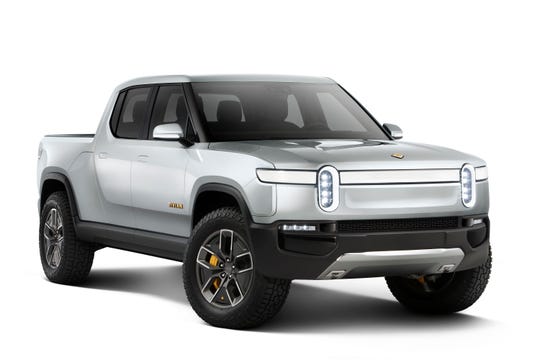
Rivian R1T electric pickup. (Photo: Lians Jadan, AP)
Rivian R1T
For all Tesla’s brand cred, many analysts see Plymouth-based Rivian as the surest bet, given its massive investment from Fortune 500 clients like Amazon and Ford. With its chiseled iPhone-simple interior and clever tricks like “tank turn” that lets it spin in place, the R1T gives off an upscale, playful vibe.
“Rivian has a lot of buzz,” says Navigant’s Abuelsamid. “It has really diverse and relevant business partners.”
Those partners guarantee the brand income for commercial vehicles (Amazon) and contract jobs (Ford/Lincoln) while Rivian builds its own reputation with individual customers.
The midsize R1T pickup (a similar R1S will be built as an SUV) claims impressive numbers like 11,000-pound towing capacity, but is smaller than the full-size Cybertruck. There’s an electric motor for each wheel.
Starting at $69,000, it’s aimed at outdoors lovers.
To promote its lifestyle appeal, Rivian has tweeted photos of offroad trips to western locations with the R1T’s “frunk” (where the engine normally would be) filled with beverages and a tent pitched in the bed. Rivian promises park-based electric chargers to relieve range anxiety for its wanderlust customers.
Due date: Fall 2020

Bollinger B2 electric truck. (Photo: Bollinger Motors)
Bollinger Motors B2
If the Rivian and Tesla are aimed at weekend wanderers, then Ferndale-based Bollinger’s B2 is intended for hard-core outdoorsmen.
Its roots are in founder Robert Bollinger’s need for a truck on his farm in New York’s Catskills. “It had to be electric,” he said on Autoline last year. “We designed it the way we wanted to make it. Electric (architecture) is so much better for trucks than gasoline and diesel, anyway.”
For Bollinger, pickups are all about utility. With the batteries in the basement, the full length of the B2’s interior can be used for storage. The tailgate and front panels drop so you can run 16-foot plywood boards into the cab.
The 614-horsepower B2 has Cybertruck-like 15-inch ground clearance, with 10-inch suspension travel for extreme off-roading. Given its battery weight, the B2 will be classified a Class 3 truck, comparable to a Ford F-350. (The Tesla will be Class 2, like a Ford F-250.)
Compared to the Rivian and Cybertruck, the design of the B2 is utilitarian. Its body is constructed of simple aluminum sheets — a carry-over from Bollinger’s lack of expensive stamping dies when he built his first prototypes by hand. The B2 will start at $125,000.
Due date: Early 2021

A artist rendering of the Lordstown Endurance electric pickup. (Photo: Lordstown Motors)
Lordstown Endurance
The least is known about the $52,500 Lordstown Endurance, which will be built at GM’s former Lordstown Assembly plant in northeast Ohio. Like the Rivian, the Endurance will have a motor at each wheel. With on-board electric export to power tools, the Endurance appears to be aimed at fleet customers and claims a 7,500-pound towing capability.
Due date: Late 2020
EV pickups: By the numbers
2021 Tesla Cybertruck
Vehicle type: 5-passenger electric pickup
Price: $39,900-$69,900
Powerplant: Lithium-ion battery pack; 1-3 electric motors
Power: NA
Performance: 0-60 mph, 2.9 seconds (3-motor); towing, 7,500-14,000 pounds
Range: 250-500 miles
2021 Rivian R1T
Vehicle type: 5-passenger electric pickup
Price: $69,000-plus
Powerplant: 105/135/180 kWh lithium-ion battery pack; 4 electric motors
Power: Up to 754 hp, 829 pound-feet torque
Performance: 0-60 mph, 3.0 seconds; towing, up to 11,000 lbs
Range: Up to 400 miles
2021 Bollinger B2
Vehicle type: 5-passenger electric pickup
Price: $125,000
Powerplant: 120 kWh lithium-ion battery pack; 2 electric motors
Power: 614 hp, 688 pound-feet torque
Performance: 0-60 mph, 4.5 seconds; towing, 7,500 pounds
Range: 200 miles
2022 GMC Hummer
Vehicle type: 5-passenger electric pickup
Price: $70,000 est.
Powerplant: Up to 192 kWh lithium-ion battery pack (est.); 1-3 electric motors
Power: 1,000 hp
Performance: 0-60 mph, 3.0 seconds; towing, NA
Range: NA
2021 Lordstown Endurance
Vehicle type: 5-passenger electric pickup
Price: $52,500
Powerplant: Lithium-ion battery pack; 4 electric motors
Power: NA
Performance: NA
Range: NA
Payne: Adorable Hyundai Venue mini-SUV is a bargain at under $20,000
Posted by Talbot Payne on February 6, 2020

Where are the headlights? In the middle. Framed by an LED tube, the headlights for the 2020 Hyundai Venue SUV sit under a running light “eyebrow” like the Chevy Blazer. (Photo: Henry Payne, The Detroit News)
The Hyundai Venue is a tasty little snack box. Loaded with standard features, a remote smartphone app and perky styling, it’s as Mini Cooper-cute as it is utilitarian.
And it’s also an increasingly rare dish: a new vehicle available for less than $20,000.
Finding an affordable vehicle these days is almost as hard as ordering a $3 hamburger in an airport. The average — average! — new car transaction price in the U.S. market in December was $38,948. Blame our mad rush for expensive trucks and SUVs as well as a laundry list of nanny-state regulations.
Small cars have struggled under the burden while sales — and profit margins — shrink. As readers of this column know, I am a hatchback fan, and I’ve shed a tear as wee appetizers have been crossed off the menu. For example, my favorite Ford Fiesta hatch has packed its bags for Europe, taking its mild fuel appetite and ST sportiness with it.
But I am also a part of the problem.
As entry-level car prices have risen, I’ve purchased used cars instead of new. In the last 15 years, I’ve bought four small cars — Dodge Neon, Ford Focus and two Honda Civics. All used. Why pay $25,000 for a new car when I can walk across the lot to the pre-owned salesman and buy a perfectly good used hatchback with 25,000 miles and extended warranty for just $15,000?
There are whispers among some manufacturers that this is the new business model: forget entry-segment vehicles and concentrate on $23,000-plus subcompact SUVs. What of the buyers who want a car for less? Let ’em buy used.
Don’t think automakers are happy about this trend. Ford and Fiat Chrysler are losing sleep over losing first-time buyers to Asian competitors. Happily, there’s the Ambien of fat profits from pickups to help them rest easier.
Foreign-makers don’t have the luxury of selling mega-trucks. They put bread on the table by moving new vehicles. As prices of new vehicles rise, entry-level buyers are fewer.
Hyundai thinks it has an answer. The Venue is a segment-buster.
Starting at just $18,470, it is the cheapest SUV on the market — and one of only three utes under $20,000 (along with the Nissan Kicks and the funk-tastic Kia Soul). That’s about $3,500 less than a subcompact Ford Ecosport or Mazda CX-3. Call the Venue a sub-subcompact. Call it a mini SUV. Just don’t call it a hatchback.
But Hyundai has cooked the Venue in its secret sauce. Not only does it conform to millennials’ SUV tastes, it’s peppered with the modern electronics they crave and that have only been available on more expensive Hyundais like the Elantra and Tucson: standard features like phone app, automatic emergency-braking, automatic high-beams, Apple CarPlay connectivity, 8-inch tablet infotainment display …
You had me at phone app.
One of my favorite luxury conveniences — courtesy of brands like BMW and Tesla (and always cutting-edge Ford) — is monitoring my car by app. Remotely. I run my life by phone, so why not my car, too?
Download Hyundai Blue Link from the Google Play store. Enter VIN number. Simple.
On a Venue media test on a toasty Miami day in January, I remote-cooled the interior to 65 degrees while at lunch. Try to do that in your old used car.
My wife would like preheated seats as well, but that would require adding the $1,750 premium package that include navigation and a sunroof — pushing an automatic, front-wheel drive Venuewell north of $20,000 and into the path of better-equipped, more powerful, all-wheel drive subcompact utes like the stylish $23,000 Mazda CX-3 (for some reason, a Chevy Trax doesn’t get these goodies until it hits $28,000).
With its upright proportions, Venue beats a similarly priced Toyota Yaris hatchback in nearly every metric. The Venue has three more cubic feet of cargo room and another inch of head- and rear legroom. That means more space for your music case, bandmates, golf clubs, bicycle or whatever your hustle.
All this and looks, too. My mini ute was so cute I was comparing it to the Mini Cooper Clubman ($30,000) and Audi Q3 ($40,000).
The jack o’ lantern grille is sandwiched by mid-fascia headlight cubes that are topped by “eyebrow” parking lights. The cube lights are echoed in the taillights. Choose the Denim trim and its Mini Cooper-like white roof, and — aw, what the heck — you may be willing to cough up $23,000 it’s so adorable. The interior is a pleasing dish of chunky climate dials, storage cubbies and 8-inch tablet screen.
Pleasing, too, is Venue’s willingness to play. Despite its boxy shape, this SUV is no high-riding porker. Weighing just 2,612 pounds, the Venue feels more hatchback than SUV with a 6.6-inch ground clearance, just an inch higher than the Yaris. Miami is hardly a twisty alpine playground, but the Hyundai eagerly attacked the odd 360-degree cloverleaf.
The driveline, however, will only create goosebumps on EPA bureaucrats.
To meet stringent emissions regs, the meek 121-horse, 1.6-liter 4-banger (at least it bests Yaris’ 103 ponies) has been designed with expensive dual-injectors for better fuel burn. It’s then matched to a continuously variable transmission that returned 37 mpg on my 100-mile hustle. I think I out-dragged a box turtle at a stoplight once.
For the budget-conscious buyer not shy of stick shifts, I’d suggest ditching the CVT for the more-fun $18,470 manual-transmission model. Or you could just buy a used low-mileage 2018 Hyundai Elantra GT hatchback with more power, room and same electronic features for $17,000.
Now I’m causing trouble again.
2020 Hyundai Venue
Vehicle type: Front-engine, front-wheel drive, 5-passenger compact SUV
Price: $17,350 including $1,120 destination charge ($23,280 SEL as tested)
Powerplant: 1.6-liter inline-4 cylinder
Power: 121 horsepower, 113 pound-feet torque
Transmission: 6-speed manual, 6-speed automatic continuously variable-transmission (CVT)
Performance: 0-60 mph, 9.9 seconds (Car and Driver est.); top speed, 115 mph
Weight: 2,612 (with CVT)
Fuel economy: EPA 32 city/37 highway/34 combined (automatic as tested)
Report card
Highs: Cute ute; standard features galore
Lows: Zero-60 mph in a while; fat $1,210 destination charge hurts value play
Overall: 3 stars
Premiere: New Cadillac Escalade aims to reclaim throne as King of Bling
Posted by Talbot Payne on February 6, 2020
Los Angeles – The fifth-generation 2021 Cadillac Escalade premiered Tuesday night in Hollywood.
The fourth sequel to the big SUV that debuted in 1998, the all-new Escalade is roomier and is packed with tech features. Long a favorite of Hollywood’s elite, the land yacht has been challenged lately at the box office by the Lincoln Navigator.
Determined to re-assert itself as the King of Bling, Cadillac kicked off Oscars week here with its Escalade premiere. Detroit’s celebrity SUV was introduced by director Spike Lee, who took the wraps off the big ute at Red Studios where TV shows like “I Love Lucy” and “Seinfeld” have been filmed.
“”The Escalade is a star like no other,” said the “She’s Gotta Have it” director who hails from Brooklyn. “It’s not just okey-doke. Art leads to innovation as we like to say in the People’s Republic of Brooklyn.”
Lee has had a relationship with Cadillac for about eight years, not unusual for celebrities in Hollywood where the Escalade is an icon. Indeed, Cadillac used the occasion to debut Lee’s short film about the Escalade titled “Anthem.”
Fittingly, a movie-screen sized instrument panel dominates the interior of the new ute with a single 38-inch curved pane of LED glass that contains three separate digital screens. And the optional Super Cruise self-driving system can perform tricks like changing lanes automatically.
“Our innovation, we feel, is redefining the boundaries and the limits of mobility,” said Cadillac President Steve Carlisle.
The latest Escalade dials back its chunky, vertical design cues for the more subtle look that integrates horizontal touches first seen on Cadillac’s Escala concept car. But the Escalade defiantly is still the only Cadillac without an alphanumeric badge.
The Escalade began life in 1998 as a rushed response to Lincoln’s segment-busting F-150 truck-based Navigator. With its cutting-edge-style and interior, the Cadillac lapped the Navigator as a cultural icon at the turn of the 21st century. It was big and flashy, and became a something of a hip-hop touchstone.
Sprawling interior landscape
Just as the Escalade’s assertive new exterior no longer slavishly follows vertical design cues (though the instantly recognizable tall taillights remain), the interior ditches the old vertical console for a sprawling, horizontal landscape.
The right-side infotainment screen of the 38-inch array is nearly 17 inches wide, while the driver has the option of four different screen layouts on the 14-inch screen behind the steering wheel: instrument-gauge view, night vision, navigation and augmented reality – the latter using live street views to indicate where the driver should turn.
The Escalade forfeits its old truck-like steering-column shifter for a modern console-based monostable shifter. Like other Cadillacs, Escalade’s touchscreen infotainment system can also be controlled by a remote console rotary-knob and voice commands.
Second-row passengers get their own twin 12.6-inch screens mounted in the rear seats. If 19 speakers aren’t enough, buyers can opt for a 36-speaker system with movie theater-quality surround-sound.
The rear compartment gains legroom (10 inches more, Cadillac says) and cargo space (68% more), thanks to an extended wheelbase and a sunken floor made possible by Escalade’s first independent rear suspension.
“This vehicle is longer than “The Irishman,”” laughed Carlisle in reference to the long Oscar-contending film.
Combined with standard magnetic ride and a lighter architecture, the big ocean liner promises smooth sailing even on Michigan’s choppy roads.
An Air Ride suspension will be available, just like its cousins the Chevrolet Tahoe and Suburban. Most notably, Air Ride suspension will allow the beast to kneel down 2 inches — like an elephant bowing before its king — to assist passengers getting in and out.
“The new Escalade will offer much more interior space with better driving dynamics, and that unmistakable Escalade presence is still there,” said Tim Herrick, Cadillac’s global product chief. “Our goal was a vehicle that was larger on the inside with driving dynamics of a smaller vehicle.”
The latest Escalade conforms to the marketing conventions of its SUV siblings: the compact XT4, midsize XT5 and three-row XT6. Like those members of Cadillac’s lineup, Escalade models will be offered in a simple “Y” model format starting with a base Luxury trim, then splitting into Sport or Premium Luxury options. As the name suggests, the black-detailed Sport offers a sportier look compared to the chrome-tastic Premium Luxury. Customers wanting more bling can opt for a Platinum version of both Sport or Premium Luxury.
Standard are 22-inch wheels and heated and cooled leatherette seats. Customers can slather on the goodies as they climb the Y-model tree.
Turbodiesel option
Under the hood, the rear- or all-wheel drive Escalade will be propelled by a new version of its familiar 6.2-liter V-8. It develops a claimed 420 horsepower and 460 pound-feet of torque. For those looking for more fuel efficiency, GM’s 3.0-liter turbodiesel will make its Escalade debut, developing the same torque as its gasoline counterpart.
Both engines will be mated to a 10-speed automatic transmission.
Like the Silverado truck that shares its ladder frame, Escalade is offered with a trailer package with nine camera views. Towing capacity was not released.
Although pricing will be announced closer to its introduction to showrooms later this year, the Escalade will likely start just under $80,000.