Hustling along County Road 56 west of Boyne in PERFORMANCE Mode, I come upon two slower cars. Adaptive Cruise Control slows me to 50 mph behind an SUV but the automotive gearbox doesn’t upshift — holding at 3,500 RPM in 4th gear with all 369 pound feet of torque at the ready. OK.
At the first broken center line, I stomp the throttle. The gearbox automatically downshifts ANOTHER gear to 3rd and the RS3 devours the SUV instantly, settling back into line at 50 mph behind the next victim, a minivan. Sensing its next prey (and my willingness to oblige its appetite), the RS3 incredibly remains in 3rd gear — the engine quivering at 5,500 RPM.
BOOM! The minivan is toast in the blink of an eye, the Audi sprinting by at 7,000 RPM redline in 4th gear. The Audi obliterates the next pair of ess turns before I rein it in. The tailpipes crackle and pop, satisfied burps after a quick meal.
In this era of electronic wizardry, the gap between luxury and mainstream has shrunk rapidly. With mainstream athletes like the $52K Kia Stinger GT, it becomes harder to justify the $30,000 brand jump to, say, a comparable Audi S7. In the VW Group, the Golf R is the pinnacle of V-dub performance with sensational handling, power, all-wheel drive. I wondered if its cousin Audi RS3 — built on the same MQB platform — could justify its $30K premium hike over the V-dub.
It makes its case the old-fashioned way: with raw speed and wicked looks.
Golf R is a sleeper car, a hellion in drag that will surprise muscle cars at a stoplight. You won’t recognize its signature quad tailpipes until it’s past you. Ooooooh, so that was a Golf R! My Kemora Gray metallic RS is about as subtle as a rocket launcher.
This is the junior member of Audi’s RS (short for Rocket Ship?) family that includes the 591-horse RS and RS6 Avent monsters — the latter the most awesome station wagon I’ve piloted. Junior RS3 doesn’t want to be ignored at the dinner table.
The front fascia is covered in black as if it’s been stuffing its face with asphalt all day. Under the hood is not the Golf R’s 315-horse turbo-4, but a mighty 2.5-liter turbocharged inline-5 making 401 horsepower. The beast needs air — lots of it — so every inch of the front is covered with intakes, including center grille and two massive gills.
Then Audi paints everything black — even the Audi rings — for added menace.
Aft of 19-inch black (natch) wheels wrapped in gummy Pirelli P Zero Trofeo R tires is air scoop — shades of the Civic Type R. Indeed, Audi RS3 has more styling in common with the loud Type R than the stealthy Golf R. There are huge rocker panels and lots of fake black cladding and … what, no rear wing?
RS3’s lack of rear hatchback is a disappointment (only the sedan is offered here, while Europe gets hatch and sedan). Rear boot storage is less than Golf, as is rear headroom. But twin exhaust pipes the size of ship cannons at least give the rear menace like the front. Speaking of room, however, RS3’s four doors are an upgrade to its similarly equipped predecessor: the 400-horse TT RS coupe.
The Rocket Ship’s all-wheel-drive system is up to task of channeling the engine’s power.
RS3 not only wants to play with its big brothers, it wants to play on the race track. This is a track-focused production car like the Porsche Cayman GTS or BMW M2. Riding around town in COMFORT or AUTO modes, and the beast is docile. The driveline is not so laid back. It’s often on edge — its shifts abrupt, its throttle touchy.
There is also lots of turbo lag. Only at speed does RS3 feel truly content as the high-strung PERFORMANCE mode keeping the shift points high in the rev range.
Over my favorite, M-32 twisty road in northern Michigan, I alternately used paddle shifters and PERFORMANCE mode — the AWD system rock solid all the while. No torque-steer, no excessive push. A sophisticated twin-clutch assembly in rear (shades of the glorious Ford Focus RS track rat. I miss it so) replaces the old single-clutch Haldex unit, allowing for true torque-vectoring at each wheel. Take RS to the track where you can find the limits of car’s limits.
On back-country public roads, the combination of 401 ponies and AWD grip launched me to insane speeds, and I made liberal use of adaptive cruse control to keep me legal through small towns and bustling burgs. ACC also came in handy on I-75, where the system did a reasonable job as an assistant driver which allowed me time to learn the car’s ergonomics.
Like Golf R, RS3 is quirky. That is, it is nearly devoid of rotary knobs.
A haptic touchscreen dominates the console with wireless Android Auto (and Apple CarPlay) which I put to good use on my travels north. Climate? Controlled by toggle switches. Volume control? Move your finger in a circular motion on an iPod-like button.
Anchoring the console is my favorite feature: a chicklet shifter similar to Golf R or Porsche 911, which easily selects REVERSE-NEUTRAL-DRIVE with flicks of the wrist. The simplicity is a contrast to the cluttered Audi consoles of old, with shifter, rotary controller and volume knob all arguing for space.
Audi has been a pioneer in locating more information in front of the driver via steering wheel buttons (a redundant volume scroll wheel, for example) and configurable instrument display. RS3’s cockpit is typically excellent. An RS3 button sat at my itchy right thumb ready to toggle between DYNAMIC, INDIVIDUAL and PERFORMANCE modes — each changing the instrument RPM display.
My only beef was that PERFORMANCE mode triggered an awkward, ladder-like RPM display. Better is DYNAMIC mode’s horizontal band — like a race car.
The RS3 muscles its way into a highly-competitive $60K pocket bull ring that includes the Tesla Model 3 Performance, Mercedes CLA AMG-45 and BMW M2. The latter is peerless in its handling and the Model 3 addictive with its electric torque — but with all-season AWD, eager engine and aggressive attitude, the RS3 can trash talk with any of ’em.
Just be sure and feed it the occasional minivan.
2022 Audi RS3
Vehicle type: All-wheel-drive, five-passenger performance sedan
Price: $59,995, including $1,095 destination fee ($71,390 as tested)
Bruce Township — Ford’s supertruck just got super-sized.
Ford took the wraps off the 700 horsepower, 640-torque F-150 Raptor R on Monday. The 2023 R model puts the Raptor’s legendary off-road performance on steroids by stuffing a supercharged, 5.2-liter V-8 — the same engine used in the Mustang GT500 track king — under the hood, upgrading from the standard Raptor 450-horse, 510-torque, twin-turbo V-6 engine.
The V-8 is the first offered in the Raptor since the first-generation Raptor, which ran from 2010-14. Despite The Raptor R’s $109,145 sticker price — a healthy 40 grand over the base Raptor — Ford expects the R to make up 25%-plus of all Raptor orders.
“This Raptor really speaks to customers who are looking for the ultimate performance off-road,” said Raptor product manager Tony Greco at a media sneak peek of the super truck at Ford’s Proving Grounds here. “This truck has so much capability that most customers will run out of courage before they run out of power.”
The torque-dense, supercharged V-8 even exceeds the Mustang GT500’s 625 pound-feet of torque to help the Raptor R power out of deep sand dunes.
The R shares the standard Raptor’s legendary high-speed off-road abilities with Fox live-valve shocks, five-link rear suspension and standard 37-inch all-terrain tires (an option on Raptor). Wheel travel of 13 inches front and 14.1 inches in the rear — coupled with 13.1 inches of ground clearance — helps Raptor R negotiate uneven off-road terrain at speeds in excess of 100 mph.
Performance trucks have become hot in the industry since Ford created the super truck segment more than a decade ago and pickups and SUVs have become the dominant sales segments. The V-8-powered Ram 1500 TRX makes 702 horsepower and the GMC Hummer has been remade as an electric super truck with 1,000 horsepower and 3.0-second zero-60 mph acceleration sprint. Buyers who once coveted a Ferrari are now dropping six figures on a pickup.
“The segment is growing. There seems to be a shift in industry to go more off-road,” said Greco. “When you see competitors come into a space we established a decade ago it makes us feel good.”
The R’s exterior changes from the base Raptor are subtle.
Body panels are the same, though the hood’s power dome is modified to help feed the V-8 engine 66% more air. Bumpers and fenders are painted midnight black, but you’ll recognize the R over its standard sibling by the Code Orange tow hooks, R badge on the front grille and power dome — and by the Raptor graphic on the 5.5-foot bed. The graphic (which buyers have the option of deleting from the truck’s build) features dinosaur-like scales made up of tiny number 8s — a single letter V interrupts the pattern on either side of the bed.
The big changes are under the skin.
Greco says the Raptor R has about 100 different parts from the standard Raptor as his Ford Performance team engineered the third-generation Raptor chassis, which debuted last year, to accommodate the V-8’s massive power output for use in extreme, Baja 1000-like desert racing environments. Nevertheless, the R gains only 100 pounds over the base Raptor, maximizing the engine’s power-to-weight potential. The R boasts a new front axle, unique aluminum driveshaft, specially tuned torque converter, and unique oil cooler, filter and deep oil pan.
“We felt this was the right time to put the Shelby in the Raptor because we have the right chassis in place,” said Greco. “The benefit we got five years ago with an aluminum body, that weight-save still translates to more power today. It makes for a nimble monster.”
The result is Ford’s fastest, most-extreme high-performance off-road pickup yet. It comes after tremendous demand from Raptor’s passionate buyer base that pushed back on Ford’s decision to axe the super truck’s original 5.4 and 6.2-liter V-8 engines in 2017.
The second-generation Raptor adapted to Ford’s green priorities as the company emphasized fuel savings with aluminum and a turbocharged, six-cylinder Ecoboost engine. Though the Ecoboost engine brought healthy power gains over the eight-holer, purists missed the V-8’s visceral thrill.
“Some customers have been very subtle asking when a V-8 would come out — others have been more blunt about it,” laughed Greco. “The Ecoboost is very capable V-6 with a lot more horsepower and torque than the V-8s we left behind. That said, customers have always asked for more.”
Push the start button and the Raptor R gurgles with menace.
The V-8 also helps differentiate the F-150 lineup from the newly-introduced 2022 Bronco Raptor, which is powered by a 418-horse twin-turbo V-6. The Bronco Raptor is targeted at multi-purpose, rock crawl-and-run off-roading, while the F-150 Raptor and Raptor R are the ultimate in high-speed desert predators.
Inside, Raptor R comes only in black — with Code Orange stitching on the leather and Alcantara seats. The vehicles is loaded with tech, including 12-inch screen, SYNC 4 infotainment system, smartphone compatibility, and off-road toys like Trail-Turn Assist, Trail Control (low-speed cruise control) and Trail 1-Pedal Drive. The truck features multiple driving modes — including a MyMode feature familiar to supercars like the Porsche 911 and Chevy Corvette C8. Drivers can customize drive, steering and suspension modes — then access the feature with a simple press of a steering-wheel-mounted “R” button.
Options are few on the loaded truck: Beadlock-capable wheels are available, as are Code Orange beadlock rings. R can be outfitted in eight color options, including new Avalanche and Azure Gray. Orders are open, with the first beasts roaring out of Ford’s Dearborn Truck Plant into the wild this fall.
Henry Payne is auto critic for The Detroit News. Find him at hpayne@detroitnews.com or Twitter @HenryEPayne.
Braselton, Georgia — Three years ago, I watched here at Road Atlanta Raceway as a blood red, V-8-powered Cadillac DPi-V.R prototype streaked ahead of a snarling pack of IMSA race cars into Turn One on its way to a convincing victory at the Petit Le Mans 10-Hour endurance race.
The Cadillac was the class of the field.
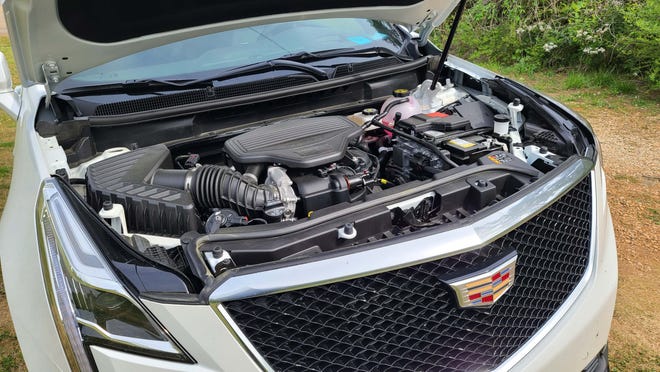
This year I returned to Road Atlanta driving an XT5 SUV, the best-selling Caddy in the luxe maker’s lineup. There is an unmistakable similarity between the DPi-V.R and XT5. They share Caddy’s signature tear-drop headlights, vertical taillights and brand logo on the nose. And that’s about it.
These are the bookends of the Cadillac brand: the single-seat, 600-horsepower, championship-winning race car and the five-seat, entry-level luxury utility vehicle. They are part of Caddy’s multiple identities formed from navigating the crazy, shifting winds of the auto industry over the last decade.
How crazy? Consider: the DPi-V.R is the V-8-powered halo for the V-series CT4 and CT5 Blackwing sedans that are soon to be retired because Cadillac is going all-electric beginning with the Lyriq later this year — the model that will replace the XT5. Yet, Cadillac’s racing program will live on with a new, V-8-powered hybrid race car coming in 2023, the same model year as the battery-powered Lyriq. The race car will be the fiercest V-8 this side of a 2023 Cadillac Escalade-V.
Confused? Join the club. But as I drove through Road Atlanta’s gates in the XT5 — the ute loaded with four family members and our luggage — it had an undeniable cool factor.
Like a Porsche Macan or a BMW X3 or an Audi Q5, the Cadillac basks in the glow of its brand’s successful racing heritage.
Which is a good thing, because SUVs are really hard to tell apart. Indeed, my favorite compact SUV is the Mazda CX-5. Stuff it with all-wheel-drive, head-up display, 250-horse turbo-4 and leather seats, and it’s a $42,000 bargain. And its sleek styling echoes that of the Mazda RT24-P IMSA race car that, ahem, once competed against the Cadillac DPi-V.R.
At $70,365, my Caddy tester was loaded with similar features — plus.
My family and I were at Road Atlanta because we have a team of three sports racers that compete in amateur motorsport. “The Mitty” at Road Atlanta is one of the country’s most famous gatherings of classic race cars competing in classes from our 2-liter sportscar-class to Indy Lights open-wheel cars.
We loaded four carry-on suitcases, a briefcase, and backpack under the rear hatch with room to spare. We three Payne boys are all north of 6 feet and were able to sit comfortably behind ourselves — though I resisted the rear seat due to the compromised headroom caused by the panoramic roof.
Our weekend round trip to Atlanta’s northeast Braselton exurb would cover some 350 miles, a peek at the challenge of Cadillac going all-electric this decade, led by the 312-mile range Lyriq. Our Best Western hotel had no charging stations. The only hotel in the area that did was a La Quinta with two, 240-volt Level 2 chargers. On a busy weekend’s racing schedule, only overnight charging made sense.
But with 462 miles of gas range and gas stations everywhere, we didn’t give the Caddy XT5’s fuel needs a second thought as I merged into 80 mph Atlanta interstate traffic for our 65-mile drive to Road Atlanta.
With a 3.6-liter V-6 under the hood, the XT5 Sport model spits out a healthy 310 horsepower (an upgrade from the car’s standard, 235-horse turbo-4). But the engine is EV-quiet — a stealthy attribute I came to appreciate when I broadcast my Car Radio Show on 910 AM-Detroit from the Caddy’s interior. On Saturday. In the middle of a loud race track.
The quiet cabin made a superb radio studio.
On road, the XT5 is competent but didn’t inherit any DPi-V.R DNA. Which is just as well given the groceries we stored in back — and the grocery bag we put in the XT5’s useful, sub-console storage space.
Wireless Apple CarPlay proved wonky on our trip so we connected the phone via cord for navigation. The dash design is tasteful, though it won’t impress those looking for fashionable, expansive dash screens. The smallish, 8-inch console screen was useful for tight parking in the Road Atlanta paddock.
The $2,275 tech package offers a bird’s-eye view of the SUV as well as crisp forward-and-rear cameras. Racers tend to leave body parts on the ground — tires, car noses, drills — so the cameras came in handy for parking in the paddock.
In addition to the action on track, the Road Atlanta grounds attracted thousands of spectators — some of them queuing in Shelby Cobras, Acura NSXs, Porsches, Corvettes and so on.
I saw a classic, bling-tastic, 1950s Cadillac Eldorado — an icon the fancy Lyriq intends to recreate. The XT5? Not so much. It will never achieve Eldorado’s legendary status, but it offers a comfortable daily driver experience . . . so you can go check out cousin DPi-V.R when it comes to your local race track.
Next week: 2022 Audi RS3
2022 Cadillac XT5 Sport
Vehicle type: All-wheel drive, five-passenger SUV
Price: $57,090 including $1,195 destination charge ($70,365 AWD Sport as tested)
With gas prices rising to $5 a gallon this summer, Sen. Debbie Stabenow, D-Lansing, took a trip from her hometown to Washington, D.C., in her Chevrolet Bolt EUV to tout the benefits of driving electric.
“I got it and drove it from Michigan to here this last weekend and went by every single gas station, it didn’t matter how high it was,” Stabenow said last month during a Senate Finance Committee hearing that discussed the nation’s highest gas prices since 2008. “I’m looking forward to the opportunity for us to move to vehicles that aren’t going to be dependent on the whims of the oil companies and international markets.”
Moving to electric vehicles, however, comes with its own challenges.
According to a record of the senator’s trip shared with The Detroit News, the Bolt EUV’s journey highlights the trade-offs consumers face in choosing an EV today. While saving in refueling costs compared to a comparable, $22,995 gas-powered Chevy Trailblazer, a $28,195 Bolt EUV not only carries a higher sticker price but also a higher tolerance for travel time. And if gas falls back below $4.25 a gallon, the cost advantage disappears as well.
Stabenow made three stops at Electrify America fast chargers in Toledo, Pittsburgh and Hagerstown, Maryland, over her two-day journey, with a stop overnight in Lordstown, Ohio. The senator didn’t share details of her trip beyond its schedule, but The News recreated her journey using two popular charging apps, A Better Route Planner and Chargeway.
Assuming the senator left her home in Lansing with 100% of charge, the Bolt EUV would have have a maximum battery range of 247 miles. The Bolt EUV is the sister vehicle to the Bolt hatchback, which Chevy delivered in late 2016. In a battle of compact EVs, the Bolt beat the Tesla Model 3 to market, becoming the first mass-market EV to offer more than 200 miles of range. Just as Tesla has supplemented the Model 3 with a Model Y crossover, Chevy introduced the Bolt EUV as a bigger, more luxurious version of its $26k Bolt.
Over the course of her journey, ABRP calculates that the Bolt EUV used almost 200 kWh of energy at a cost of $80. Electrify America charging rates across Michigan, Ohio and Pennsylvania are a uniform 43 cents per kWh (like gas stations, EA also has discount rates with member programs, and some manufacturers are offering free charging with purchase of an EV).
That compares to $88 if she had driven a comparable, gas-powered Trailblazer SUV, which gets 33 mpg on the highway. That’s a savings of $8 for the 600-mile trip at $5-a-gallon gas.
That savings comes at a price in time. Stabenow’s charging stops added nearly three hours to the 9 hour, 30-minute Lansing-to-D.C. road trip (13 hours, 9 minutes total) compared to a single, 5-minute stop in the Trailblazer to fill up. There are other variables as well, depending on which app you use to plan your trip.
Chargeway, for example, estimates the length of a three-stop trip in the Bolt EUV at 15 hours, 35 minutes with 3 hours, 30 minutes of charging time.
“Our trips are based on real-world data of users,” said Matt Teske, CEO of Chargeway. He said the difference in ABRP and Chargeway app calculations is likely due to ambient temperature conditions and what speed the app calculates the Bolt EUV needs to travel to make long-distance runs between scarce chargers.
“Speed and weather are the #1 and #2 variables in EV trip time. We base our algorithms on warm and cold weather,” said Teske. The same is true of gas-powered vehicles, though refueling convenience helps mitigate the issue.
Chargeway assumes an average speed of 60 mph on the Bolt EUV’s Lansing-to-D.C. trip while ABRP assumes 65 mph — though ABRP urges drivers to travel at, for example, 55 mph in the long leg between Toledo and Pittsburgh. Ohio and Pennsylvania have a 70 mph speed limit.
The high cost of EVs plus the challenges of long-distance travel are key reasons manufacturers have focused their EV lineups on higher-income owner demographics where households typically have multiple vehicles in the garage.
Used as a commuter vehicle, the Bolt EUV, for example, can take advantage of cheaper, 17-cent per kWh when charging at home on a 240-volt wall plug compared to 43 cents at superchargers. Home charging also comes at a price, too, though as installation typically costs $1,500.
While Chevrolet has dramatically reduced the price of the Bolt EUV by more than $6,000 in the last year, it would still take years to recoup its premium over the gas-powered Trailblazer in saved fueling costs. And if gas prices drop to pre-pandemic January 2020 lows of $2.50 per gallon, a Chevy Trailblazer’s gas cost from Lansing to D.C. will be just $44.
Henry Payne is auto critic for The Detroit News. Find him at hpayne@detroitnews.com or Twitter @HenryEPayne.
Clarington, Ontario — The federal government is forcing automakers to go all-electric, but even some of my green friends are balking at the idea.
“Why not plug-in hybrids so we can use electricity around town and gas on trips?” asks one.
“Electric doesn’t make sense. Are there plug-in hybrids?” asks another.
“I’ve heard plug-ins are a good middle ground,” says another.
Washington ain’t much for middle ground these days, so plug-ins are a nonstarter because (horrors) they use the demon gasoline. But manufacturers are listening to their customers, and for those who like the EV driving experience — but appreciate the efficiency of gas — there are good choices in the premium market.
Consider the 2022 Volvo XC90 Recharge and Jeep Grand Cherokee 4xe I recently put to the test.
Big and roomy, they are midsize family SUVs designed to do everything from haul the groceries home to haul the family on long excursions. For customers who need this kind of diversity, EVs don’t make sense. Who wants to wait for 45 minutes at a supercharger while the kids scream: “Are we there yet?”
Volvo has been particularly aggressive at going all-electric with compact around-towners like the XC40 Recharge and (sister EV brand) Polestar 2. But its midsize XC90 better fits the plug-in market given its road trip ambitions . . . road trips like my summer journey from Detroit to Ontario, where I was scheduled to race my Lola at one of North America’s epic tracks: Mosport International Raceway just north of Lake Ontario.
Battery power fits the Scandinavian brand that has long appealed to tree-huggers. A century after alcohol Prohibition, America is in the midst of a second temperance movement — this time focused on limiting carbon consumption. For luxe buyers who crave a Tesla Model X but need a plug-in’s versatility, the XC90 Recharge satisfies moral and practical concerns.
The Jeep Grand Cherokee 4xe fits the bill too.
Jeep’s enormous brand bandwidth allows it to appeal to everyone from mainstream buyers shopping for a $25K Renegade to swells who want to arrive at the country club in a $110K Jeep Wagoneer.
Mention the Jeep Grand Cherokee in the same breath as Volvo, BMW, Audi and Cadillac. and my friends don’t flinch. The Jeep name has that kind of cachet. So Jeep has shrewdly brought its 4xe plug-in drivetrain to the Grand, where it offers a premium ride at $63K while still coming in well short of the Volvo Recharge’s (cough) $84K.
My testers were similar yet different. These brands play to their strengths.
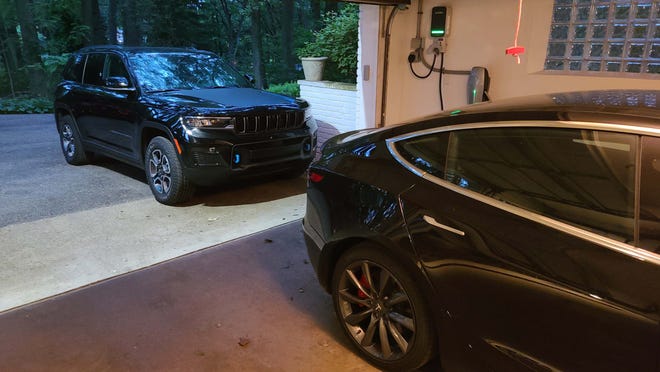
Preparing for my trip across the border, I juiced both the Jeep and Volvo batteries on my garage-mounted, 240-volt charger. At about $2,000 to install, the 240-volt is an expensive but necessary accessory for plug-in buyers. It’s also a major reason battery-powered vehicles are best-suited for a high-income demographic.
Once charged, both Volvo and Jeep gave me the option to save the battery range for when I want to use it. With a 300-mile journey ahead to Mosport, I chose the Volvo and its superior 36 miles of battery-only range.
Like European nations, Canada is more militant than the United States on carbon prohibition, with plans to ban gasoline by 2035. Cities are proposing “zero-emission zones” allowing only battery-powered vehicles. While I would encounter no such zones on my trip to metropolitan Toronto, the XC90 Recharge could qualify — assuming I could switch over to EV power only.
The Jeep has a similar feature — which could be saved for, say, a silent run through Holly Oaks off-road park an hour up I-75. However, it’s only good for 26 miles compared to the Volvo’s 36. That’s a big difference — and the first of many reasons that the XC90 Recharge is priced $20K higher than the Grand.
After crossing the Canadian border at Sarnia, I selected the Volvo’s driver-assist mode and set the speed to 78 mph (Canadian speed limit is 60 mph but natives ignore it like Americans used to ignore 55). The green steering wheel icon in the digital ash indicated the car needed limited input from me.
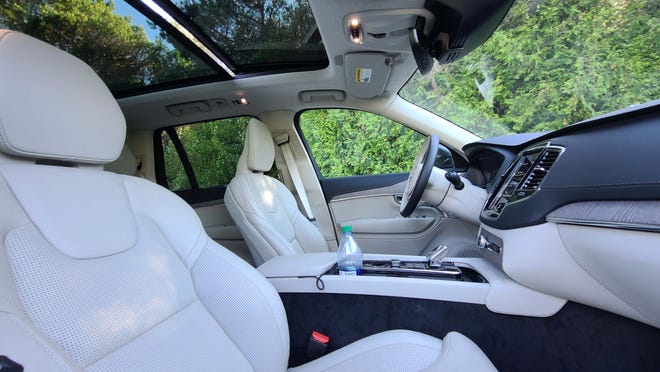
Casting my eyes around the cabin, I saw the Volvo was a lovely piece of work with its white leather interior, Orrefors crystal shift knob and big panoramic roof. Lovely, but uncomfortable for this 6-foot-5-inch driver, given that the headrest was immovable and forced my head forward. Fortunately, placing a pillow behind my back helped alleviate the discomfort.
The Grand Cherokee’s interior has come a long way from the previous gen and is a big reason I recommend it to luxury buyers. The design is upscale with a cascading black console that houses a small infotainment screen — not unlike the Volvo. These brands have eschewed the trend to ginormous screens. The Jeep also gave me choice of cruise controls — standard cruise or adaptive — though not an ambitious drive-assist system like the VC90.
After a lunch stop with Mrs. Payne, I put the pedal to metal and the Volvo merged with authority onto the interstate — its combined supercharged, turbocharged inline-4 and electric motor putting out a beastly 440 horsepower. This is a hot Swedish meatball.
That acceleration is tempered in EV mode. Upon arriving at Bowmanville, Ontario, I switched over to my saved battery power. The resulting EV mode is all-electric — but doesn’t offer torquey, kick-in-the-pants acceleration like a big-battery, 75 kWh Polestar 2. Instead, the 14.9 kWh battery enabled smooth driving around town, if not lively performance.
In contrast, the Grand Cherokee 4xe’s EV mode only provides limited battery-only driving. Speed up over 60 mph and the gas engine kicks in to help. The Jeep apparently thinks you’ll use the battery at low off-road speeds (like a Wrangler 4xe) or in delivering the kiddies to school on moderate, 45-mph secondary roads.
For both plug-ins, the estimated battery range proved optimistic. I used up the Jeep’s 21 miles quickly around Metro Detroit, whereas the Volvo’s 36 miles only took me about 22 miles in real-world driving. For all Canada’s talk of an electric future, charging stations were rare east of Toronto.
I found a Hyundai dealership next to my Comfort Inn with a public 110-volt outlet that recharged my VC90 Recharge each night so that I could drain the battery the next day on my 22-mile round trip commute to the track.
I filled up the Volvo on the way back home from Mosport — the plug-in proving its worth with a big gas tank. The Grand Cherokee, too, would have been suited for the Ontario trip. But with its blue tow hooks, matte-black hood, and meaty off-road tires, the Trailhawk trim is better for an off-road rally driver instead of an asphalt, road-course jockey like me.
Heck, the Jeep could even do the rally itself.
2022 Jeep Grand Cherokee 4xe
Vehicle type: All-wheel-drive, five-passenger SUV
Price: $57,660 including $1,795 destination fee ($64,280 Grand Cherokee Trailhawk as tested)
Powerplant: 2.0-liter, turbocharged inline-4 cylinder mated to AC motor and 14.0-kWh lithium-ion battery pack
The race for world sports car racing domination revved up in the last month as manufacturers Cadillac, BMW and Acura unveiled concepts of their first hybrid race cars. But the Porsche program — run by Bloomfield Hills’ legendary Team Penske — seems to be well ahead of everybody.
Porsche Motorsport and Team Penske unveiled their 680-horsepower, 963 prototype race cars at Goodwood Festival of Speed this month in full racing livery with eight drivers and already 4,900 miles of testing to their credit.
It puts 85-year-old Roger “The Captain” Penske in the driver’s seat as he seeks to add the twin jewels of sports car racing — the 24 Hours of Daytona and the 24 Hours of Le Mans — to his already illustrious trophy case. Penske will field two factory cars for 2023 while Porsche also announced a private entry run by Minnesota JDC-Miller through its customer racing program. JDC-Miller has run Cadillac IMSA prototypes for the last four years.
The 963 marks a return to glory for Porsche, which dominated prototype podiums in the 1970s to 1990s — establishing its reputation as one of the world’s great performance brands.
“Over the past few months, Porsche Motorsport and Team Penske have grown into an efficient and committed squad — the Porsche Penske Motorsport Team,” said Porsche Motorsport LMDh chief Urs Kuratle. “We’ll have powerful driver crews in the factory cars. The Porsche 963 should be homologated this autumn. Until then, we want to make further progress with test drives and gain additional insights.”
LMDh stands for Le Mans Daytona Hybrid and will replace the current DPi class next year in North America’s IMSA series, where it will also be known as the GTP class. Cadillac and Acura compete in DPi, with Cadillac winning at the Detroit Grand Prix in June.
The new LMDh category has been endorsed by both IMSA and the international World Endurance Series, rekindling a global war of performance brands not seen for decades. The first-ever hybrid-powered prototype series — the world’s fastest sports car class — offers an opportunity to prove brand superiority in electrification at a time when manufacturers are introducing battery-powered production cars.
In addition to Porsche, Cadillac, BMW, Ferrari, Toyota, Peugeot and Acura, Lamborghini and Alpine are expected to join in LMDh racing come 2024.
While manufacturer cars and teams have been solidifying this summer, Porsche Penske Motorsport has been noticeably aggressive in getting its horses on track. The team’s concept car was unveiled in May with a top-drawer driver lineup already putting test miles on the test mule.
“It’s a typically efficient Penske operation. They got started well ahead of anyone else,” said veteran Hagerty racing correspondent Stephen Cole Smith in an interview. “If I were to put money on a team to win Daytona next January, I’d put my money on Penske.”
The sleek white, red and black machine took a run up the hill climb at Goodwood, trailing its signature, whispery exhaust note from a twin-turbo V-8.
“We’re on a very good path but there is still work to be done before the start of next season,” said Thomas Laudenbach, Porsche Motorsport vice president. “Our new Porsche 963 should continue the legacy of legendary models such as the 917, 935, 956, 962 and the 919. I’m positive that we’ll be well-positioned for wins in the thrilling competition between many manufacturers.”
In addition to its IMSA series debut next January, Porsche Penske Motorsport has targeted a noncompetitive dress rehearsal at the final WEC round in Bahrain this November.
Hagerty’s Cole Smith said Penske’s test schedule has allowed it to share technical information with IMSA, WEC and other teams proving the nascent hybrid technology that will be shared across brands. Under class rules, each manufacturer will campaign its own unique engine, but to reduce costs and encourage close racing, the hybrid system developed by Bosch, Xtrac and Williams Engineering will be common technology.
At the wheel of the twin 963 will be France’s Kévin Estre, Michael Christensen of Denmark, André Lotterer from Germany, Belgium’s Laurens Vanthoor, Aussie Matt Campbell, Mathieu Jaminet of France, American Dane Cameron and reigning IMSA champion Felipe Nasr of Brazil.
Porsche Penske Motorsport has established two race bases: one in Mooresville, North Carolina, for the IMSA series and one in Mannheim, Germany, for the WEC.
The LMDh chassis has ben developed for Porsche by Canadian manufacturer Multimatic, which also developed the Ford GT for the Dearborn brand’s Le Mans win in the GT class in 2016. Mated to the spec hybrid components will be a 4.6-liter, twin-turbo V8 based on the engine in Porsche’s million-dollar 918 Spyder hypercar.
Porsche and Team Penske last teamed up from 2005 to 2008 with the RS Spyder prototype that scored multiple victories. The design of the new Porsche 963 echoes that of the iconic 956 and 962 racers of the 1980s and early 1990s.
Other suppliers of significance to the global program are tire manufacturer Michelin, Mobil1 oil, and software specialist Ansys. Sponsors include luxury watchmaker TAG Heuer, Hugo Boss clothing and Puma.
Henry Payne is auto critic for The Detroit News. Find him at hpayne@detroitnews.com or Twitter @HenryEPayne.
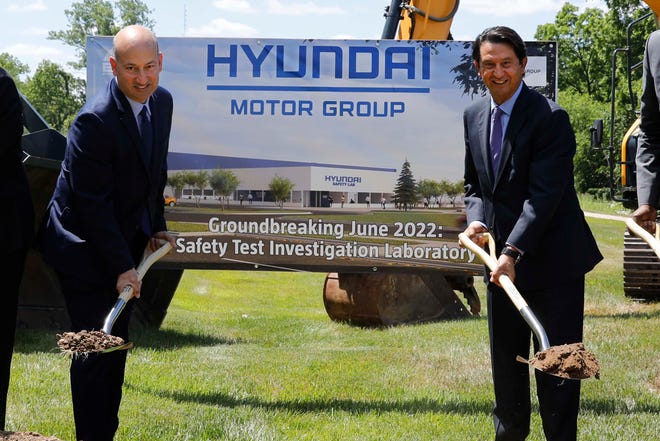
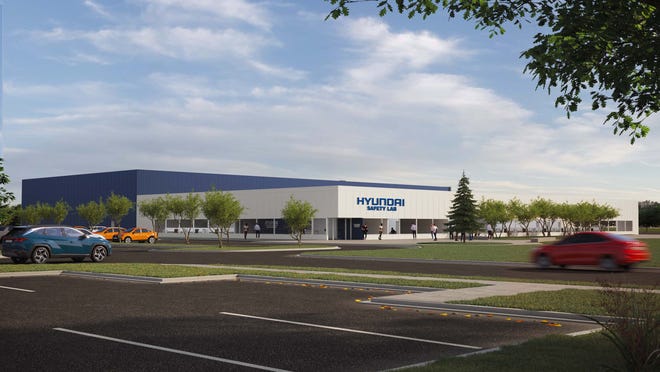
Drawing on Metro Detroit’s extensive engineering talent, Hyundai broke ground this week near Ypsilanti on its new Safety Test and Investigation Laboratory, its first such facility in North America.
STIL expands on the Hyundai America Technical Center, one of six Hyundai R&D centers worldwide. The new facility, which satisfies a consent order from the National Highway Safety Administration, will augment existing safety testing and analysis for Hyundai and Genesis luxury brand vehicles. The facility will include a field crash investigation lab, high-voltage battery lab, forensics lab, and 3/10-mile test track.
The $51.6 million facility, being built in Superior Township, is expected to employ 150 people and be operational in the fall of 2023.
“Safety is the top priority at Hyundai and is embedded throughout the entire organization,” Hyundai Motor Company President and CEO José Muñoz said at the Monday groundbreaking. “We excel in third-party crash testing and ratings, and strive to be a leader in the latest safety features. The new laboratory will enable us to even more effectively protect our customers.”
Hyundai this year earned eight 2022 Top Safety Pick and Top Safety Pick Plus awards from the Insurance Institute for Highway Safety, placing third in the industry behind Volvo and Audi. Each of its SUVs won a Top Safety Pick award: the Venue, Tucson, Palisade, Santa Fe and Santa Cruz. Together with sister brands Kia and Genesis — which also placed in the IIHS Top Ten — Hyundai Motor Group had 21 Top Safety Pick awards.
The STIL comes in the wake of a consent order Hyundai agreed to with the federal government after NHTSA determined Hyundai and Kia had moved too slowly in an engine recall involving more than 1.6 million vehicles from 2011-2014. The Theta II four-cylinder engines were prone to seizing, and NHTSA faulted Hyundai for inaccurately reporting recall information. In total, Hyundai-Kia paid $210 million in fines.
The order required Hyundai to spend at least $25 million in the U.S. to “build and develop a fully-functioning U.S.-based outdoor test laboratory and vehicle tear down facilities.”
Munoz was joined at the event by Hyundai North America Chief Safety Officer Brian Latouf and Hyundai America Technical Center president John Robb, as well as government officials including U.S. Rep. Debbie Dingell, D-Dearborn, and Lt. Gov. Garlin Gilchrist II.
“This investment by Hyundai is critically important not only to southeast Michigan but to our entire country,” said Dingell. “This new Safety Test and Investigation Laboratory will save lives, and I applaud Hyundai for their commitment to keeping passengers safe.”
Gilchrist added that “Hyundai’s cutting-edge Safety Test and Investigation Laboratory will create good-paying, high-skilled jobs right here in Michigan. Michigan put the world on wheels, and I am grateful for Hyundai’s partnership in building on that tradition with a $50 million investment in Superior Township.
In addition to being home to Detroit Three headquarters and tech centers, Michigan has a technical workforce that has attracted large operations from foreign automakers.
Toyota’s largest research center outside of Japan (the Toyota Motor North American R&D Purchasing and Prototype Development Center), for example, is in York Township in southern Washtenaw County. And the Honda Research Institute-Detroit is next to the University of Michigan campus in Ann Arbor.
Hyundai’s Michigan lab comes in addition to the Hyundai Motor Group’s planned $10 billion investment in the U.S. by 2025, including its Georgia manufacturing facilities building electric vehicles and producing batteries.
Henry Payne is auto critic for The Detroit News. Find him at hpayne@detroitnews.com or Twitter @HenryEPayne.
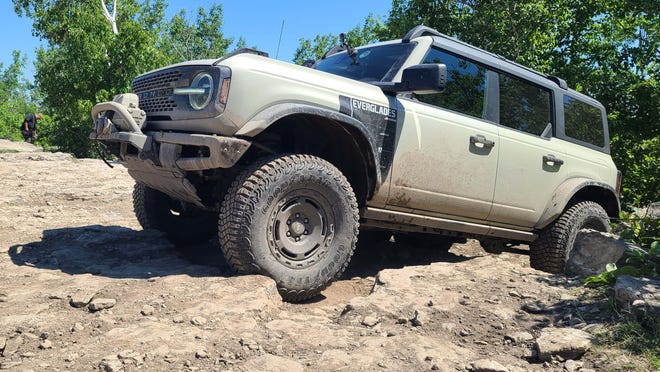
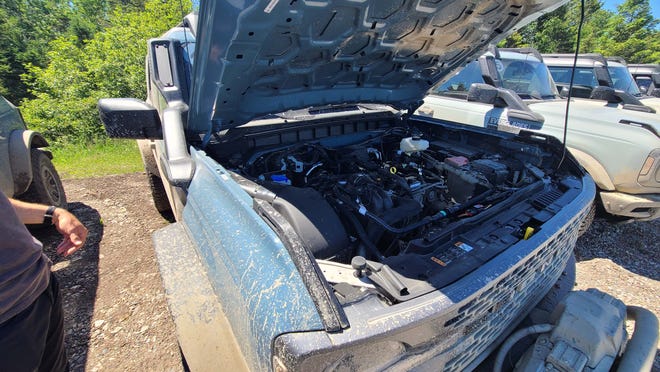
Drummond Island — So this week I’m chewing up Drummond Island’s labyrinth of soggy off-road trails in a Ford Bronco Everglades. It’s the latest in a stream of Bronco trims aimed at conquering every corner of God’s green earth.
First there was the base Bronco optioned with ginormous 35-inch Sasquatch trim tires and dual-locking diffs so you could commute via the Rouge River bed to work.
Then came Bronco Badlands with detachable front sway bar and rock-resistant armored plating so you could climb Mount Rushmore.
Next up: the Bronco Raptor with ridiculous live-valve Fox shocks so you can avoid L.A. traffic and take a shortcut through the desert at 75 mph.
What’s next? Maybe Bronco Sleeping Bear Dunes so you run a shuttle up and down the world’s most formidable sand dunes?
Or the Bronco Moon so astronauts have something to drive through the Sea of Tranquility?
My latest, $54,595 Everglades tester fills a nice off-roader’s niche between the Black Diamond trim and the purist’s Badlands.
Built on the same bones as Black Diamond — five skid plates, rock rails, seven GOAT (Go Over Any Terrain) modes, standard 35-inch tires — Everglades then adds more standard features for customers who want an extreme off-roader without having to dig deep into the Badlands toolbox and assemble accessories themselves.
Significant Everglades upgrades include WARN winch, engine intake snorkel, plastic bumpers and roof rails. Dude, you’re ready to chase Star Wars’ speeder bikes through the forests of Endor.
But let me recommend Drummond Island. It’s closer.
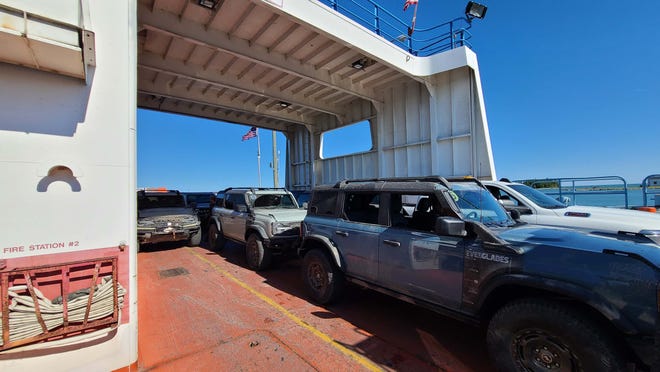
Just five hours up I-75 from Detroit, cross the mighty Mackinac Bridge, then hook a right and go to the east end of the U.P. Hop the ferry and five minutes later you’re on Drummond, the seventh largest lake isle in the world — and the only island in the Manitoulin island chain that belongs to the USA (the rest of the archipelago is Canadian).
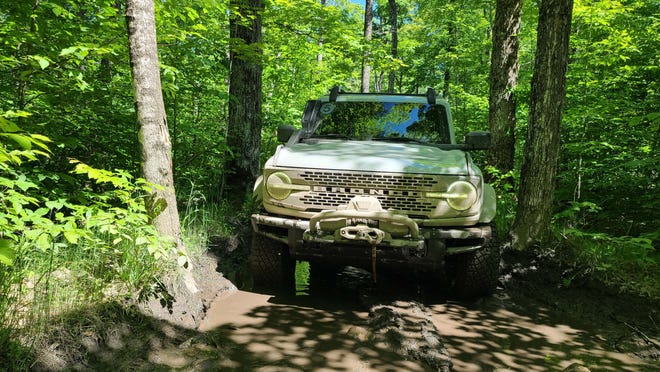
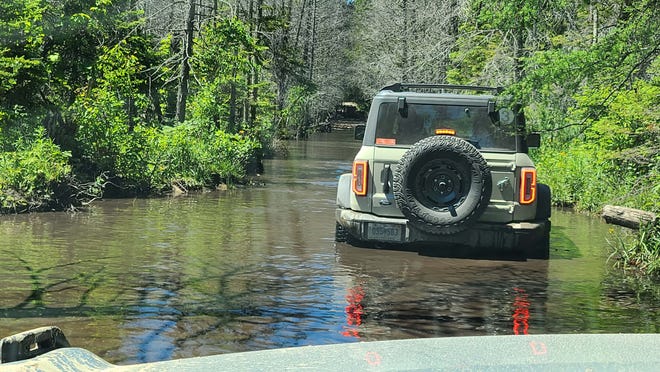
Once aboard Drummond, I joined a convoy of Everglades and headed to the island’s eastern forests. Drummond’s 134 square miles is covered by 100 miles of off-road trails — one of the largest closed-loop ORV parks in the United States. And for some reason, the trails are wet all the time, which is perfect for a vehicles named Everglades sporting a snorkel.
Bronco engineers Seth Goslawski and Jamie Groves played Lewis and Clark and guided us through the labyrinth. Let me recommend downloading the GAIA GPS app if you come here with your own groups of trailblazers — it provides good trail guidance. Here’s another tip: bring waders.
Swampy Mounds ORV park in Flint is the only park I’ve found comparable to Drummond, but the latter is much bigger and combines swamp with spectacular views of Lake Huron.
I shifted Everglades to Neutral. Spun the GOAT mode selector to Mud/Ruts putting me in 4WD High. Shifted back to DRIVE. Punched it.
With the 35-inch Goodyear Territory tires aired down to 33 PSI (from 40) the beast romped happily thought the woods. Splashed through puddles. Danced over rocks. Sliced between trees.
This ain’t the 75-mph desert running I did in the Bronco Raptor earlier this month.
Everglades doesn’t have Raptors’ 418 horse, twin-turbo 3.0-liter V-6 beast under the hood. Heck, the 87.5-inch wide Raptor wouldn’t have fit through some of the tight Drummond trails, which were apparently cut by years of Jeep Wrangler and side-by-side owners. Nor is Everglades optioned with the 2.7-liter, 330-horse V-6 available on the Badlands buffet. For the Everglades’ simplified menu of options, the standard 300 horse, 2.3-liter turbo-4 is enough.
Ford’s logic? With that 100-pound winch hanging off the front bumper, the 2.3 saves 100 pounds from the V-6 for good weight balance. Which makes sense when you’re front end starts sinking in Drummond mud and needs to power out. This is the same peppy engine found in the Mustang High Performance model.
A spirited run through the forest suddenly opened into a beautiful beach, Lake Huron’s crystal-clear water lapping at the stones. Sprayed with mud, our Everglades Broncos were equipped with washable vinyl seats and drain plugs so you can hose down the interior.
They are also equipped with Rock Crawl, which would come in handy for our next trail: Drummond’s famed Marblehead Steps.
Shift to Neutral. Spin GOAT to Rock Crawl mode, enabling 4-LOW for extreme rock crawling. Engage both front and rear lockers for max traction. Time to climb.
This is where the Badlands and Raptor editions excel, thanks to detachable front sway bars allowing their craft to walk up steps like a horse. Without the detachable sway bar option, Everglades is less deft, but that’s where its truck-like rock rails prove their worth.
GRONK! The rails landed on a marble step. ROWWWRRRR! Deft use of the accelerator pedal spun the rear end around, allowing for better grip. RROOOMP! The beast was on to the next step. We gathered around to help each other up the steps. Coaching. Directing. Congratulating.
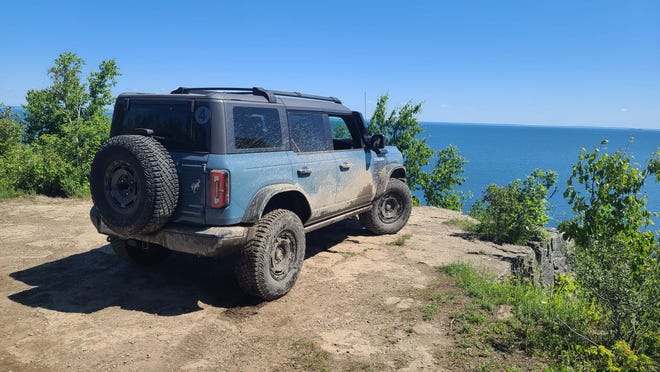
The steps reward their visitors with a spectacular cliff view of the lake. Freighters dotted the horizon, and beyond that, Cockburn Island, the next step in the archipelago.
At this point, I felt like Superman. Is there nothing this Bronc can’t do? I started playing with other electronic toys on Everglades. Trail-turn assist, which brakes the inside wheel to enable quicker rotation on tight trails. One pedal-drive, which allowed me to drive Everglades like the electric Mustang Mach-E.
And my favorite: Trail Control to manage the car’s speed feet-free. Traversing an 800-foot stream bed — 30-inches deep in water — I used only my left hand on the steering wheel’s cruise button.
Then we were on back on our way. The beauty of Bronco and its independent front suspension, of course, is that it makes a good commuter as well as off-road driver. And so we headed back to the ferry at the end of our day. But does the Bronco really need to take a ferry back to the mainland?
How about an amphibious trim so the Bronco can swim across Huron? Maybe they’ll call it the Bronco Mackinac.
2022 Ford Bronco Everglades
Vehicle type: Four-wheel-drive, five-passenger SUV
Park City, Utah — Inevitably, every Dream Cruise season, someone sidles up to me, points at a passing, bling-plated 1950s Eldorado shouldering aside Woodward traffic and says:
“Why doesn’t Cadillac make cars like that anymore?”
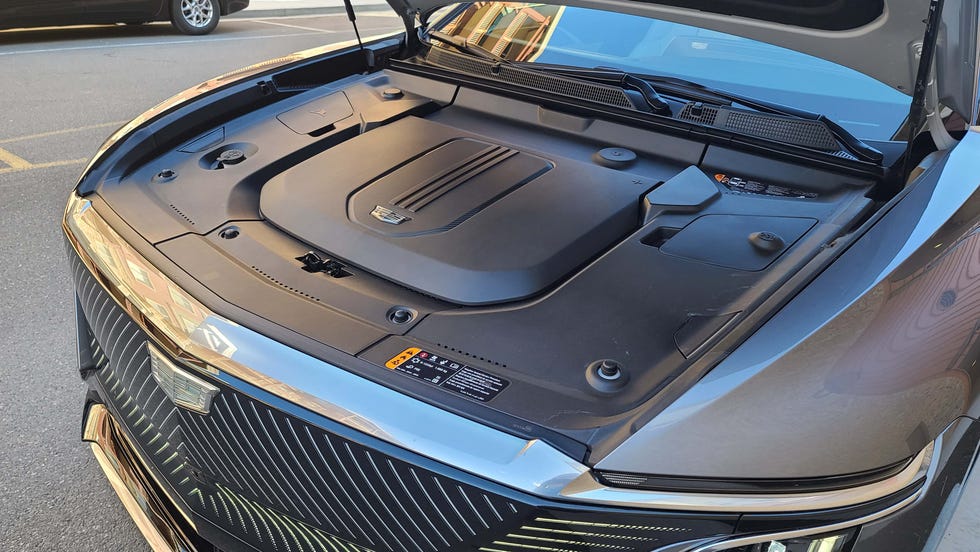
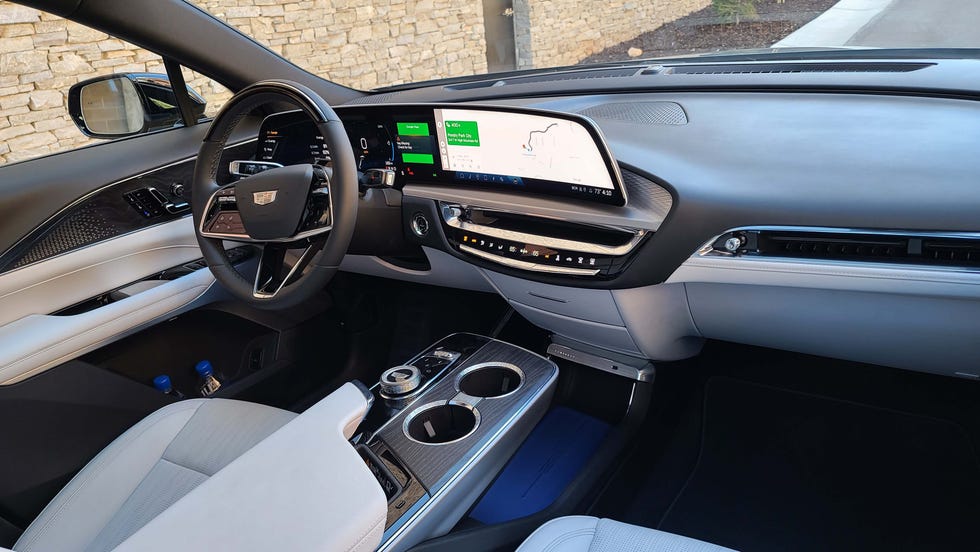
Say hello to my bling-tastic 2023 Lyriq tester, the first all-electric Caddy. I mean, just look at it. Chiseled bod right off a designer’s sketchbook draped over huge 22-inch pinwheels. Under the single-panel panoramic roof, a 33-inch screen arches across the front cabin. Below the screen, a royal blue-lined sunglasses drawer rolls out of the dash like a palace carpet … greeting a floating center console as long as the Queen Mary’s bow. The console comes equipped with a silver-crusted rotary dial and knurled cupholders that should hold wine glasses, not cups.
I adjusted my front throne with chromed, door-mounted seat avatars protruding from real ash wood, then stomped the accelerator pedal with my size 15s. The 5,610-pound sled surged forward with liquid-smooth power.
Yes, Cadillac is making cars like that again.
Actually, it never stopped, as owners of the magnificent Escalade land yacht know. But Escalade was an outlier, a properly-named land yacht out of place in an alphanumeric soup of CTs, XTs and Vs. Though flawed (more on that later), Lyriq signals that ol’ Cadillac swagger will be standard across the lineup as General Motors Co.’s iconic luxury brand transitions to electric vehicles.
Startup ingenuity led by Silicon Valley electric automakers Tesla, Lucid and Rivian has stirred interest in a new generation of luxury automobiles powered by batteries and giant screens, and it turns out Cadillac is perfectly suited for the new electric wave.
This is a brand, after all, that made its mark innovating technical advances like the electric starter and automatic transmission while introducing the world to jet-age design. That’s not to discount the athletic advances Caddy made in the last two decades chasing German rivals with weapons like the ATS-V and CT5 Blackwing. But the EV lets Cadillac be Cadillac.
If the austere Tesla Model 3 is an Apple smartphone on wheels, then the exotic Cadillac Lyriq is a rolling jewelry box. The anti-Tesla.
To make sure I noticed that Escalade style now rules The House of Caddy, my Lyriq was wrapped in more lights than a Trans Siberian Orchestra show. Spot a Lyriq in your rear-view at night and it looks like you’re being followed by the Fox Theatre marquee. Vertical headlights frame a faux Cadillac shield of white light. When the Lyriq slips past, the rear vertically-lit marquee recedes into the distance.
Cadillac is understandably targeting the Lyriq at young, techy Gen X and Yers, but I think Lyriq will naturally draw boomers, too. The older we are, the more sensitive we get to noise — even my Porsche-racing, flat-6-obsessed father wanted a break from the world’s cacophony when he reached his 60s — and Lyriq is a silent sanctuary.
Yes, Cadillac makes cars like that again. Driving along Utah Route 138 south of Salt Lake, wind noise was nonexistent (in contrast to the noisy Hummer EV’s A-pillar) a testimony to extensive sound-deadening, four wheel-well-mounted accelerometers, noise-canceling speakers and, of course, that electric drivetrain.
Rolling jewelry boxes exact a cost in weight. Lyriq’s nearly three tons of mass is 1,200 pounds more than a Model Y and just 500 pounds shy of an Escalade.
Where Eldorado once growled like the king of beasts, the Lyriq’s stealthy power was welcome on Park City roads. I performed repeated 0-60 launches to test the 325 pound-feet of torque from Lyriq’s Tesla Model S-sized, 102-kWh battery — which would have awakened every officer in the surrounding county if it had been a V-8.
Complementing stealth with tech, the Caddy struts its technical know-how with innovations like one-pedal driving, steering-paddle regenerative braking and rear aerofoil that channels air over the rear window — enabling a wiper-less design that clears rain and snow. Years of know-how gained from going toe-to-toe with the German Trinity are apparent. Despite its girth, the Lyriq’s low center of gravity and sophisticated shocks made for neutral handling in Utah’s mountain twisties. Surely there’s a Lyriq V-series Backwing in the wings?
With a gem so polished, imperfections stand out.
Cadillac’s signature cut-and-sew dashboard has been replaced by — imposter! — a vellum material right out of a Ford Explorer. And Lyriq lacks a front trunk like Tesla or Mustang Mach-E. Indeed, despite its skateboard construction and a wheelbase nearly 10 inches longer than the comparably priced gas-powered XT5 SUV, the Lyriq’s cargo and seating capacities are similar. A head-up display — technology pioneered by General Motors — is not available on 2023 models. Blame a rush program to get Lyriq to market nine months ahead of schedule.
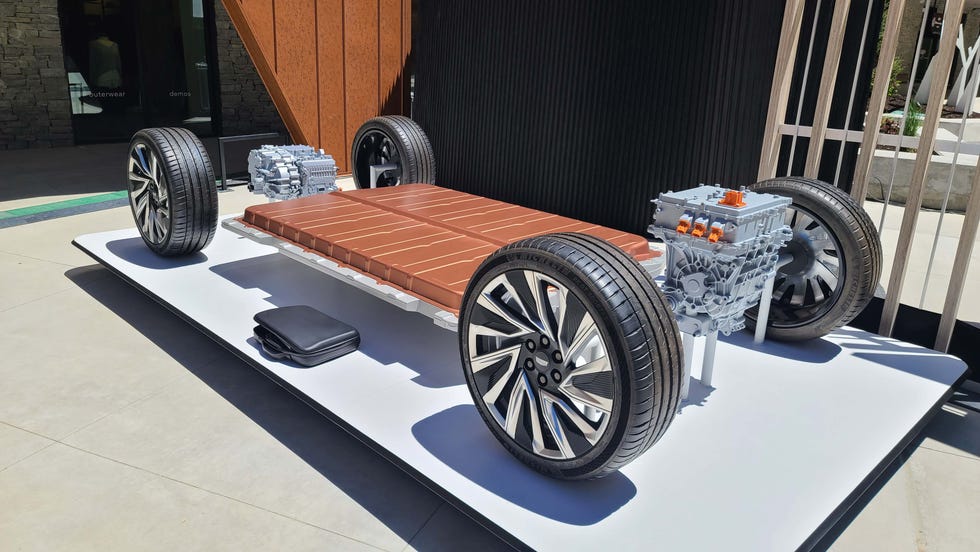
Cadillac’s 800-volt Ultium battery platform promises quick charge rates on 350 kW fast chargers, but its capability’s been dialed back to 190 kilowatts (unlike, say, Porsche’s 800-volt system. which charges to 270 kW) so you only get 187 miles of charge in 40 minutes as opposed to a Taycan’s 169 in 22 minutes. For quick stops around town, the Caddy will gain 76 miles in 10 minutes.
I plotted a trip from Park City to Denver, and charging would have added 4.5 hours to the eight-hour trip. Better to stay close to home, as I figure most Lyriq owners will do with 312 miles of battery range (versus an XT5’s road trip-friendly 462 miles of gas range).
Lyriq’s range will also get you the 250 miles from Ann Arbor to, say, your Glen Arbor summer cottage Up North. A suggestion: take advantage of Cadillac’s $1,500 offer for home charger installation and put it in your second home.
That trip will be made easier later this year when Lyriq gets an over-the-air update to Super Cruise update, the semi-autonomous system competitive with Tesla’s Autopilot. That’s right, my $62,990 rear-wheel-drive tester ($64,990 with all-wheel-drive) comes standard with Super Cruise as well as Google Maps, wireless Apple CarPlay/Android Auto, 19-speaker AKG stereo system, blind-spot assist and a Windows-like configurable screen start bar.
That’s a lot of bling on a luxury SUV priced just $7K north of the $55,725 Hyundai Ioniq 5 — and well below the $75,440 you’d pay for a comparable Model Y with its $6,000 Autopilot system.
That leaves behind other midsize lux contenders like the Audi e-Tron and BMW i-4, which lack the technical ambition of Lyriq/Tesla.
The question mark is Cadillac’s ambition. A decade ago, Caddy beat the Model 3 to market with the gorgeous, compact ELR plug-in. But it was overpriced and under-sold. Then GM followed up with the electric Bolt — but badged it a Chevy, not a Caddy.
Lyriq is just a start, but it’s got Papa Eldorado’s DNA.
2023 Cadillac Lyriq
Vehicle type: Battery-powered, rear-wheel and all-wheel-drive, five-passenger SUV
Price: $62,990 including $1,195 destination fee for RWD model; $64,990 for AWD
Powerplant: 102 kWh lithium-ion battery with rear electric-motor drive
Park City, Utah — Cadillac is going back to the future.
The new, battery-powered Lyriq SUV is more than a new car, it is a return to Cadillac’s 20th century, “Standard of the World” iconography. For all its high-tech wizardry, Lyriq is a throwback to a time when the Cadillac brand was the pinnacle of American style, its craftsmanship a hallmark of the brand.
Capitalizing on 21st century advances in electronics and electrification, Lyriq wants to set the tone for a return to Caddy’s brand heyday. Designed with extraordinary detail from climate-control knob knurling right down to windowpane monogram fonts, the midsize chariot struts with high style and big brand ambitions.
“Lyriq is a really big project. Not only from delivering this car through the production pipeline, but envisioning a brand new future for Cadillac,” said interior design chief Tristan Murphy. “It’s an opportunity to pivot a brand and really go into the future with EV technology and all the things that enables from a design standpoint.”
There are no tailfins on the $59,990 Lyriq or missile-shaped chrome bumper like the ’50s Eldorados that ruled American streets and inspired Aretha Franklin songs, but there is an embrace of fashion different than the sleek, more austere XT5 and CT4 models that have led sales in recent years.
The Lyriq is lit up with lighting and chrome accents from the outside in.
“We’re really not being shy about it,” said Murphy. “You go back to some of (the 1950s icons) and there was nothing shy about those original tailfins and the colors we used to do. It’s not about looking back and being retro, but taking some of that swagger into the next generation of cars and leaning into what it means to be American luxury.”
To communicate this swagger to buyers, Cadillac in six weeks put together a sassy ad campaign that pairs Lyriq with strutting fashion models in eyeball-burning outfits.
“The ads catch your attention. You see luxury and design in these people; it’s aspirational,” said Lyriq marketing guru Kristin Lewis. “Cadillac has been an icon in our culture. The Lyriq is a return to that iconic status.”
The transformation began with an obsession with detail. Consider the simple, universal, microscopic glass monogram usually stamped with a General Motors logo.
“All automotive glass have monograms that with a manufacturer’s logo on it. This is standard across every vehicles globally,” said Murphy. “We used our own Cadillac-specific font . . . and replaced the GM logo with the little Cadillac crest in there. It’s a subconscious thing that helped say this isn’t just a GM vehicle — it’s a Cadillac.”
Murphy’s team was determined to carry that obsession throughout the interior.
“We have no bin parts in this car. No more parts shared with a Buick or a Chevy,” said Murphy. “There is that subconscious level of detail (here) that makes it feel ‘wow.’ Everything is bespoke in here — you’re not going to see it in any of our other products.”
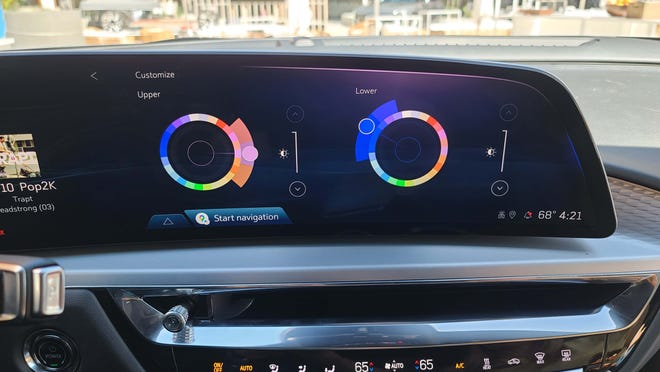
If Tesla created the luxury EV segment with its Apple-simple smartphone on wheels, then Cadillac’s team wanted to bring their own Detroit swagger. At night, the grille lights up like a Christmas tree. Inside, passengers can use a touchscreen color wheel to create 36 different combinations in the interior lighting.
“We had a lot of conversations about that,” said Murphy. “There are things that (Tesla does) great, and they have moved the industry forward in a different way. But it is not Cadillac to be a smartphone on wheels. It’s not true to the brand, it’s not creating a unique experience.”
Where many EV screens dominate their interiors, Lyriq’s huge, curved, 33-inch dash display is but one element of a cabin full of jewelry.
“The screen is. . . a technological showcase, the first in the industry with this advanced LCD display. It’s fantastic and has beautiful features — but we fell like when you talk about a luxury product and how you can tie it into human emotion — it’s the little physical things.”
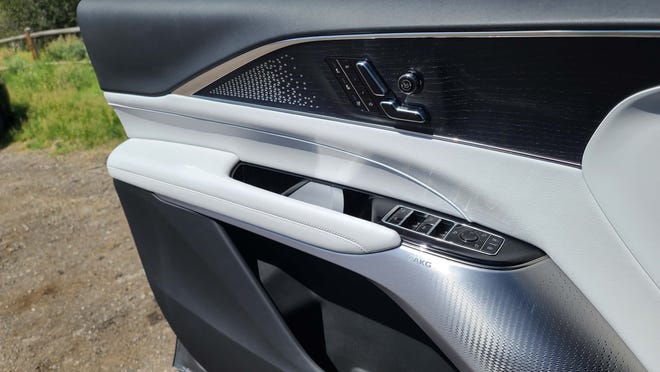
Physical things like exquisite, curved sliver door speakers integrated into the armrests. Or a floating console punctuated by a knurled, radial screen controller. Or an industry first, laser-cut wood door trim.
“We take a piece of black ash wood and then we come through with a blue light laser. It comes through twice to cut the pattern, then we overlay that over a very thin — almost a film of metal veneer — that fills in the holes. It’s so thin that at night we are able to shine light through (the) holes. We think that gives it emotional wealth that customers are always looking for.”
Marketing chief Lewis said this emotional connection is a key piece of Cadillac luxury. “It’s like staying in a luxury hotel. It’s the secondary elements you discover during your stay. We want to run everything through the lens of being iconic. In the Lyriq you see boldness, color saturation, humanity.”
At the Lyriq’s media introduction here in Park City, the Cadillac display was anchored by design sketches and the brand’s cutting-edge, 800-volt battery platform. But it was also littered with symbols of Cadillac’s glorious past: an elegant 1936 hood ornament here, a 1975 hood ornament there.
“Details are how you create those little memories that stay with you,” Murphy said. “It’s a deeper philosophical question that we had about making these very deliberate decisions on what the engagement was going to be and (which) becomes a very different experience than Tesla.”
Murphy points to the past decade in which Cadillac gained industry respect for its athletic, corner-carving V-series and Blackwing sedans that could hang with German icons like the BMW M-class at the famed Nurburgring test track. But despite those cars’ technical progress, the brand struggled to gain sales.
Meanwhile, Cadillac — which in the early 20th century pioneered technology like the automatic transmission, steering column shifter and electric starter — failed to capitalize on innovations like the plug-in, compact ELR that came to market eight years ahead of the $40,000 Tesla Model S, but was priced at an uncompetitive $80,000.
“We proved to ourselves that we could make world-class cars like the Blackwing,” said Murphy. “It allowed us to go back to really embrace who we are and be confident about that. . . not try to chase like we’ve maybe done in certain aspects.”
Henry Payne is auto critic for The Detroit News. Find him at hpayne@detroitnews.com or Twitter @HenryEPayne.
Charlevoix — The new 2023 Kia Sportage isn’t so much a car as it is a Universal Studios theme park attraction: an affordable look at the latest auto technology that you can do with the whole family: huge screens, semi-autonomous driving, red leather, hybrid-electric power.
My Matte Gray (yes, Matte Gray in a $38,000, non-luxe car) tester looks like it was sketched by a Hollywood designer.
The front is all grille, chrome accents and LED light bars — the headlights pushed to the very edges of the fascia. It’s a stark contrast with the previous-generation Sportage and its anthropomorphic features. The ‘22 Sportage was a cutie, its big eyes and happy mouth — er, grille — seemingly inspired by Pikachu from the Pokemon family. The new Sportage looks like something from the Tron movies.
“Is that from the future?” my neighbor John commented as I rolled past his driveway on my way Up North for a long Memorial Day road trip to enjoy the Kia’s featured attractions.
While it must conform to the traditional layout of four-door SUV, Sportage challenges styling convention. Sister Hyundai has done the same with its angular Tucson ute, which is built on the same platform as Sportage. The Kia’s rear is nearly as intriguing as the front with a wedding cake construction that separates rear window, taillights, license plate panel and diffuser into four planes. The whole sculpture sits under a fashionable floating-roof design.
For all its design ambition, however, my Sportage tester was quite practical. It sat on high-profile, 18-inch wheels with a useful, Wrangler-like 8.3 inches of ground clearance should I encounter a typical Up North dirt road.
The long drive up I-75, however, was anything but typical.
The Sportage has the best semi-autonomous system this side of Caddy’s Super Cruise and Tesla’s Autopilot. I’m not making this up. Like Super Cruise (and unlike Autopilot) the system has no interest in nannying me all the time.
Unlike those sophisticated systems, Kia doesn’t give its adaptive cruise feature a fancy name and it won’t self-navigate to your destination (so it won’t automatically switch lanes in the process). Otherwise, it allowed me to relax, assume a chair-like seating position (hands on my knees) — only reaching for the steering column when another car got in the way.
The radar brick in the front grille read cars in front of me, slowing down from my set speed of 79 mph as I approached. Assuming the controls, I turned on the blinker, drove around them, then settled back into hands-free driving. The cameras kept the car centered, even in long interstate curves. While Tesla’s Autopilot nannies me every 30 seconds to apply torque to the wheel (making sure I’m paying attention), the Kia system left me alone, rarely asking me to affirm my presence.
A brief rainstorm through Flint didn’t faze the system. Over the Zilwaukee Bridge, Sportage was a rock, following the lane beautifully. A pair of full-size pickups — in a hurry to get up I-75 — roared into view behind me, swerving across lanes and passing traffic. Suddenly alongside, they cut in front of me and into the left lane. The Kia braked quickly as the Ram cut across its bow — testing the emergency braking system — then continued on its way as the pickups disappeared into the distance. Impressive.
As the Sportage drove itself, I had the chance to make phone calls, save my favorite radio stations, marvel at the interior. The modern cabin is on par with the Sportage’s sci-fi exterior and cutting-edge adaptive cruise control.
A huge, hoodless curved screen stretches across the dash like — well, a Mercedes. It houses two digital 12.5-inch screens — one for instrumentation, the other for infotainment — that are graphically impressive and configurable. Amid all this electronic wizardry, Sportage is still curiously a generation behind its peers in not offering wireless Apple CarPlay and Android Auto. Happily, there was ample console space to plug in my phone for navigating my journey. The Kia native system was no match for the smartphone’s voice and navigation abilities.
The handsome gloss-black center console is full of clever ideas. To minimize buttons, the infotainment and climate controls alternately access the same middle console screen for adjusting, say, volume or heat. Kudos to the first member of your family who figures out this little Easter egg without first consulting the glovebox manual.
Speaking of buttons, the starter, rotary shifter and rotary mode controller are all neatly aligned like the sun, moon and earth in a solar eclipse.
Console cupholders are multi-functional. Taking a page from Honda — whose Civic and Pilot consoles are engineering gems — the Kia’s cupholder rims can be hidden at the touch of a button, turning the space into bigger storage for a box of fries or a small purse. I made good use of the space while downing a fast-food meal on my trip.
All of this was wrapped in red leather under a panoramic sunroof that I usually see in, well, a Mercedes (or Mazda CX-50, another mainstream vehicles with upscale ambitions like Kia).
Again, this in a $38,000 automobile.
Speaking of family, there is lots of room for second-row passengers. Sportage boasts excellent rear legroom, courtesy of a wheelbase stretched by 3.4 inches over that last-gen, and I could tilt the seatback farther to allow myself more headroom.
How does it drive, you ask?
So high-tech is Sportage that I almost forgot the hybrid drivetrain, which went about its duties in workman-like way. The hybrid marries a turbocharged 1.6-liter four-banger with a single electric motor for a healthy 226 horses. It made good acceleration out of stoplights, but when it came to tackling the twisties on my favorite M-32 west of Gaylord, the Kia wasn’t interested. It’s no Mazda CX-5.
The hybrid drivetrain is new to Sportage (there is also a plug-in model available with 32 miles of battery-only range) and claims a combined 38 mpg with all-wheel drive — a big jump over the non-hybrid’s 28 mpg. That’s welcome news as I passed by gas price signs of $4.51 (soon to rise above $5).
But in my week of driving, the Sportage hybrid returned a much more modest figure of 29 mpg. Oh well. That’s a rare miss in a vehicle that otherwise exceeds all expectations for the average family ute.
2023 Kia Sportage Hybrid
Price: $28,585, including $1,215 destination fee ($38,000 Hybrid SX-Prestige AWD as tested)
Powerplant: 1.6-liter turbocharged inline four mated to twin electric motors and 1.5 kWh lithium-ion battery pack
Power: 227 horsepower, 258 pound-feet torque
Transmission: 6-speed automatic
Performance: 0-60 mph, (8.0 sec., Car and Driver est.); towing, 2,000 pounds.
Weight: 3,896 pounds (as tested)
Fuel economy: 38 city/38 highway/38 combined; range, 521 miles
Report card
Highs: High-tech features; comfortable interior
Lows: Polarizing looks; fuel economy came up well short of 38 mpg
Overall: 4 stars
Henry Payne is auto critic for The Detroit News. Find him at hpayne@detroitnews.com or Twitter @HenryEPayne.
Johnson Valley, California — Sixty miles north of Palm Springs, Johnson Valley is synonymous with Ultra4 racing — America’s most demanding off-road competition. Every February, 75,000 people descend on this 96,000-acre desert pasture to watch insane, all-wheel-drive 1,000-horsepower dune buggies on ‘roids vie for the King of the Hammers crown over high-speed flats, mountain passes and extreme rock-choked trails.
Incredibly, this alien landscape is also the natural habitat of the Ford Bronco Raptor.
Like tackling Road Atlanta — one of America’s greatest race tracks — last July in a production Porsche 911 GT3, I assaulted the Hammers course with a production Bronco Raptor. In extreme 116-degree temperatures, Raptor not only survived — it thrived.
Ford’s latest performance beast is part of an emerging breed of super-trucks — SUVs and pickups built on ladder frames — that can take on the most challenging off-road adventures just as supercars have taken on asphalt race tracks for years.
And like the Porsche GT3 supercar, Bronco Raptor is the new standard for super-trucks. Not the most powerful, not the most expensive, but the most versatile. Taking the Bronco’s basic goodness and then weaponizing it with premium shocks, tires and turbo-V6, there are few places where Raptor won’t go — just like the Ultra4 racers that inspired it.
With my lead foot planted on the floor, I tore across the desert floor at 75 mph. Wearing ginormous 37-inch BFGoodrich tires aired down to 24 PSI and live-valve Fox shocks, the Raptor absorbed ruts, whoops and moguls. Tearing into a left-hand sweeper, I stabbed the brake — the Scandinavian flick on sand! — like a rally-racer, swinging the rear end out so I could power thorough the turn, sending up plumes in my wake.
I’ve done this before in the F-150 Raptor, the first super-truck that redefined off-road performance. With a nearly identical suspension, width and big tires, I reached speeds beyond 100 mph in the Borrego Springs desert in 2016. Some Hammer hot shoes in Johnson Valley told me the Bronco Raptor can run in triple-digits too, but F-150 Raptor does it more confidently thanks to its longer wheelbase.
Important to Raptor’s athleticism is an independent front suspension, a major departure from the off-road model pioneered by the Jeep Wrangler, Bronco’s arch-rival. Like F1’s Hamilton and Verstappen, it’s almost impossible to have a conversation about Bronco without talking Wrangler too.
Learning from F-150, Bronc’s independent front suspension allows pilots to assault punishing terrain without having their limbs shake off. What elevates Bronco Raptor over Big Brother, however, is that it can transition from high-speed flats to rock crawling in an instant. Like a Bronco Badlands. Or Wrangler Rubicon.
I’m a speed freak, but the Raptor’s rock-crawling prowess is truly extraordinary. As I contemplated the rocky inclines of the Hammers course, my jaw dropped. We’re going up that?
“Yeah, we raced this at Hammers,” said Ultra4 racer Brian, who works for Driven Experience, a firm that specializes in off-road insanity. “The Ultra4 trucks will do this at about three times the speed of the Bronco Raptor — 7-10 mph — and we need to make sure there are multiple routes for when Ultra4s break down. You know, from broken driveshafts, flat tires, flipping upside down.”
My steed suffered no maladies. It simply crawled up the boulders like some sort of mechanical spider. The same Foxes and Goodriches who had launched me across the Means Dry Lake bed carried me over boulders.
But what about that independent front? Off-road purists will note that Jeep’s solid front axle allows greater suspension travel across uneven ground. But Raptor — mindful not to throw the Bronco out with the bathwater — makes up the difference with the 37s and ridiculous 13-inch front (14-inch rear) suspension travel (for comparison, an Ultra-4 racer sports 20 inches).
GRONCH! Rock-crawling is a social sport, and a spotter motioned for me to back up when I got stranded on a frame rail. Shift back into Drive. Change a tool. Change your line.
Love those tools … Raptor comes equipped with every trick in the Outback book: front-locker, rear-locker, detachable front swaybar, multiple camera views, Trail-turn assist, One-pedal drive, AWD low, AWD high. All are accessed with a simple push of an electronic button, different from the more analog Wrangler.
Where Bronco lags Jeep is in the engine compartment. I pined for the Wrangler’s 392-cube V-8 whenever I punched the Ford across the desert. Now that’s the sound of a predator. The Raptor’s turbo-6? More a bark than a roar.
Bronco’s’ state-of-the-art tech transfers to daily commutes as well since, naturally, few need commute over the San Bernardino Mountains to work. Despite its enormous tires (not to mention doors ‘n’ roof that come off for when you want to get closer to nature) Bronco Raptor was surprisingly compliant around town with little cabin noise and a smooth ride.
That daily comfort is also a big benefit over F-150 Raptor, which is like owning a pet whale — and the inconveniences that come with it. Despite its smaller size, the Bronco Raptor still has F-150 Raptor-like presence with its bulging fenders, F-O-R-D grille stamp, wide stance and cartoonish 37-inch spare out back (so big that engineers had to change the rear architecture to accommodate it).
Raptor is roomy inside — which us tall guys particularly appreciate. I could fit under the rollbar with a helmet on (unlike, say, in a Porsche 911), and I never bounced off the roof even when bouncing along the desert at 75 mph.
Naturally, Ford knows that many who can afford this comprehensive $70K off-road weapon want premium trim. My tester included swish blue leather seats with felt inserts. La-di-dah. Let me recommend the standard washable vinyl seats with rubberized flooring for when you get this thing dirty — which should be often.
As I tell my supercar friends: if you don’t track it, you have no idea of its capabilities. Ditto Raptor owners.
Michigan offers plenty of opportunity to push the off-road envelope — whether at Silver Lake in west Michigan or Holly Oaks and Flint ORV parks up I-75. Like skiing, however, the big hills are out west.
So when you get your Bronco Raptor, put Johnson Valley on your bucket list. It’s the ute’s home away from home.
2022 Ford Bronco Raptor
Vehicle type: Front-engine, four-wheel-drive, four-door, five-passenger, compact SUV
Price: $70,095, including $1,595 destination fee ($72,700 as tested)
The 2022 Eyes on Design show promises a full weekend of activities, culminating in a concours Sunday at the Ford House in Gross Pointe Farms.
Dedicated to showcasing the art of auto design, Eyes’ theme this year is “Designed for Speed” — appropriately following the Detroit Grand Prix and showcasing 200 significant race car design of the past, present and future — including the 2023 IMSA-prototype Cadillac GTP Hypercar, making its first public appearance.
The program will also celebrate the work of Peter Brock — noted Corvette and Shelby designer – and hold a symposium at General Motors’ Design dome featuring top Corvette designers weighting in on Chevy’s first mid-engine Corvette.
“Many of the nearly 200 vehicles are rare, significant race cars that the general public have never seen up close,” said Glen Durmisevich, Eyes on Design design and theme director, in an interview. “Individual descriptor signs will be placed in front of the cars at the Ford House, telling the unique story and significance of each vehicle.”
Among the race cars on display will be:
1955 Lancia D50 Formula 1 car. Campaigned by Enzo Ferrari and driven to world title by Juan Fangio in 1956.
2016 Ford GT GTLM class #66 Livery – Developed by Multimatic for Ford’s ambitious return to Le Mans 50 years after the Ford GT-40 won in 1966, the ’16 GT placed first, third and fourth in class. The #66 car was the fourth-place finisher driven by Billy Johnson, Stefan Mucke and Olivier Pla.
1970 Plymouth Superbird. The legendary Superbird featured an extended nose, high-mounted rear wing, fender air extractors, and hidden headlights to give it a significant edge on the track. It ran away with 21 NASCAR wins for Plymouth in 1970 before being outlawed.
2023 Cadillac GTP Hypercar Concept. Eyes on Design will mark the first public viewing of Cadillac’s new IMSA prototype. Unveiled to media earlier this month, the Hypercar Concept previews the hybrid V8-powred race car that Cadillac will campaign at the Rolex 24 Hours of Daytona and 24 Hours of Le Mans next year.
Other notables are Jim Hall’s Chaparral 2 from the Petroleum Museum; 1952 “Fabulous” Hudson Hornet; 1964 Shelby Daytona “Brock” Coupe; 1988 Corvette GTP Prototype from Hendrick Motorsports Collection.
The weekend kicks off at M1 Concourse Friday night with an event honoring Brock as a Lifetime Design Achievement Recipient.
A visionary designer who penned early Corvette designs as well as the notorious Shelby Cobra Daytona Coupe fastback that won Le Mans in the 1960s, Brock was feted by dignitaries like Amelia Island Concourse founder Bill Warner and Jack Roush.
Eyes on Design moves Saturday to the GM Design Dome in Warren for two design symposiums. The first honors the work of Strother MacMinn, a founder of Toyota’s Calty Design Research studio in California. Over a 50-year teaching career at the Art Center in Pasadena. MacMinn influenced many future designers, including J Mays, Chris Bangle and Wayne Cherry.
“If you are in a car today, Mac probably influenced its design,” said former GM Vice President of Design Chuck Jordan. “No one influenced car design more.”
An example of his renowned Le Mans Coupe will be on display. It will be a central focus of a panel discussion featuring Le Mans Coupe builder Dennis Kazmerowski; Stewart Reed, Art Center’s head of transportation design; designer Steve Pasteiner and Peter Brock.
Eyes on Design events:
Saturday
“The Influence of Strother MacMinn and the influence of the Le Mans Coupe”
GM Design Dome, 9-11 a.m.
$50/person
“Stingray Racer to C-8, from a Design perspective, featuring the Kings of Corvette Design”
GM Design Dome, 1-4 p.m.
$100/person
Sunday
Ford House, Gross Pint Shores
Designed for Speed car show
Time: 10 a.m.-4 p.m.
Tickets: $35 per person. Children 10 & under free w/adult.
Henry Payne is auto critic for The Detroit News. Find him at hpayne@detroitnews.com or Twitter @HenryEPayne.
Scottsdale, Arizona — The Cadillac Escalade-V’s specs seem like something out of a Marvel comics creative session: Big as Hulk, seats seven, built on a steel truck frame, cruises on autopilot — yet accelerates from zero to 60 mph in 4.4 seconds, dances on Corvette-inspired magnetic shocks, and stops on a dime with Brembo brakes the size of Captain America’s shield. Superhero stuff.
Oh, but it’s very real.
Like Hulk in that desert tank scene, I bounded across Arizona’s Tonto Basin northeast of Phoenix gulping miles of Route 188 real estate. ROARRRRRR! went the 682-horsepower, supercharged 6.2-liter V-8 as I took high-speed corners like a locomotive on rails. HUUUUHHH? went my brain wondering how this was possible in a 6,407-pound, three-row SUV that could comfortably transport the Phoenix Suns’ starting five plus standout sixth-man Cam Johnson.
The Escalade has been Cadillac’s halo vehicle for 23 years, setting the brand’s tone in style, design and notoriety. But adopting the V-series performance badge for 2023, Escalade-V takes its ambitions to another level: a halo vehicle for all SUVs. Forget your Merc G-wagons and Bimmer X7s. This super-ute represents the industry’s pinnacle in performance, design, comfort, driving-assist tech and just plain ol’ visceral fun.
Let me count the ways.
Power. At the heart of the Escalade-V is the same nuclear power plant that motivates the 662-horsepower Cadillac CT5-V Blackwing that I hammered around Pittsburgh International Racing Complex last fall. Only the Escalade-V, ahem, increases the Blackwing’s output by another 20 ponies, thanks to the 2.65-liter supercharger ripped off the Corvette ZR-1 (the CT5-V’s supercharger merely gulps 1.7 liters of air).
My Marvel comic imagination thought that kind of power (and heat management) would require a hood scoop the size of my front door to manage, but no. The sheet metal changes are subtle, with larger “grillettes” on the fascia’s flanks and chin feeding air to the beast within.
Not so subtle are the four quad exhausts out back that burp at start-up like Hulk digesting an ox and a side of grenades. WAAWWRHGHH! Chief engineer Mike Symons and his devious minions were determined that the V have an assertive voice. The voice grows more pronounced in V-mode (the same selectable mode as the Blackwing, and a close cousin to Corvette’s Z-mode), complete with popping exhaust backwash when you let off the throttle.
At a rural intersection, I engaged Launch Control. Yes, Launch Control in a three-row SUV. Flatten the brake with my left foot, flatten the accelerator with my right. Release the brake, release the Kraken.
The monster erupted off the line, slinging rapid upshifts on its way past 60 mph in 4.5 seconds (the shorter wheelbase model will get you there a tenth quicker, says Symons).
Driver assist. After breaking every window in Gila County with a few more launches, I settled into a long, comfortable drive on Arizona-87, a divided four-lane perfect for Super Cruise, GM’s state-of-the-art driver-assist system. I recently self-drove an Escalade Diesel home largely hands-free on I-75.
Route 87 was similarly effortless, while its climbing hills and downhill switchbacks added a degree of complexity not present on pancake-flat I-75. Super Cruise kept an eye on me to make sure I was paying attention (the green light on the steering wheel turns red if it thinks I’m inattentive for too long) but otherwise let me relax in the driver’s seat — hands in my lap like it was a Barcalounger.
Super Cruise smoothly passed slower truck traffic — automatically engaging the turn signal — without breaking stride (unlike the Mercedes EQS I recently drove that runs up on a slower car’s rear bumper before passing), then respectfully moved back in the right lane.
Encountering sharp curves along the route, Escalade-V slowed to 65 before resuming my set speed of 75. Only on curves would the big ute balk at passing, preferring that I give the OK by tugging the left turn signal for an automatic pass.
Tech ‘n’ utility. Confidence in Super Cruise’s abilities allowed me to interface with the cutting-edge interior. Big screens are all the rage these days, and Caddy puts up a big number — 36 inches (to match the 36-speaker AKG sound system) — of curved display. With three screens in one, it manages multiple functions, including head-up display, wireless CarPlay and Android Auto, Sirius XM, massaging seats, and the rear jacuzzi (kidding about that last one).
An independent rear suspension (IRS) means more footwell for third-row passengers to enjoy the ride under a cabin-length panoramic sunroof. And since those seats are in another ZIP code, a microphone (accessed via a button on the steering wheel) allows the front row to communicate with the third. Hey, kids, where do you want to stop for dinner?
The Escalade’s sinister looks (get it in black) and 7,000-pound towing capability make it an excellent race-car hauler, and V comes in an extended wheelbase version (for an extra three grand) so you have more storage room behind the third row for helmets and gear.
The ride is buttery smooth, and IRS means no crow hop when you have to maneuver through tight parking lots.
Naturally, 682 horses means you can break up long Super Cruise stretches by putting on Superman’s cape. As a particularly long, curvy stretch of AZ-87 loomed, I tapped the V-mode button behind the monostable shifter. Oh, joy.
The shocks stiffened, the steering tightened and the 10-speed tranny shifted down a gear to access all 653 pound-feet of torque at 2,000 RPM. BOOOM! Hulk was off again, its massive body crouched another half-inch for a lower center of gravity.
Cadillac may be experimenting with a new age of battery power, but it was the Escalade that dominated the brand’s fan activation zone at the Detroit Grand Prix.
Like race cars on track, Escalade-V is a technology showcase that allows even a mega-ute to defy physics like a Marvel superhero, while providing 380 miles of range in a cabin as comfortable as the passengers’ living room. That basket-full of goodies will ring the cash register at a $152,990 — about the price of a tank of gas — when V goes on sale later this summer. That’s on par with the Mercedes G-Wagen and three-row Range Rover Autobiography.
Yet the Caddy is bigger, faster, more high-tech. The V in Escalade-V is for Valhalla.
2023 Cadillac Escalade-V
Vehicle type: All-wheel-drive, seven-passenger performance SUV
Price: $149,990, including $1,795 destination charge ($152,990 long wheelbase model as tested)
Powerplant: Supercharged 6.2-liter pushrod V-8
Power: 682 horsepower, 653 pound-feet of torque
Transmission: 10-speed automatic
Performance: 0-60 mph, 4.4 seconds (mfr. short wheelbase, 4.5-seconds long wheelbase as tested); towing capacity, 7,000 pounds
Offerings for the prestigious, 2023 North American Car, Truck, and Utility Vehicle of the Year awards look like a sprawling, cruise line buffet.
The 47 entrants — tying a record set in 2019 — announced Thursday reflect historic trends in the industry as international manufacturers, startups and a torrent of electric vehicles vie for the attention of the world’s richest consumer market. Electronic advancements, government regulations and battery technologies are changing the market amid unprecedented gas prices and supply-chain challenges.
Only eight entrants are from U.S. brands, five are from startups, 19 are electric vehicles, and 31 are SUVs. Seventeen of the entries are all-new or substantially-modified badges.
“This high number of eligible vehicles highlights the wide range of choices consumers have among new vehicles driven primarily by increased offerings of EVs, continued popularity of SUVs, and arrivals of new automakers,” said NACTOY President Gary Witzenburg, who heads a jury pool of 50 independent journalists from the U.S. and Canada, including the author of this article. “We look forward to evaluating this diverse list to determine this year’s winners.”
While only eight entrants are from North American brands, many foreign badges are assembled in the United States, including the Honda CR-V, Kia Sportage and Toyota Sequoia. Of the American badges — Cadillac Lyriq, Fisker Ocean, Rivian R1S, Chevrolet Silverado ZR2, Ford F-150 Lightning, Jeep Wagoneer (long wheelbase), Jeep Grand Wagoneer (long wheelbase) and Lordstown Endurance — three are electric startups.
Together with the VF 8 and VF 9 models from Vietnam’s VinFast brand, these rookies hope to replicate the success of Tesla, which has dominated the emerging EV market since its introduction of the Model S sedan a decade ago.
SUVs dominate the NACTOY list, as nearly 7 of 10 vehicles sold in the U.S. are of the sport ute variety. Early favorites include the all-new 2023 Cadillac Lyriq — the first EV from Caddy as the brand goes all-electric by the end of this decade — as well as remakes from popular, mainstream models like the Ohio-made Honda CR-V and Georgia-assembled Kia Sportage.
Seeking to make EVs mainstream, manufacturers have flooded the segment with electric entries, including notables like the Audi Q4 e-tron, Fisker Ocean, Kia EV6, Nissan Ariya, Rivian R1S, Subaru Solterra, and Toyota bZ4X.
“Once again the SUV category has the most eligible vehicles, but this list of confirmed vehicles demonstrates that automakers continue to believe in the future of the car category,” said NACTOY Secretary Nicole Wakelin.
Yet, none of those 13 car entries will come from U.S. makers, as they have nearly abandoned sedans. Standouts for Car of the Year include the Acura Integra — revived after a 17-year hiatus — BMW i4 eDrive 40i, Genesis G80, Mercedes EQE, Nissan Z, Subaru WRX, and dramatic Maserati MC20 mid-engine supercar.
After showcasing a new breed of unibody-based trucks in 2022 — the Ford Maverick, Hyundai Santa Cruz and Rivian R1T were finalists — the category is back to all, ladder-frame bruisers for 2023. The twist? Two of the three are battery-powered.
The Ford F-150 Lightning should be a shoo-in for Truck of the Year over the Chevrolet Silverado ZR2 and Lordstown Endurance EV.
Drawing its jury from independent writers and broadcast journalists — rather than a single publication — the unique NACTOY awards are among the industry’s most coveted.
To be eligible for the prize, vehicles must be all or substantially new and available for purchase before the end of the ‘23 calendar year. NACTOY jurors will narrow the list with a preliminary vote in September as they test vehicles across the continent, then winnow the field to semifinalists in each category after a comprehensive October comparison program. A final three are then announced in each category in November and winners unveiled next January.
The winners for the 2022 model year were Honda Civic as Car of the Year, Ford Maverick as Truck of the Year, and Ford Bronco for Utility.
List of eligible 2023 entrants:
Car of the Year
Acura Integra
BMW i4 eDrive 40i
BMW i4 M50i
Genesis G80
Genesis G90
Maserati MC20
Mercedes C Class
Mercedes EQE
Nissan Z
Porsche Cayman GT4 RS
Porsche 911 GTS
Subaru WRX
Toyota GR Corolla
Truck of the Year
Chevrolet Silverado ZR2
Ford F-150 Lightning
Lordstown Endurance
Utility Vehicle of the Year
Audi Q4 e-tron
BMW iX xDrive M50i
Cadillac Lyriq
Fisker Ocean
Genesis GV60
Honda CR-V
Honda HR-V
Honda Pilot
Kia Sportage
Kia Niro
Kia EV6
Jeep Wagoneer (long wheelbase)
Jeep Grand Wagoneer (long wheelbase)
Land Rover Range Rover
Land Rover Range Rover SV
Land Rover Range Rover Sport
Land Rover Defender 130
Lexus LX600
Lexus RX
Mazda CX-50
Nissan Ariya
Porsche Cayenne Turbo GT
Rivian R1S
Subaru Solterra
Toyota Sequoia
Toyota bZ4X
Toyota Corolla Cross
Vinfast VF 8
Vinfast VF 9
Volvo C40 Recharge
Additional Utility vehicle TBA
Henry Payne is auto critic for The Detroit News. Find him at hpayne@detroitnews.com or Twitter @HenryEPayne.
Warren — The Cadillac DPi-V.R prototype won the last IMSA Weathertech sports car race on Belle Isle, outpacing the rest of the field Saturday with its rib-rattling V-8 engine. Cadillac revealed its intention Thursday to return to an all-new downtown circuit in 2023 with an all-new, third-generation racer.
The Project GTP Hypercar previews a mid-engine missile that will be sleek, electrified and still V8-powered.
The first hybrid race car from General Motors’ luxury brand, the Hypercar will carry Caddy’s flag to multiple continents as it competes for North America’s IMSA title as well as the FIA World Endurance Championship. Unlike Cadillac production cars starting with the 2023 Lyriq, the Hypercar won’t be fully-electric. It will instead feature an electric-motor-assisted, dual-overhead-cam, 5.5-liter V-8 replacing the last-gen, 6.2-liter, pushrod V-8.
“We want fans to know that performance is not going away” as Cadillac transitions to battery power, said lead Hypercar designer Chris Mikalauskas at a media sneak peak at GM’s Warren design dome ahead of Thursday’s global reveal. “Cadillac is still going to be producing cool cars in the future.”
The V8-powered mill dovetails with the brand’s current crop of V-series hell-raisers: the CT4-V and CT5-V Blackwing sport sedans as well as the insane, 682-horsepower Escalade-V SUV.
The Caddy will compete against some of the world’s elite performance brands in the new Hypercar class, including Acura, BMW, Ferrari and Porsche. Lamborghini and Peugeot are poised to join overseas as well. The competitive series is a throwback to a Golden Era of 1960s racing when Alfa Romeo, Ferrari, Ford, Lola and Porsche dueled for international sports car racing supremacy.
The Hypercar’s long, muscular shape is an excellent canvas for brands to showcase their unique designs. Porsche, BMW and Acura have already unveiled their concepts.
Like the current, Batmobile-like DPi-V.R, Caddy’s GTP Hypercar promises one of the field’s most dynamic shapes.
Slightly longer and wider than the current DPi-V.R, GTP Hypercar maintains a familiar profile with a narrow greenhouse, high wheel arches, rear sail, and high-mounted rear wing. Thanks to coordination with Italian chassis manufacturer Dallara from the get-go, designers were able to integrate signature Caddy design cutes.
Vertical headlights echo the Lyriq EV, while the front nose comes to a point like the Cadillac shield. It sniffs the pavement above a wide airfoil that sucks air under the car for downforce. GM sports car racing boss Laura Klauser said manufacturers will have some leeway to shape that airflow underneath.
Draped over big 18-inch wheels, the fenders are more sculpted than the current DPi-V.R racer. The Hypercar concept sports distinctive winglets fore and aft of the cockpit.
Out back, the giant wing works with a rear diffuser for downforce. They are book-ended by thin, vertical lights that echo those on, say, an Escalade-V. Blade-thin, they will be put to the durability test when the car begins testing this month.
The Hypercar program has a short development window before its first race at Daytona in January. In addition to winning Daytona four times in a row from 2017-2020, Caddy has won the IMSA championship three times including last year.
Expect the new V-8’s song to be a bit different than the guttural roar of the 6.2-liter, pushrod V-8 in the 2022 car. The all-new 5.5-liter V-8 is dual-overhead cam like the Corvette C8.R race car’s high-pitched mill.
Each manufacturer can bring their own engines to the fight, but in order to keep costs down and encourage tight competition, the hybrid Motor Generation Unit and control system are made by Bosch and shared by all teams. So too is the Xtrac transmission, while the battery system comes from Williams Engineering in England.
In addition to competing for the IMSA and WEC titles, automakers will be vying to win the two most prestigious endurance races in motorsport: the Rolex 24 Hours of Daytona and the 24 Hours of Le Mans in France. These prizes have attracted top teams to manage the race cars — titans like Penske (Porsche) and Chip Ganassi (Cadillac), who have long been rivals in IndyCar as well.
“Competing for the overall win at Le Mans with an iconic American brand is an honor,” said Klauser. “The entire team is excited to continue building Cadillac’s racing legacy in the world’s toughest race.”
The rear-wheel-drive Project Hypercar also gives a nod to the first Cadillac to grace the Le Mans circuit in 1950 — the so-called Le Monster. The new racer carries the same stylized #2 on its side as the ‘50 Caddy.
Henry Payne is auto critic for The Detroit News. Find him at hpayne@detroitnews.com or Twitter @HenryEPayne.
Stratford, Virginia — I’m a fan of minnows. Affordable, fun entry-level subcompacts. The versatile Honda Fit hatchback. The Mazda Miata sportscar. I still weep for the loss of the Ford Fiesta ST funbox.
Allow me to add another unsung candidate, the $25,795 Buick Encore.
On a recent road trip to Stratford, Virginia — marinated in U.S. history, from George Washington’s birthplace to the Lee family home — Mrs. Payne and I rented a compact vehicle from Hertz. “Anything in Aisle Two” said the attendant. And there amongst the usual Corollas and Sentra sedans was Buick’s premium entry-level SUV.
I was quickly reminded just how good this wee ute is.
With its fold-flat front seat — a cool, rare feature shared by the Fit and GM sibling Chevy Trax — the Encore and I bonded years ago. With a stiff leg after knee surgery, I sat in back and flattened the front seat for use as an ottoman. It’s the gift that keeps on giving. On my weekend trip to Stratford, I also used the feature from the back seat, stretching out my stork legs, writing on a laptop. Or just stretching out when I needed a break on the road.
A unique feature, but this SUV is best known for pioneering the small SUV category. In 2012, Encore led the way and Ute Nation followed in breaking the sport utility mold of mid-size family carrier. The Buick introduced the idea that crossovers could populate every segment, including subcompacts.
Every automaker now offers something in the space, from the Hyundai Kona to the Honda HR-V to the Mazda CX-30.
But Encore’s move was unheard of for a sleepy, geriatric brand that was limping along on sedan sales. Overnight, Encore reset the Buick brand and paved the way for a “That’s a Buick?” lineup that now includes delightful SUVs like the Encore GX, Enclave and Envision.
At just 25 grand, my base Encore rental was not only ergonomically efficient — it was fun.
Its cute face and trim bod is irresistible. Like every subcompact I’ve every driven, the short wheelbase is a hoot to drive — instantly provoking rebuke from my long-suffering wife to “SLOW DOWN!” on our trip from Reagan National Airport down Routes 301 and 205 through Virginia’s Northern Neck.
Mrs. Payne and Encore had bonded quickly at the airport when she hooked up her iPhone to Apple CarPlay and navigated to our rural destination. Like the blob, the federal government grows bigger by the day, and D.C. is a nightmare to exit with its Beltway traffic and gridlocked suburbs.
Apple CarPlay artfully guided us to the best route — and a Chick-Fil-A lunch along the way.
So successful is Encore that it has already inspired a bigger sibling — the aforementioned Encore GX. With push-button start, a sippy 155-horse 4-banger and leatherette-and-cloth seats, my standard Encore is an affordable chariot. So relentless is technology, however, that this premium ute is already aging next to comparably priced mainstream vehicles.
Essential goo-gaws like blind-spot assist and adaptive cruise control are now standard on utes like the Mazda CX-30 or Kia Seltos. My Encore sported neither. To remain an icon in the segment it pioneered, Encore needs to get crackin’.
We headed to dinner — a 20-minute drive — with a friend who volunteered her minivan. But I was determined to show off Encore’s comfy rear seats and headroom. Heck, I’m a tall ex-basketball player and can sit behind myself in the Encore. Try that in any other subcompact. Or an Alfa Romeo Stelvio.
Virginia’s Northern Neck isn’t London streets — but its historic places are full of tight confines. The Encore — thanks to its rear-view camera-assist and short proportions — navigated tight spots and driveways easily. The undulating roads are a similar challenge, and I volunteered more than once to fetch groceries over the weekend just so I could explore them. The Encore is fun to flog and I would inevitably hook up with a local — in a Ford Mustang or Fusion — who knew the roads well and would enjoy a game of cat and mouse.
After my Northern Virginia adventures, I returned my four-wheeled companion to Reagan National and took a wrong turn into the rental lot. The only way out was a series of tight 180-degree turns. Piece of cake.
The rare negative I’ve heard about Encore is from my son’s fiancée. She rented one recently and complained of a lack of power. Understandable. Her daily driver? A VW Beetle Turbo stuffed with the Golf GTI’s 200-horse turbo engine.
Now there’s another great minnow.
2022 Buick Encore
Vehicle type: Front-engine, front- and all-wheel-drive four-passenger SUV
Price: $25,795, including $1,195 destination fee for base model as tested
Detroit — Downtown is gonna’ be fast ‘n’ furious next June.
The Chevrolet Detroit Grand Prix presented by Lear passed the baton from Belle Isle to Detroit’s streets Monday as the race returns to its Motor City roots next June 2-4 for the first time since 1991. Chevrolet President Mark Reuss, GP Chairman Bud Denker and Penske superstar driver Will Power — who won the last race on Belle Isle Sunday — held a news conference at the new finish line on Franklin Street just east of the Renaissance Center and gave the media its first tour of the new track, where speeds will hit 180 mph.
“I’m definitely going to miss the island,” said Power, flanked by his Penske teammate Josef Newgarden, who finished fourth on Sunday. “But it’s going to be great racing around the Renaissance Center and half of the track is going to be free to fans. This is my first glimpse of the track, and it’s got a lot of character.”
The 10-turn circuit’s biggest character is a 7/10s-of-a-mile long main straight (similar to the epic, main straightaway at Road America Raceway in Wisconsin) down Jefferson Avenue running east-to-west from Rivard Street to a 180-degree Turn One at Griswold. The swarm of 700-horsepower IndyCars will take the green flag on Jefferson, howl past the RenCen and The Fist monument, before climbing on the brakes into Griswold’s (legal, but just for the race) left-hand turn for the track’s best passing opportunity.
“The track is very three-dimensional,” Power said, describing the surprising amount of elevation change that takes racers off Jefferson after the Griswold hairpin for a plunge down Bates. After hanging a 90-degree left at Atwater (ignore the stop sign), the course climbs to Turns 5-6 — a tricky, blind, left-right sequence past Renaissance Drive West and the Detroit Marriott.
Then it’s back down the Atwater ramp, heading east along the Detroit riverfront with the RenCen’s Wintergarden as backdrop.
“I can’t wait to see car racing through the city again, including right past the GM headquarters,” said GM’s Reuss, who remembers attending the first Formula One race through the city streets in 1982 when he was a senior in high school. “We are returning the Detroit Grand Prix to its roots.”
Ripping past the RenCen’s southeast tower — GM’s HQ — race cars will then hang a quick left onto St. Antoine before immediately jogging right onto Franklin Street’s wide lanes, which will be flanked by IndyCar’s only dual pit lanes.
Racers will flash across the finish stripe, drafting one another with another excellent passing opportunity ahead at the corner of Franklin and Rivard. It will likely be a very busy intersection as cars will be merging back onto the track there from the twin pit lanes.
Then the field will climb up Rivard — across Woodbridge — to the final, off-camber, Turn 10 lefthander back onto East Jefferson Avenue. Getting the power down onto Jefferson will be key to a good run down to Turn One.
At 1.7 miles total, the new track is shorter than the original, 2.5-mile Formula One circuit (and the 2.35-mile Belle Isle track). That will mean quicker laps. Cadillac racing driver Renger Van Der Zande, who won the IMSA Weathertech sportscar race Saturday, told Autoweek he expects laps in the 1.10-minute range. The shorter length also promises better access to downtown, which has been reborn since the ’90s with restaurants, hotels and shops that offer attractions to fans beyond the competition on track.
“It’s a whole different city now,” said Reuss, who was flanked by a trio of mid-engine Corvettes, including the 670-horsepower Z06 Detroit GP pace car. “We are seeing the rebirth of Detroit. We’ve put in a lot of money here . . . and into Factory Zero, and we’re going to grow the city.” GM’s president added that the Detroit Grand Prix investment would further boost a downtown that is now home to the Detroit Pistons, Red Wings, Tigers and Lions, as well as the headquarters to diverse companies like Quicken Loans and Shinola.
Organizers say that the wide sightline opportunities of the pit-lane, Atwater waterfront, and River East parking area should be ideal for corporate suites — while the wide Jefferson straightaway and grandstands will enable half of the race’s footprint to be open free to the public. Fans will also have open access to activation areas including Spirit Plaza, Hart Plaza and the Riverwalk, which will have feature music, food and games.
“We had an amazing year on Belle Isle with the biggest crowds we’ve seen in 13 years,” said GP Chairman Denker, who then looked ahead to 2023. “There are 12 cities in the world that have downtown racing. We are one of them now.”
Henry Payne is auto critic for The Detroit News. Find him at hpayne@detroitnews.com or Twitter @HenryEPayne.
Belle Isle — Cadillac Racing isn’t following the brand’s electric makeover just yet. Two weeks after the quiet Cadillac Lyriq — the first model in all-electric-by-2030 lineup — opened for customer orders, Cadillac will headline the Detroit Grand Prix with its window-rattling, V8-powered Cadillac DPi-V.R IMSA Weathertech sports car.
Don’t expect to see the Lyriq on Belle Isle. There will, however, be a fleet of high-performance, gas-fired V-series hellions at Cadillac’s customer display – including the all-new, 682-horsepower, 2023 Cadillac Escalade-V stuffed with a similar, growling V-8 mill as the race car on track.
The DPi-V.R and its production brethren give a glimpse at racing’s V8-powered, hybrid future when Cadillac Racing debuts its next-gen racer at IMSA’s Rolex 24 Hours of Daytona in January, 2023. The so-called GTP Hypercar will gain a rear-axle electric motor in an attempt to build a bridge to electrification. But the V-8 monster is more in line with the brand’s gas-powered, V-series performance models than the Lyriq EV.
Auto racing has long been a key piece of performance vehicle marketing. The paradox of Cadillac’s racing and consumer futures shines a light on the difficulties EVs face as they try to become more than a niche consumer market. Like 97% of the U.S. buying public that did not purchase an EV in 2021, endurance racing is a challenging environment for electric vehicles, where quick fuel stops, high speeds and long distances aren’t conducive to battery power.
“We are getting ready for the pivot to EVs. As you look at the Cadillac entries, we will be racing next year, (those) vehicles will also have an internal combustion engine and hybridization which will develop some electrification benefits to the vehicles during the race,” said GM’s U.S. vice president for motorsports, Jim Campbell, in an interview here before the race weekend kicks off. “That hybrid piece winds up being a pivot piece as well . . . as racing organizations around the world determine where electrification fits into their racing future.”
Interestingly, GM was a pioneer in hybrid drivetrains at the turn of the 21st century before shelving the technology in 2019 when the last Chevrolet Volt rolled off the assembly line. Like pure electrics, hybrids were once hailed as the future of transportation — in 2009, a consensus of auto executives in an IBM survey predicted 100% of sales would be hybrid by 2020 — but they only account for 5% of sales today.
“Over time, we’ll work with the series over when is the right time to put in another step in electrification,” said Campbell. “The hybrid is that interim step and they will be coming next year in GTP here in IMSA.”
The hybrid solution allows manufacturer-supported race series to check the electrification box while still giving race fans the visceral thrill of speed and sound they have craved for decades.
For now, the V-8 powered IMSA prototype class is the ideal ambassador for the brand’s halo performance cars — whether the Escalade-V super-ute or sedans like the 668-horse CT5-V Blackwing, armed with the same supercharged V-8 engine as the Escalade-V.
“The Blackwings — whether CT4-V or CT5-V or Escalade-V — they are going to be around for a period of time, and so we are going to leverage what we do on track with our V-8 to link what we do in our showroom,” said Campbell.
Driving home the connection, Cadillac DPi-V.R racer Renger Van Der Zande drove a CT5-V Blackwing to Belle Isle on May 16 after the IMSA Weathertech series’ Mid-Ohio stop to promote the Detroit IMSA race.
Van Der Zande’s rubber-burning exploits were captured for promotional video — very on brand for Caddy racing, if not the silent electric future. He ended his journey with a visit to GM’s technical center, where he met with engineers who are developing the 2023 race cars’ V-8 hybrid engine.
“I’m a race car driver and they want me to race those cars as fast as I can and win races. That’s the best marketing you can get,” said the flying Dutchman of his contract with Cadillac.
Win on Sunday, sell on Monday.
“When you win a race, it lifts the brand and good things happen,” said Campbell. “People put you on their shopping lists a little more quickly. So we want to be on their radar screen.”
The formula has worked for decades, going back to Cadillac’s first Le Mans race car in 1950. The formula has always been tied to engineering development, too — what Campbell calls “the tech transfer, people development aspect” — with GM using IMSA to develop its V-8 engines alongside other manufacturers like Ford, Acura and Porsche.
On the other side of the pond, European endurance racing featured diesel-powered prototypes when European governments declared diesel the future of mobility at the turn of the 21st century.
But now, as the global manufacturers adapt to battery-power mandates, the Detroit Grand Prix weekend suggests a divergence between racing and production drivetrains.
Manufacturers have struggled with marrying EVs and racing. Jaguar, for example, introduced its first electric vehicle, the I-Pace, alongside the Jaguar I-Pace eTrophy — an international race series that ran two seasons before being canceled in mid-2020.
“Jaguar Land Rover was keen to showcase . . . its ‘Destination Zero’ initiative that outlined developing battery electric vehicle technology through electric racing,” reported TheRace.com. “However, the I-Pace series struggled to make an impact in the motorsport industry with grids averaging 12 cars in its first campaign.”
Once billed as a Tesla-killer, the I-Pace has struggled with just 9,970 in U.S. sales in 2021, down 39% since 2019.
While GM’s racing programs (it also showcases the V8-powered Corvette in IMSA’s GTD class) continue to highlight its brands’ internal-combustion prowess, Campbell says that EVs will benefit from the high-level aerodynamic engineering that racing demands.
“In racing right now, the tools we use to prepare a race car — whether aero analysis, driver simulation, wind tunnel activity — all those principles and tools we’ve honed to the way we prepare for electrification,” he said. “We apply those tools to make the best aerodynamics and cooling decisions for EVs of the future.”
Henry Payne is auto critic for The Detroit News. Find him at hpayne@detroitnews.com or Twitter @HenryEPayne.
Holly Oaks — The skies dark overhead, I splashed through a muddy gulch in Michigan’s most challenging, Holly Oaks Off-Road-Vehicle park. ROARRRR! I charged up a muddy 20-degree incline, the 440-horsepower twin-turbo V-6 engine spinning all four wheels. GRONCH! The front bash plate cushioned the front bumper’s blow over the scarred turf. RRWAAAWWR! At the incline’s summit, I nail the throttle, spinning the 122.5-inch long wheelbase on a dime with Trail-Turn Assist.
I’m at the wheel of the 2022 Ford Expedition Timberline. You know, a family vehicle.
With underbody armor, 33-inch off-road tires and ladder frame similar to the Ford F-150 Tremor, Expedition is not your average family three-row hauler. This beast is as happy off-road as it is on-road. So when you head north on I-75 for the weekend, be sure to detour through Holly Oaks. The kiddies in the third-row will love it.
I’m not making this up. Bringing its Timberline trim — first seen on the Explorer SUV in 2021 (more on that later) — to the Expedition, Ford has created a three-row Frankenstein’s monster not unlike the 710-horsepower Dodge Durango Hellcat SUV. But where the Hellcat will drag race sports cars out of Woodward stoplights, Expedition Timberline can chew on trees with Broncos in Holly.
Where the Sedan Epoch brought us on-road performance cyborgs like Charger Hellcats and BMW Ms, the Era of Ute is bringing on and off-road muscle. No one is exploiting this more than Ford.
As SUVs exploded in population in the past decade, Ford transferred the ST performance badge from hot hatch hellions like the Focus and Fiesta to utes like the Ford Edge and Explorer SUV. That’s a stretch given SUVs’ inherent, top-heavy limitations. Though the badges have proven popular, no one is taking their Explorer ST to Waterford Raceway for a track day as Focus ST owners have done for years.
But take your SUV off-road? Now we’re talkin’.
Go to Holly Oaks or Flint ORV park or Silver Lake — and you’ll see plenty of Subaru Outbacks mixing it up with Broncos and Jeep Wranglers and Toyota TRDs. Ford’s Explorer Timberline — introduced late last year with upgrades like skid plates and all-terrain tires and a throaty 2.3-liter engine — fits this mode. I took it out on Holly Oaks muddy landscape and it knew its way around, the Mud and Ruts drive mode helping all four wheels churn through mud ‘n’ ruts ‘n’ water ‘n’ slop.
But slapping the Timberline badge on Expedition is a whole new level. You’ll pay for the privilege. Walking from the $47,530 three-row Explorer Timberline to my $80,255, three-row Expedition tester is more than a step — it’s a leap.
Timberline is now part of a forest of Expedition trim offerings beginning with the $54,315 XL STX followed by the XLT, XLT Max, Limited, Limited Max, King Ranch (pant, stop for breath) King Ranch Max, Platinum and Platinum Max. A new, more on-road oriented Stealth performance model joins Timberline for the 2022 model year.
Timberline is hardly the most expensive of the lot, with the Platinum edition earning its name with a price tag of nearly 88 grand when decked out with next-tech like hands-free BlueCruise highway drive assist. This is an SUV that plays with the big boys in the mega-ute, pickup-based segment that Detroit dominates. The Expedition Timberline has all the tools.
Like a Tremor pickup with a hatchback, Timberline sits on a rugged truck frame that shrugs off moguls like Hulk Hogan throwing Richard Simmons off his back. The 3.5-liter V-6, the most powerful engine in class with 510 pound-feet of torque, is also familiar to pickup buyers and rewards a heavy left foot with a throaty rebel yell. The aptly-named Goodyear Wrangler tires offer serious grip, ground clearance is a class-best 10.6 inches, and Trail Turn Assist (yes, the same feature pioneered by Bronco, for goodness sake) is magic in turning this ocean-liner on a dime.
But what is especially impressive about Expedition Timberline is how it loses none of its on-road charm.
The Ford F-150 Lightning complements its smooth, electric drivetrain with an independent rear suspension — eliminating “crow hop” for an easy turning radius in, say, a tight parking lot. Expedition went to IRS years ago.
Big footing around the charming town of Fenton, the big Timberline was silky smooth, negotiating tight turns, parking lots and U-turns with no hint of crow hop. That smoothness translated to the highway driving as well, where the suspension and quiet cabin absorbed the aggressive Wrangler tires with aplomb.
The IRS also pays dividends in the third row, where even giants like me are comfortable. The suspension allows for a proper seat well in back so my knees aren’t in my mouth. Nicer still is the second row, where I could easily sit behind myself.
In the front, I was a comfortable captain of my ship. Digital displays are everywhere (like an F-150), so you can choose the information you want to see. Ford was an infotainment pioneer years ago with its SYNC system — though not without serious teething pains. Those frustrations are in the rear-view mirror, and the system quickly paired my phone, then synced wirelessly to my Android’s Google maps for navigation.
Expedition Platinum’s semi-autonomous BlueCruise is a cool glimpse at the future, but Timberline’s good ol’ adaptive cruise did just fine, thanks very much — allowing me to relax at the wheel on I-75 while steering the freighter on my own.
And then there is towing. If you’re buying a Timberline to take the family on the road, my guess is you’ve got some toys you’d like to take with you. Motorbikes, side-by-sides, RZRs.
Ooooh, Polaris RZRs. The long-suffering Mrs. Payne and I recently did a RZR off-road adventure. Faces covered in dirt, we went places we could never find in a normal AWD vehicle. Waterfalls, rocky landscapes, deep forest wonders.
The Expedition will tow 9,300 pounds of toys, so when the road gets too gnarly for Timberline, just drop a RZR out the back and explore further.
Come to think of it — between the Timberline’s off-road prowess and the toys it can tow — that detour to Holly Oaks on the way up I-75 might take a while.
2022 Ford Expedition Timberline
Vehicle type: Front-engine, rear- and four-wheel-drive, 6-passenger SUV
Price: $71,490, including $1,695 destination charge ($80,255 as tested)



 Henry Payne RSS